
A city procurement office compares buying perpetual Office desktop licenses years ago with subscribing to cloud productivity apps today. Which framing best describes the modern Microsoft 365 Apps approach?
Select an answer to reveal the explanation.
Short Explanation
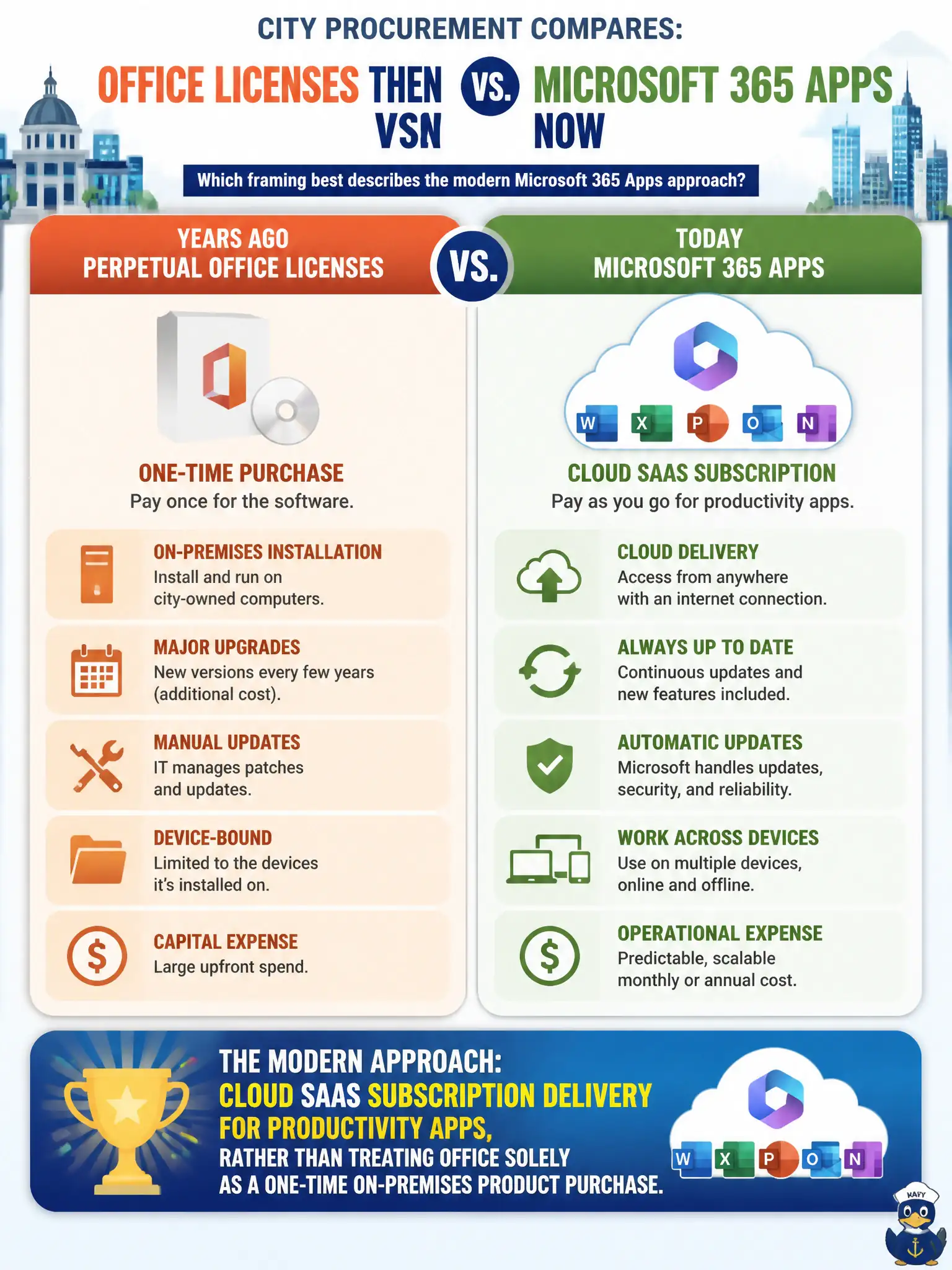
Old story: buy the box once and hope the discs age well. New story: subscribe to cloud productivity that stays current over the internet. That SaaS subscription framing is the point—not "Office can never leave a DVD."
Full Explanation
Modern Microsoft 365 Apps are commonly delivered through cloud SaaS subscriptions: organizations pay for ongoing access to productivity applications that stay current through the service, rather than treating Office solely as a one-time perpetual on-premises product purchase. For a city procurement office comparing old CapEx license buys with today’s cloud subscriptions, that SaaS subscription framing is the correct fundamentals distinction.
Claiming modern Microsoft 365 Apps are only perpetual on-premises installs with no cloud option fails because subscription cloud delivery is a primary modern path. Framing them as IaaS virtual machines that force clerks to compile Word from source fails conceptually and operationally. Requiring private cloud hardware purchase before anyone can open Excel Online fails because Excel Online is a multi-tenant SaaS experience, not a city-owned hardware prerequisite.
Exam caveat: licensing programs have nuances, but MS-900 emphasizes the shift from perpetual-box-only thinking toward cloud subscription SaaS for productivity. Operational check: align procurement language to Microsoft 365 subscription SKUs, confirm the city’s update channel preference, and remove “buy the disc once” assumptions from RFPs and board briefings.