
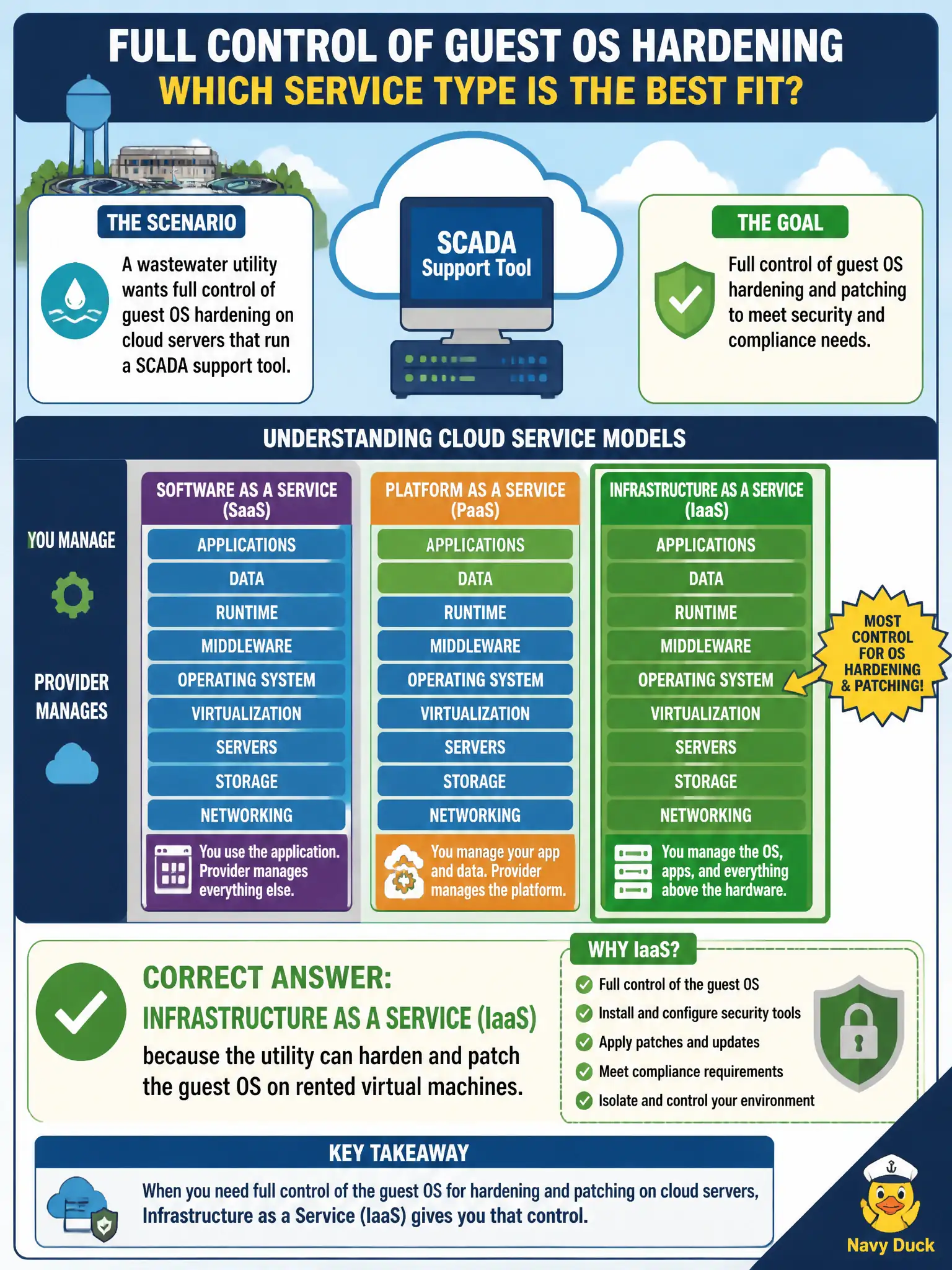
A wastewater utility wants full control of guest OS hardening on cloud servers that run a SCADA support tool. Which service type best matches that control need?
Select an answer to reveal the explanation.
Short Explanation
If you still need to lock down the OS yourself, you are in IaaS territory. PaaS and SaaS hide or remove that guest-OS knob on purpose. Rent the VM, keep the hardening playbook—that is the trade-off.
Full Explanation
When a wastewater utility must fully harden and patch the guest operating system on cloud servers that run a SCADA support tool, it needs infrastructure as a service. IaaS rents virtual machines and related fabric while leaving guest-OS configuration, hardening baselines, middleware, and applications under customer control—exactly the control surface OT-adjacent municipal teams often require for specialized tooling that cannot be absorbed into finished SaaS.
Software as a service fails because SaaS deliberately hides guest-OS access from customers; municipalities cannot “always” harden the OS of a finished SaaS application. Platform as a service fails because PaaS abstracts the underlying OS away from weekly customer host patching—the platform vendor owns that layer while customers deploy code. Saying Microsoft 365 Copilot Chat replaces server operating-system needs fails conceptually: conversational AI assistance does not satisfy SCADA support workloads that require OS-level control on servers.
Exam caveat: even on IaaS, the provider still secures the physical host and cloud fabric; “full control” never means the utility owns every layer of the stack. Operational check: define hardening baselines for the SCADA-support VMs, assign patch owners and change windows, segment networks from general business SaaS as policy requires, and evidence compliance before auditors review OT-adjacent systems.