
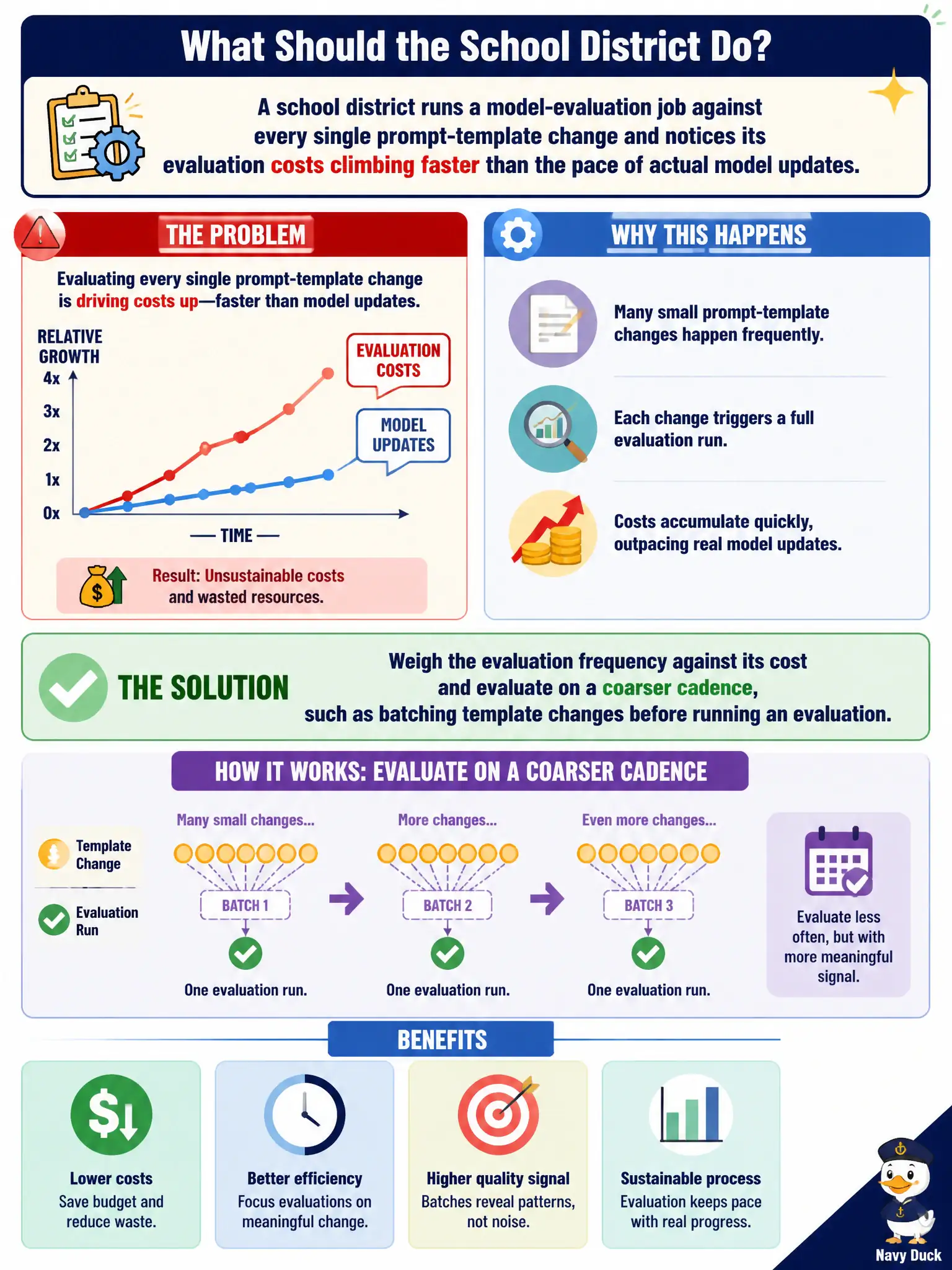
A school district runs a model-evaluation job against every single prompt-template change and notices its evaluation costs climbing faster than the pace of actual model updates. What should the district do?
Select an answer to reveal the explanation.
Short Explanation
Running an evaluation after every tiny edit is like weighing yourself after every sip of water — technically data, not useful data. Batching template changes before evaluating keeps the signal without paying for noise. The goal is confidence in the result, not the highest possible evaluation count.
Full Explanation
Evaluation runs consume compute and, for LLM-as-a-judge approaches, additional model inference calls, so running a full evaluation after every single prompt-template edit multiplies that cost by the edit frequency rather than by the pace of meaningful model change. Batching template changes — running an evaluation once a reasonable set of edits has accumulated, or on a fixed cadence — keeps the signal quality the team needs while cutting redundant runs against near-identical templates. Continuing to evaluate after every edit on the claim that skipping any evaluation invalidates the results overstates what a single evaluation run proves; evaluation frequency is a tuning knob, not an all-or-nothing statistical requirement. Switching to a larger underlying model addresses application quality, not evaluation cost, and would likely increase overall spend rather than reduce it. Turning off evaluation once a template passes ignores that future edits change behavior and need their own evaluation — it optimizes cost by discarding the safety net entirely, which is a different failure mode than the one being solved. Scope caveat: don't stretch the cadence so far that a regression goes undetected for multiple deploys — balance cost against acceptable detection lag. Operational check: track evaluation spend per model-quality-relevant change over time to confirm the new cadence is actually reducing waste.