
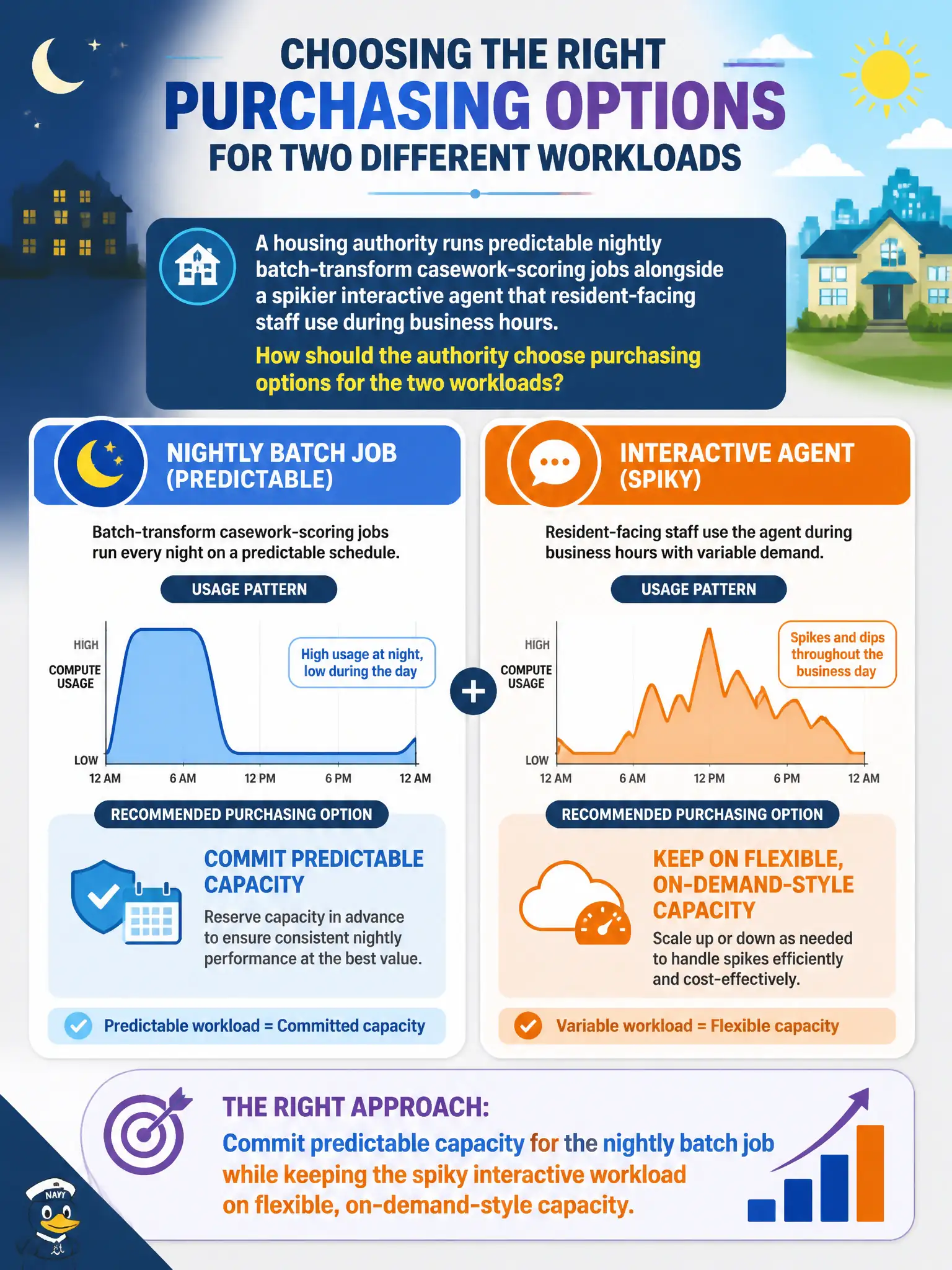
A housing authority runs predictable nightly batch-transform casework-scoring jobs alongside a spikier interactive agent that resident-facing staff use during business hours. How should the authority choose purchasing options for the two workloads?
Select an answer to reveal the explanation.
Short Explanation
Predictable workloads reward commitment, the way a gym membership beats paying per visit if you go every week. The nightly batch job is that regular visitor; the spiky agent traffic is the drop-in guest that shouldn't be locked into a plan. Match the purchase to the pattern, not the other way around.
Full Explanation
Purchasing strategy should follow workload predictability: a nightly batch job with a known, recurring schedule is a good candidate for committed or reserved-style capacity because the demand curve is stable and the commitment discount is realized reliably, while a spiky interactive workload that varies with staff activity is better served by flexible, on-demand-style capacity that can scale up and down without leaving paid-for capacity idle during quiet hours. Applying one purchasing strategy uniformly to both ignores that mismatch and either overcommits to a workload that doesn't need it or leaves savings on the table for the workload that does. Swapping the assignment — committing the spiky workload and leaving the predictable one flexible — gets the logic backwards, since a committed purchase pays off only when utilization is consistently high, which describes the batch job, not the bursty one. Claiming on-demand is cheaper for every workload shape ignores that committed-capacity pricing exists precisely because sustained, predictable usage earns a discount that on-demand pricing does not offer. Scope note: reassess the predictable/spiky classification periodically, since workload patterns can shift as the program grows. Operational check: compare actual utilization against commitment coverage each billing cycle to confirm the split is still matched correctly.