
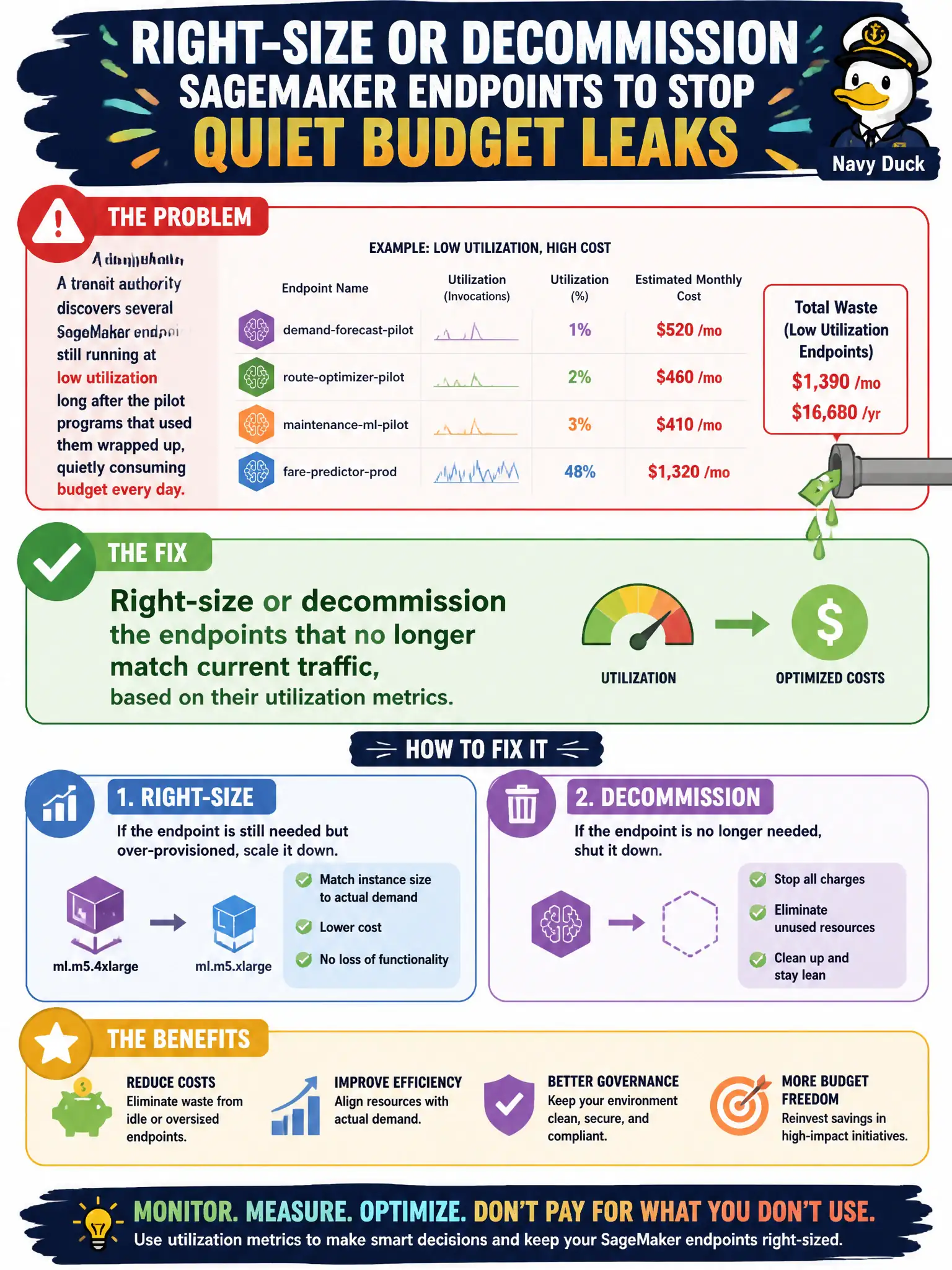
A transit authority discovers several SageMaker endpoints still running at low utilization long after the pilot programs that used them wrapped up, quietly consuming budget every day. What is the appropriate fix?
Select an answer to reveal the explanation.
Short Explanation
A pilot that ended doesn't need a runway left lit all night. Right-sizing or decommissioning what utilization data shows is idle turns quiet, ongoing spend back into savings you can actually point to. The metrics already told you which endpoints those are — you just have to act on them.
Full Explanation
Endpoints left running after the workload that justified them has ended keep accruing hourly compute charges regardless of how little traffic they see, so the fix is to act on what the utilization metrics already show: right-size endpoints that are underused but still needed, and decommission the ones that aren't needed at all. Leaving them running on the assumption a pilot might restart trades a small convenience for continuous, measurable waste, and a paused program can always be redeployed from its model artifacts when it actually resumes. Raising the auto-scaling maximum addresses a capacity ceiling, which isn't the problem here — the problem is a floor of idle capacity that's already too high for current demand. Moving the endpoints to a different account changes which bill the charges land on but does not reduce the underlying spend, and adds an operational cost of its own in cross-account management. Scope note: before decommissioning, confirm no downstream integration still depends on the endpoint's availability, even at low volume. Operational check: pull each endpoint's recent invocation and utilization metrics and compare against the current traffic baseline before deciding right-size versus full decommission.