
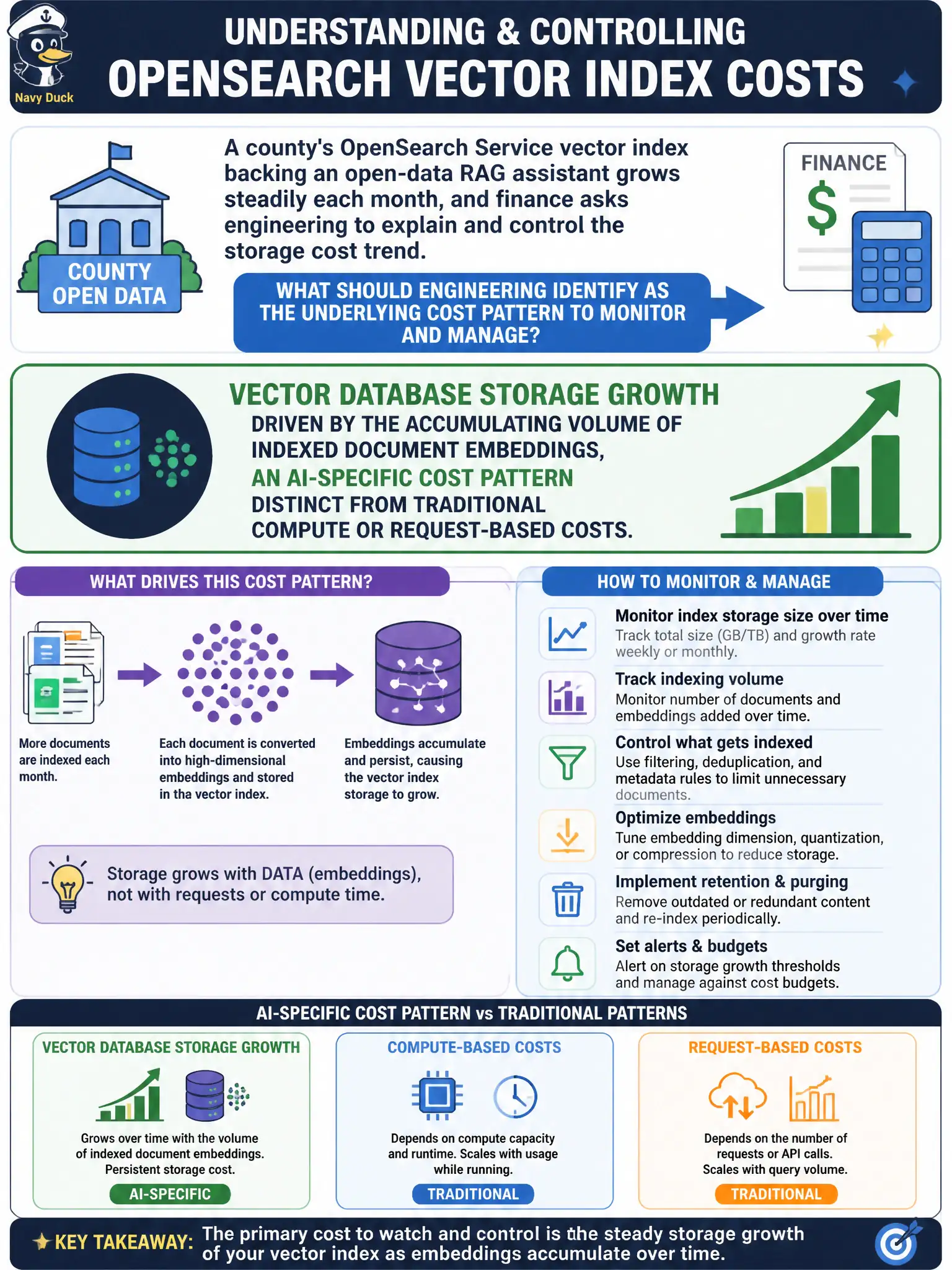
A county's OpenSearch Service vector index backing an open-data RAG assistant grows steadily each month, and finance asks engineering to explain and control the storage cost trend. What should engineering identify as the underlying cost pattern to monitor and manage?
Select an answer to reveal the explanation.
Short Explanation
A vector store's storage bill grows with what's stored, not with how many people show up to search it; every new batch of indexed documents adds embeddings that sit there taking up space indefinitely. That's a distinct cost pattern from the usual 'more traffic, more cost' story, and it's one finance and engineering need to watch on its own. Naming it as vector-database storage growth is what lets the team actually manage it, instead of chasing the wrong metric.
Full Explanation
Vector database storage growth is its own AI-specific cost pattern: every document ingested into the RAG pipeline adds embeddings to the OpenSearch Service index, and unlike request-based or compute-based costs, that storage accumulates and persists regardless of query volume, which explains a steadily rising bill even if usage patterns stay flat. Distinct-user query counts describe demand on the search interface, but demand doesn't drive storage size the way ingesting new content does; a portal could see flat query traffic while its index keeps growing from ongoing content additions. Foundation-model response latency is a generation-side performance metric, unrelated to how much data sits in the vector index or what that costs to store. IAM policy change counts are a governance and security signal, not a cost driver tied to the actual resource being consumed. Scope caveat: managing this cost pattern usually means deciding on a retention or archival policy for older or superseded documents, since indefinite accumulation is what produces the steady upward trend in the first place. A concrete operational check: break down the index's storage growth by ingestion date to confirm whether old, potentially stale content is being retired or just piling up indefinitely.