
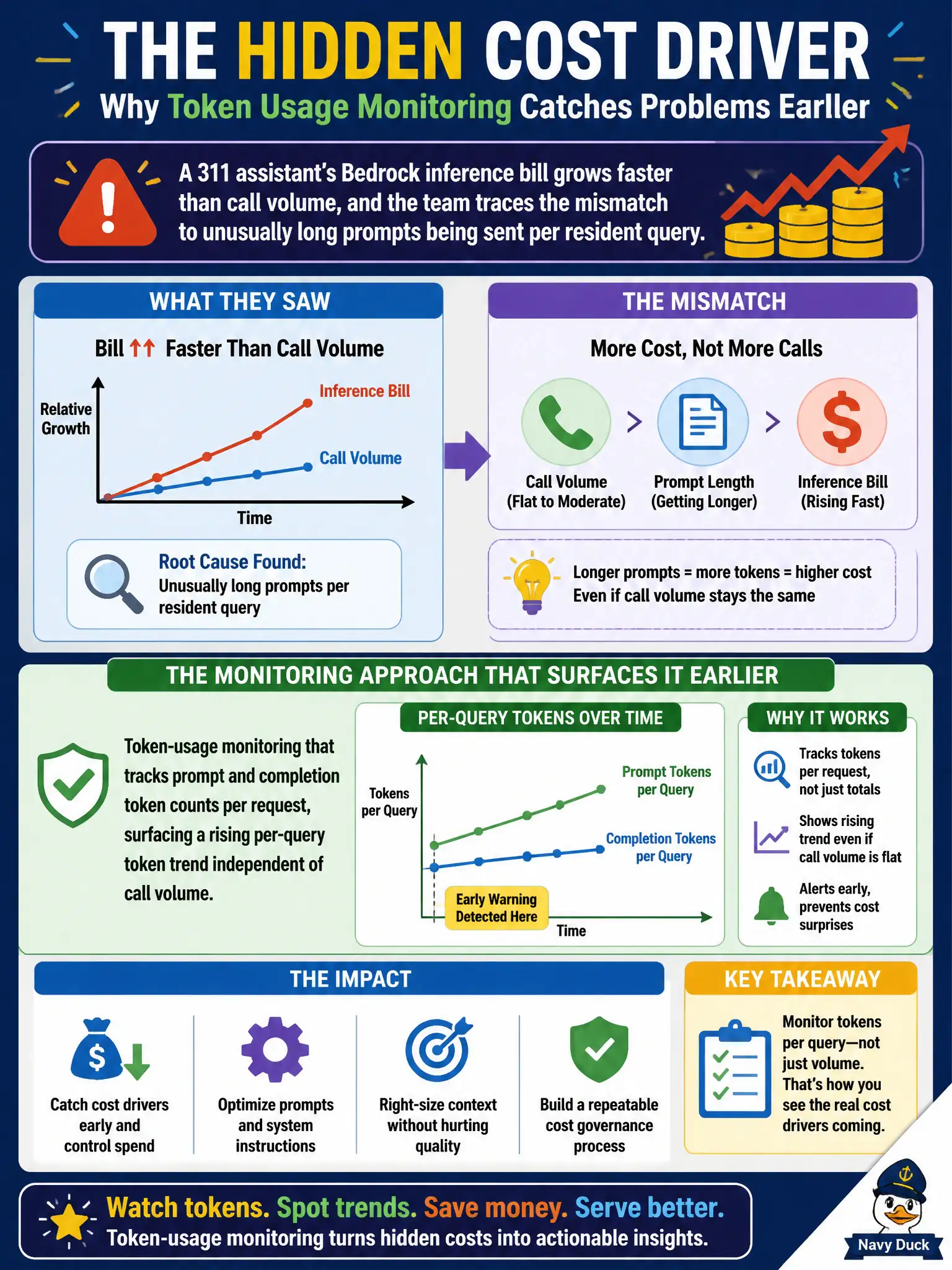
A 311 assistant's Bedrock inference bill grows faster than call volume, and the team traces the mismatch to unusually long prompts being sent per resident query. Which monitoring approach would have surfaced this cost driver earlier?
Select an answer to reveal the explanation.
Short Explanation
Bedrock's bill scales with tokens, not just with how many people called, so if the bill's climbing faster than call volume, tokens are the thread to pull. Monitoring prompt and completion token counts per request would have shown that trend rising even while the number of calls stayed flat. That's a much more direct signal than anything measuring call counts or latency.
Full Explanation
Token-usage monitoring tracks prompt and completion token counts on a per-request basis, directly measuring the quantity that drives Bedrock inference cost, so a rising per-query token trend, like unusually long prompts, shows up clearly and independently of overall call volume, giving the team an early, specific signal rather than a lagging, aggregate cost surprise. A distinct-user count dashboard measures reach, not consumption per interaction, so it wouldn't explain why cost is outpacing the number of calls being made. An invocation error-rate alarm is about catching failed requests, a reliability concern, not a cost driver, since failed calls generally aren't the source of a growing bill from successful, expensive prompts. Average response latency per conversation reflects how long a response takes to generate, which can correlate loosely with longer generations but doesn't directly measure the token volume actually being billed, and a fast response can still be token-heavy. Scope caveat: token-usage monitoring identifies that prompts are growing, but tracing why, accumulating conversation history, verbose system instructions, retrieved context being appended, still requires reviewing the prompt construction logic itself. A concrete operational check: break down the token-usage trend by prompt versus completion tokens to confirm the growth is concentrated in what's being sent, not what's being generated.