
A county deploying a custom document-classification model to a SageMaker endpoint needs to pick an instance family that balances the permitting chatbot's latency needs against monthly compute cost. What should guide this decision?
Select an answer to reveal the explanation.
Short Explanation
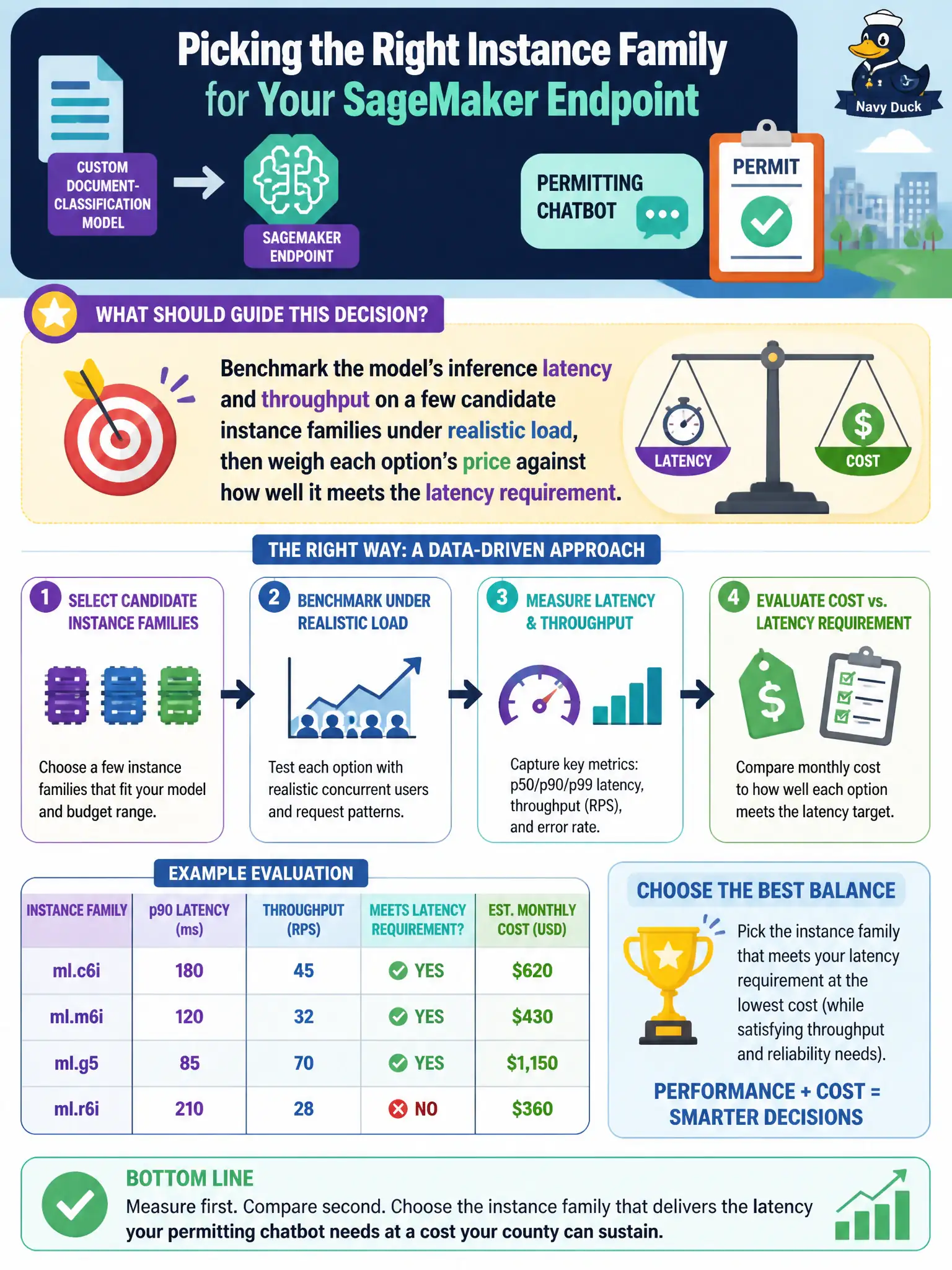
Picking an instance family by 'biggest' or 'cheapest' alone skips the actual question, which is whether it meets your latency bar at a price you can live with. Benchmarking candidate instance families under realistic load and weighing latency against monthly cost gives you an answer grounded in this specific workload. It's less about finding the best instance in the abstract and more about finding the right fit.
Full Explanation
Benchmarking a handful of candidate instance families under realistic request patterns measures how each actually performs for this specific document-classification model, and comparing that measured latency and throughput against each family's price lets the county pick the option that meets the permitting chatbot's response-time requirement at the lowest sustainable cost. Defaulting to the largest GPU-backed instance ignores that document classification, especially a lighter traditional model, may not need or benefit from that much compute, wasting budget without necessarily improving latency. Accepting whatever the console lists first treats a UI default as a recommendation, when defaults are typically generic starting points, not a workload-specific analysis. Choosing the cheapest, smallest instance assumes complexity correlates neatly with resource needs, but a classification model handling high request volume or larger documents can still need meaningful compute to hit a latency target, regardless of task type. Scope caveat: instance-family selection should be revisited if traffic patterns or the model itself changes materially, since a benchmark done once can go stale. A concrete operational check: load-test the top two candidate instance families with production-like request volume and confirm the latency numbers hold before committing to one for production.