
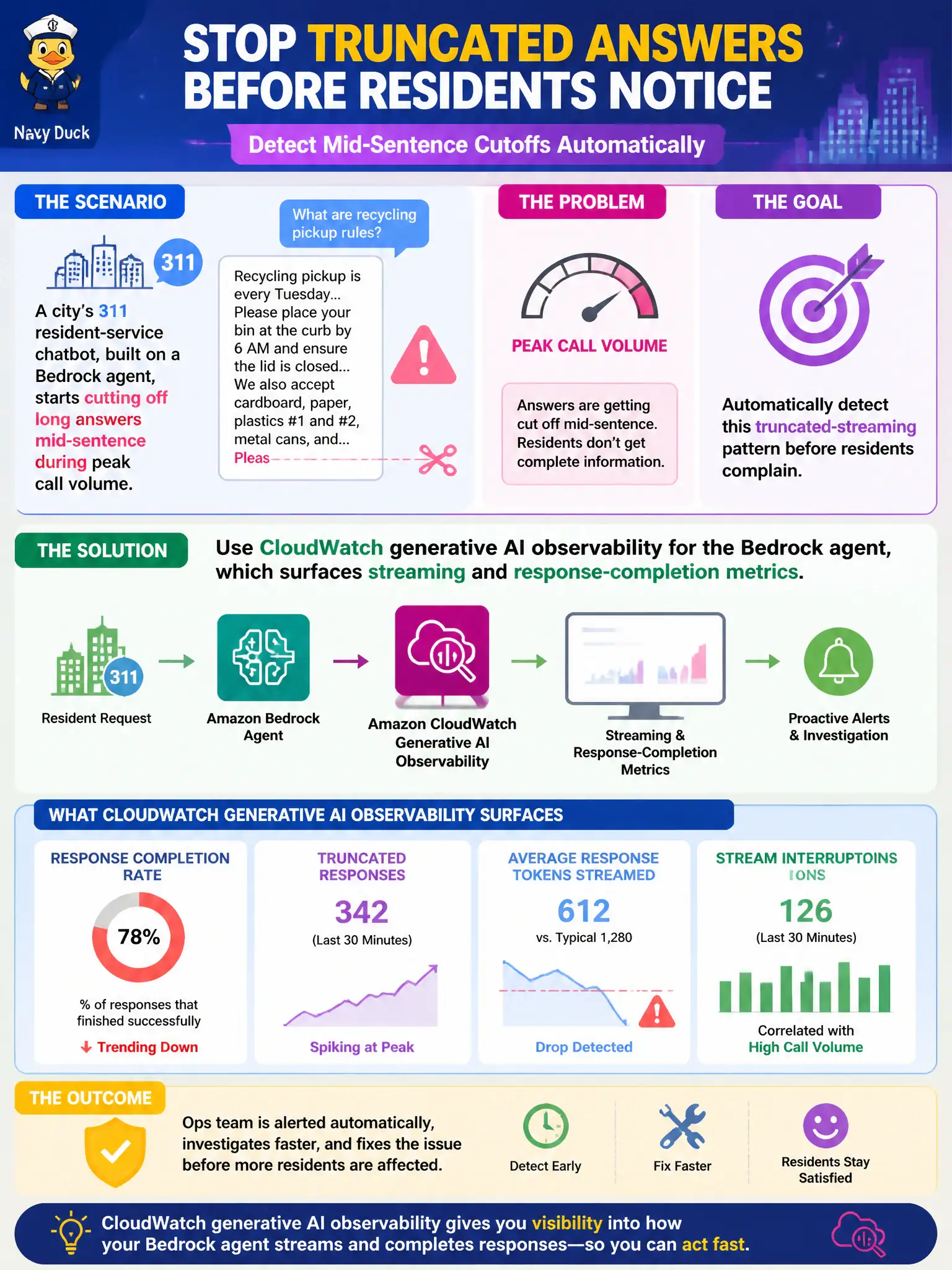
A city's 311 resident-service chatbot, built on a Bedrock agent, starts cutting off long answers mid-sentence during peak call volume. The ops team wants an automated way to detect this truncated-streaming pattern rather than relying on resident complaints. Which capability should they use?
Select an answer to reveal the explanation.
Short Explanation
Think of streaming truncation like a phone call that drops mid-sentence; you need something watching the call itself, not just logging that a call happened. CloudWatch generative AI observability is built to watch exactly that: how a Bedrock agent's responses stream and whether they complete. It turns a pattern residents would otherwise have to complain about into a metric ops can alert on.
Full Explanation
CloudWatch generative AI observability for Bedrock agents exposes metrics purpose-built for agent behavior, including whether streamed responses complete normally or get cut off, letting ops set an alarm on the truncation rate itself rather than inferring the problem from complaints. Generic log-insights queries against frontend logs can surface truncation if someone thought to log it, but that's a brittle, manual pattern-matching exercise rather than a purpose-built metric, and it won't scale as the chatbot evolves. A synthetic Lambda prober tests specific canned prompts at specific times, so it can easily miss a load-dependent truncation pattern that only appears under real peak concurrency. CloudTrail records API calls for audit and governance purposes, who invoked the agent and when, but doesn't capture streaming response quality, so it can't tell you a response was cut short. Scope caveat: generative AI observability metrics are most useful when correlated with load metrics, since this truncation pattern is tied to peak volume rather than being constant. A concrete operational check: graph the truncation-rate metric against concurrent session count to confirm the correlation with peak call volume before treating it as a capacity issue.