
A county courts system uses an LLM-as-a-judge approach, where a separate foundation model scores whether chatbot-generated legal-information responses are accurate and complete, to evaluate output at a scale human reviewers could not sustain. What is the most important limitation the team should account for when relying on this approach?
Select an answer to reveal the explanation.
Short Explanation
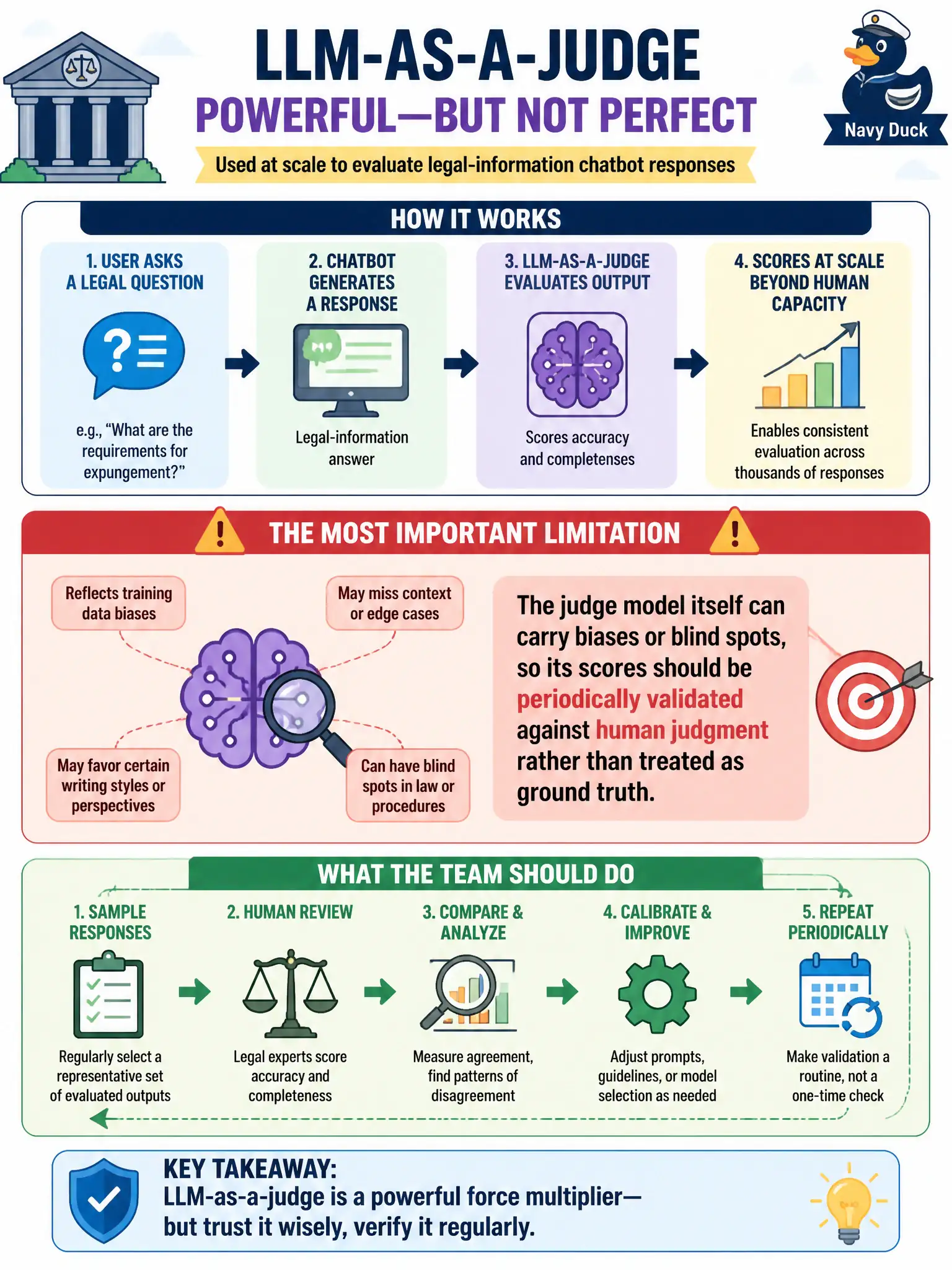
Think of asking one colleague to grade another colleague's work — useful for catching a lot of errors quickly, but you'd still want a manager to spot-check the grader now and then. An LLM-as-a-judge scales evaluation well, but it's still a model with its own blind spots and biases, so its scores need periodic checking against real human judgment. Treating its output as unquestionable truth is exactly the risk to guard against.
Full Explanation
LLM-as-a-judge scales evaluation by using a foundation model to score another model's outputs against criteria like accuracy and completeness, which lets a team assess far more responses than human reviewers could manually process, but the judge model is itself a fallible system that can carry its own biases, blind spots, or systematic scoring tendencies inherited from its training. This means judge-model scores should be periodically validated against human judgment on a sample basis, rather than treated as an infallible ground truth, especially in a legally sensitive context like court-related legal information where getting it wrong has real consequences. The option claiming no human oversight is ever needed again once configured ignores exactly this reliability limitation and removes the safeguard that catches when the judge itself drifts or misjudges. The option restricting LLM-as-a-judge to numerical outputs is incorrect; the technique is specifically valuable for scoring free-form generated text against qualitative criteria like accuracy and completeness, which is precisely the use case described. The option requiring the judge model to be identical to the model being evaluated misunderstands common practice; using a different, often more capable, model as the judge is a standard and frequently preferred approach, not a requirement violation. Scope note: judge-model reliability should be assessed against the specific evaluation criteria being used, since a judge that scores well on one dimension may still be unreliable on another. Operational check: periodically have a human reviewer independently score a sample of the same responses and compare against the judge model's scores to confirm continued alignment.