
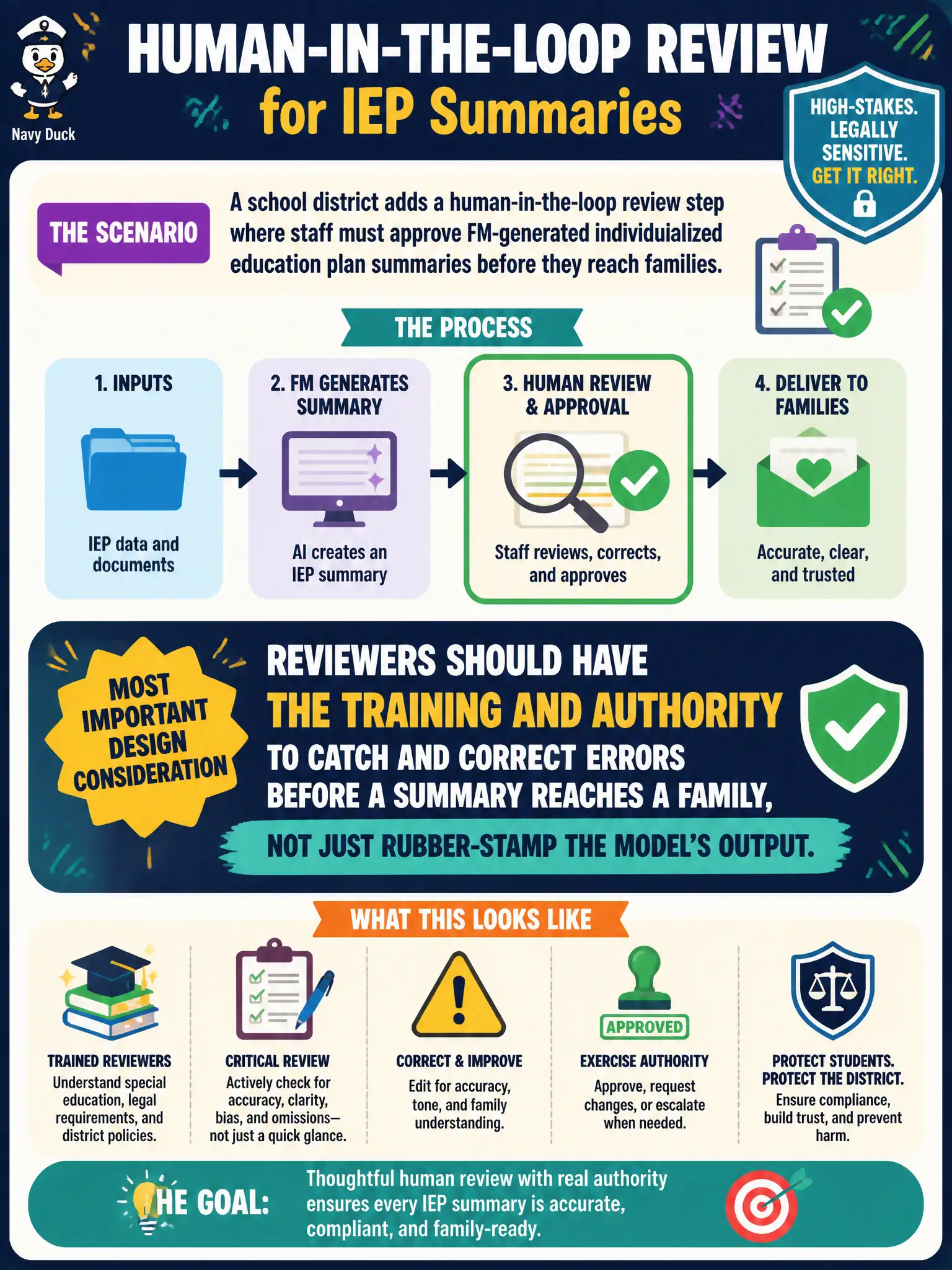
A school district adds a human-in-the-loop review step where staff must approve FM-generated individualized education plan summaries before they reach families. Given how high-stakes and legally sensitive these summaries are, what is the most important design consideration for this review step?
Select an answer to reveal the explanation.
Short Explanation
Think of a review step like a second set of eyes on a legal contract — it only protects anyone if the reviewer is actually equipped and empowered to catch a real mistake before it's signed. For something as high-stakes as an education plan summary reaching a family, human-in-the-loop review only works if reviewers can genuinely correct errors, not just wave things through. A review step that doesn't do that is a review step in name only.
Full Explanation
A human-in-the-loop review step is only meaningful as a safeguard if the humans involved have the domain training and the actual authority to identify and correct errors in the generated content before it reaches its audience; for high-stakes, legally sensitive material like individualized education plan summaries, the review step's entire value depends on reviewers genuinely engaging with each summary's accuracy rather than passively approving output. The option recommending bulk approval without individual reading defeats the purpose of the safeguard entirely, turning a review step into a formality that provides no actual error-catching benefit despite appearing to add oversight. The option suggesting the review step be removed once benchmark accuracy is high ignores that benchmark performance on a test set does not guarantee correctness on every individual live case, especially for legally sensitive documents where a single error can have real consequences for a specific student and family. The option limiting review to grammar and tone while assuming content accuracy is guaranteed misunderstands what foundation models can reliably promise; FMs can generate plausible-sounding but factually incorrect content, so content accuracy is precisely the kind of thing human review needs to verify, not assume away. Scope note: review-step design should also track reviewer workload, since an overloaded reviewer under time pressure tends toward exactly the rubber-stamping behavior the safeguard is meant to prevent. Operational check: periodically audit a sample of approved summaries against source records to confirm reviewers are catching errors, not just clicking through.