
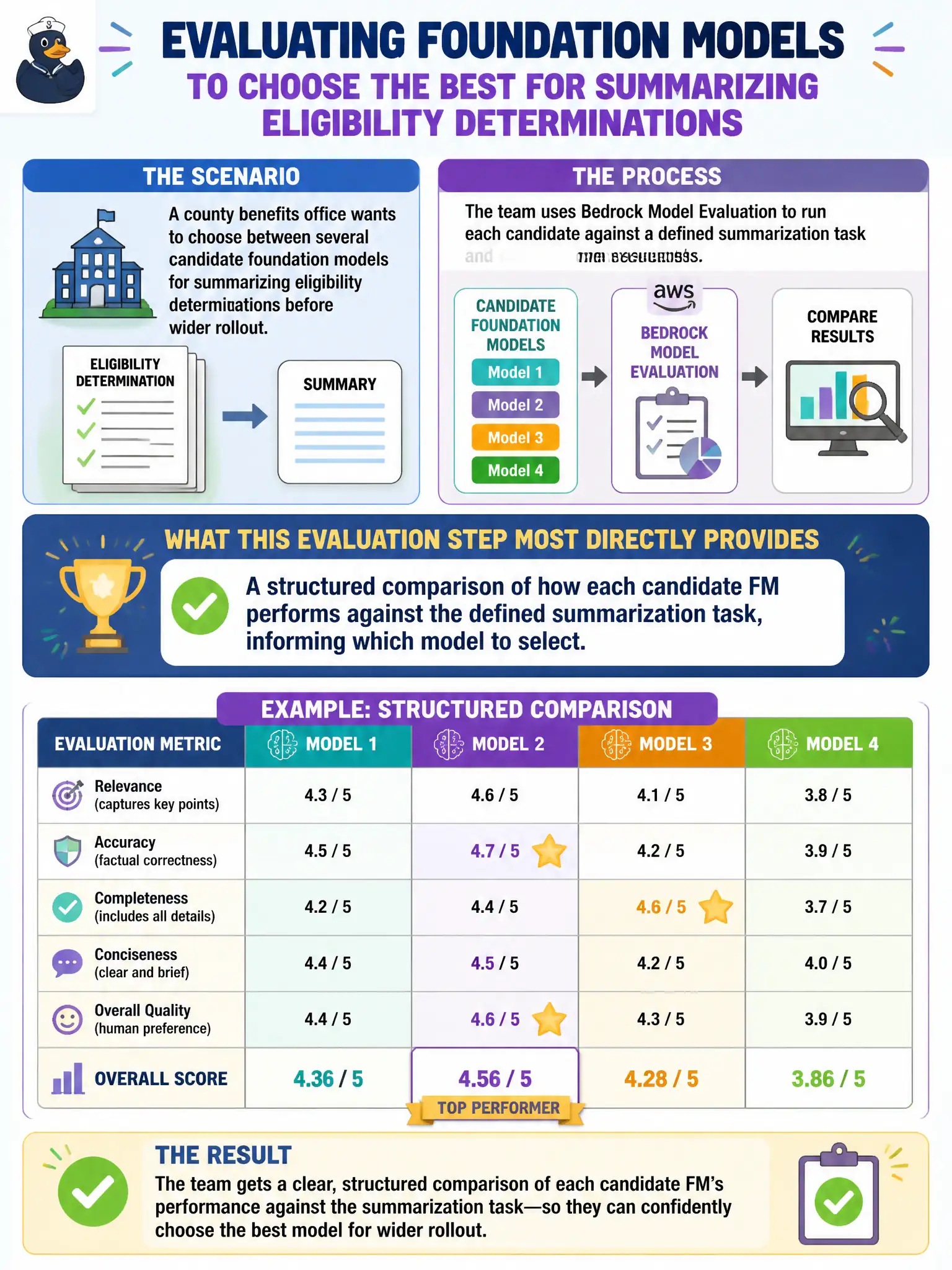
A county benefits office wants to choose between several candidate foundation models for summarizing eligibility determinations before wider rollout. The team uses Bedrock Model Evaluation to run each candidate against a defined summarization task and compare results. What does this evaluation step most directly provide to the team?
Select an answer to reveal the explanation.
Short Explanation
Think of it like a bake-off before picking a caterer — you don't just take everyone's word for it, you have each candidate produce the same dish and compare the results side by side. Bedrock Model Evaluation does that for FMs: it runs each candidate against the same summarization task so the team can compare how they actually perform, not just how they're marketed. The county still has to interpret the results and make the call.
Full Explanation
Bedrock Model Evaluation provides a structured way to run candidate foundation models against a defined task, in this case eligibility-determination summarization, and compare their outputs using consistent criteria, which gives the team evidence-based grounds for choosing among candidates rather than relying on vendor claims or informal spot checks. This evaluation step directly supports the model-selection decision named in the scenario. The option describing it as a definitive legal certification overreaches; a performance evaluation on a summarization task speaks to quality and fit for the task, not to legal or regulatory compliance, which typically requires separate review beyond a model-evaluation tool. The option claiming it automatically fine-tunes the weaker candidate misunderstands the tool's role; evaluation measures and compares performance, it does not modify a model's weights or equalize outcomes across candidates. The option promising indefinite guaranteed performance after deployment ignores that real-world data drift, changing eligibility rules, and shifting document formats can all degrade performance over time, meaning ongoing monitoring is still required regardless of a strong initial evaluation result. Scope note: evaluation results are only as representative as the task definitions and sample data used, so the summarization task should reflect real eligibility-document variety. Operational check: after selecting a model, periodically re-run the same evaluation task against production-representative documents to confirm performance hasn't drifted from what was measured at selection time.