
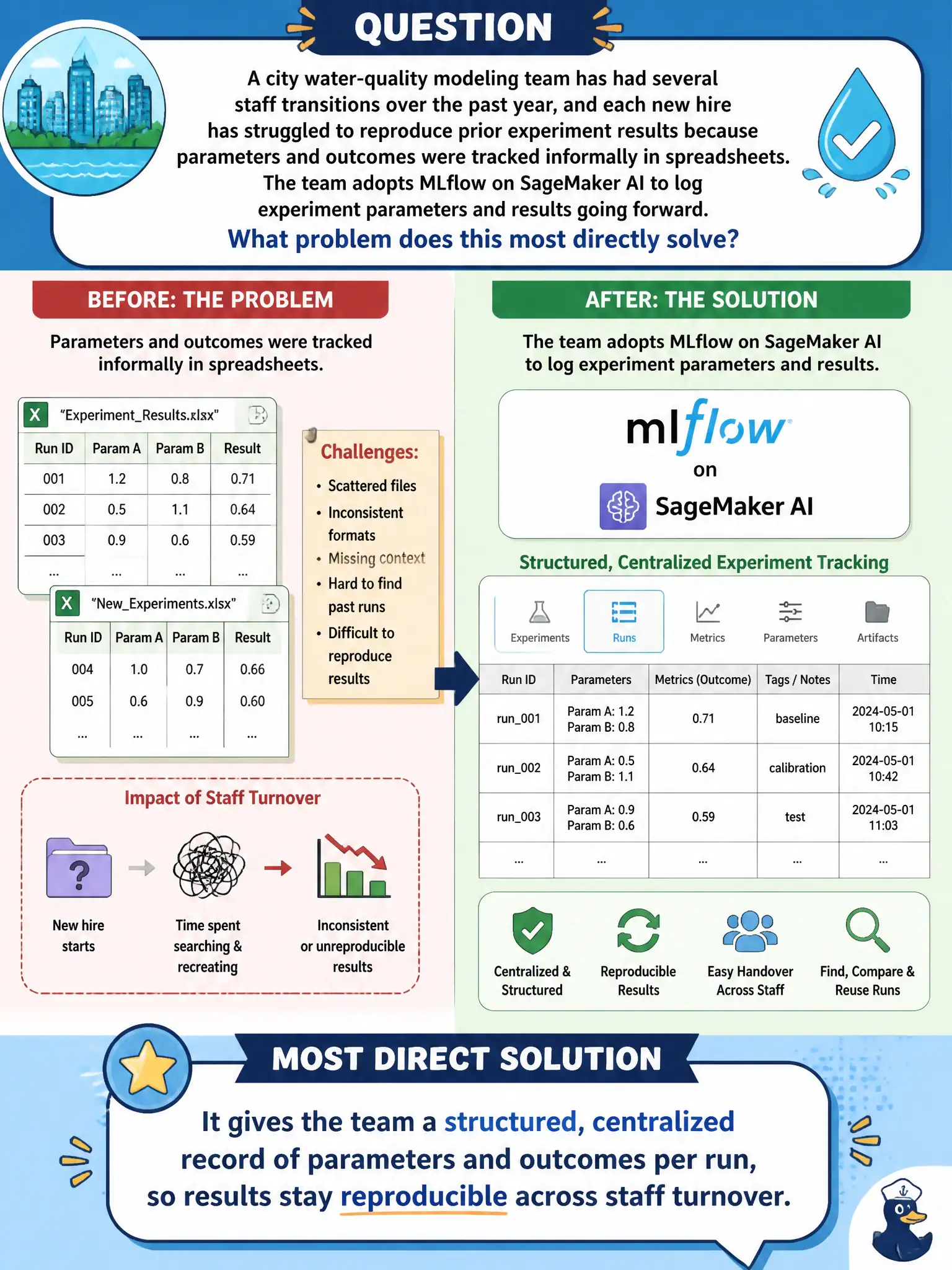
A city water-quality modeling team has had several staff transitions over the past year, and each new hire has struggled to reproduce prior experiment results because parameters and outcomes were tracked informally in spreadsheets. The team adopts MLflow on SageMaker AI to log experiment parameters and results going forward. What problem does this most directly solve?
Select an answer to reveal the explanation.
Short Explanation
Think of MLflow like a shared lab notebook instead of everyone's own scattered sticky notes — when someone new joins the team, they can open the notebook and see exactly what was tried and what happened. That structured, centralized tracking is what actually survives staff turnover, not a smarter spreadsheet. It doesn't train or pick models for you; it just makes sure the record of what happened is trustworthy and shared.
Full Explanation
Experiment tracking tools like MLflow on SageMaker AI solve reproducibility by logging each run's parameters, code version, metrics, and artifacts in a structured, centralized store that any team member can query later, which is exactly the gap informal spreadsheet tracking leaves when staff turn over and context walks out the door with them. This directly addresses the scenario's core problem: new hires being unable to reconstruct what earlier experiments actually did. The option describing automatic scheduled retraining conflates experiment tracking with a retraining pipeline, which is a separate MLOps concern about triggering new training runs, not about recording what happened in past ones. The option claiming MLflow performs model evaluation itself overstates its role; MLflow records whatever metrics a team chooses to log, but it does not independently decide how a model should be evaluated or substitute for a held-out validation methodology. The option describing automatic best-configuration selection without human review misrepresents MLflow as a decision-making system rather than a record-keeping one; comparing logged runs and choosing a winner is still a team judgment call, informed by the tracked data rather than made for the team. Scope note: tracking only pays off if logging discipline is consistently applied to every run, including failed ones. Operational check: have a team member unfamiliar with a given experiment attempt to reproduce its result using only the MLflow record to confirm the logged information is actually sufficient.