
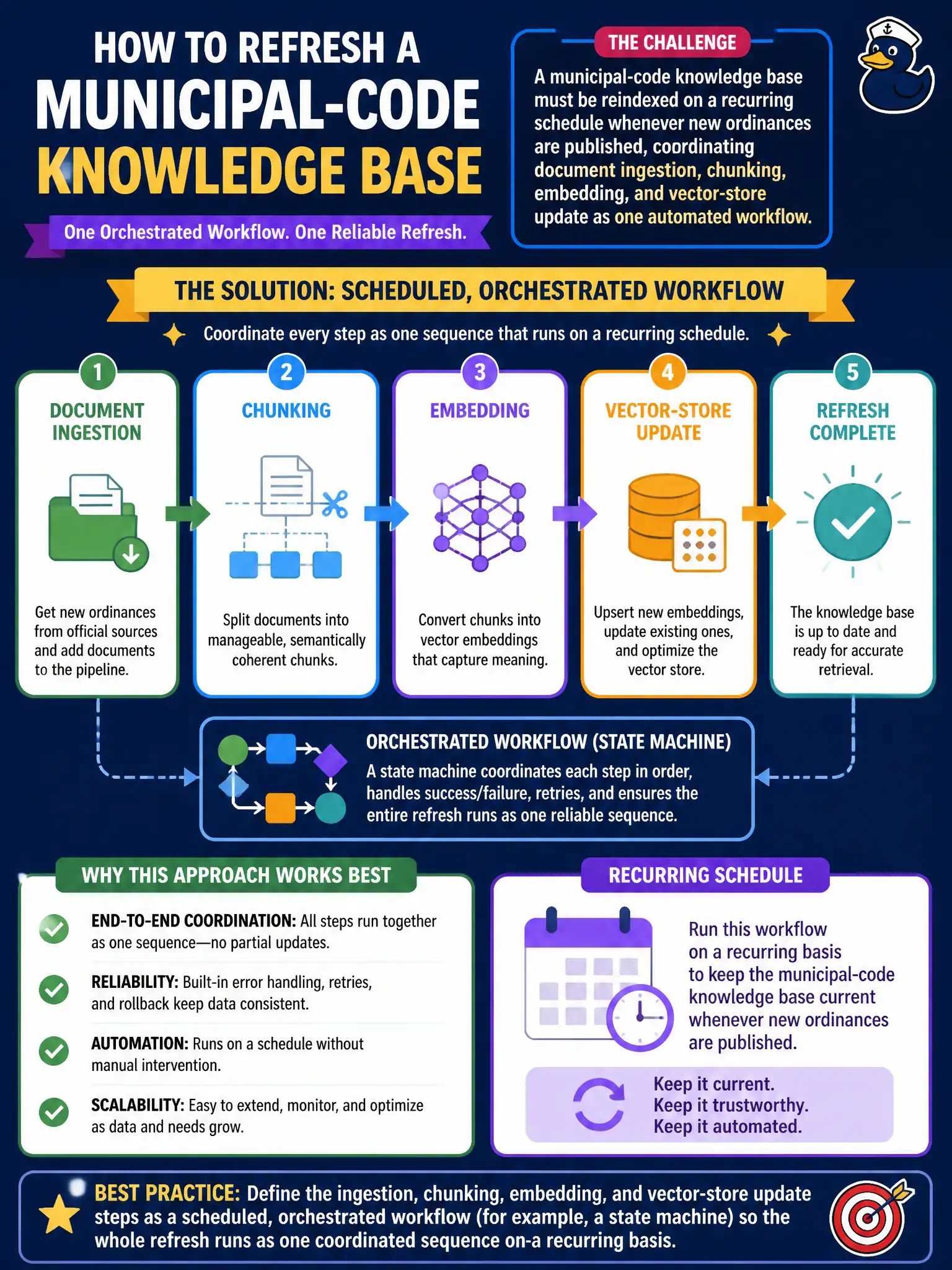
A municipal-code knowledge base must be reindexed on a recurring schedule whenever new ordinances are published, coordinating document ingestion, chunking, embedding, and vector-store update as one automated workflow. Which approach best orchestrates this multi-step process?
Select an answer to reveal the explanation.
Short Explanation
Reindexing a knowledge base has real steps in real order — pull the new documents, cut them into chunks, turn those chunks into embeddings, update the vector store — and skipping the coordination between them is how a step quietly gets forgotten. Defining the whole sequence as one scheduled, orchestrated workflow keeps those steps running in order, automatically, every time new ordinances land.
Full Explanation
A workflow-orchestration service can define ingestion, chunking, embedding, and vector-store update as discrete, ordered steps within one state machine, triggered on a recurring schedule, so the entire refresh runs as a coordinated sequence without anyone manually kicking off or sequencing the individual stages. Running each step as a separately executed script depends on a person remembering both to run every step and to run them in the correct order every single time new ordinances publish, which is fragile at any meaningful frequency. Collapsing everything into one monolithic script with no distinct stages makes a partial failure hard to recover from — if embedding fails partway through, there's no clean way to retry just that step without repeating everything before it, and there's no scheduling built in either. Scheduling only the embedding step while leaving the other three manual breaks the coordination the workflow needs; embeddings generated against stale or incomplete chunked data don't actually reflect the newly published ordinances. Scope caveat: an orchestrated refresh workflow should include a way to detect and retry a failed individual step rather than restarting the entire pipeline from scratch on any single failure. Operational check: publish a test ordinance, wait for the scheduled refresh to run, and confirm the knowledge base returns content reflecting that ordinance afterward.