
A county fine-tunes a foundation model periodically on updated case-notes data and wants each new fine-tuned version automatically brought into Bedrock with proper version tracking as part of the deployment pipeline, rather than handled as a one-off manual task each time. Which approach fits?
Select an answer to reveal the explanation.
Short Explanation
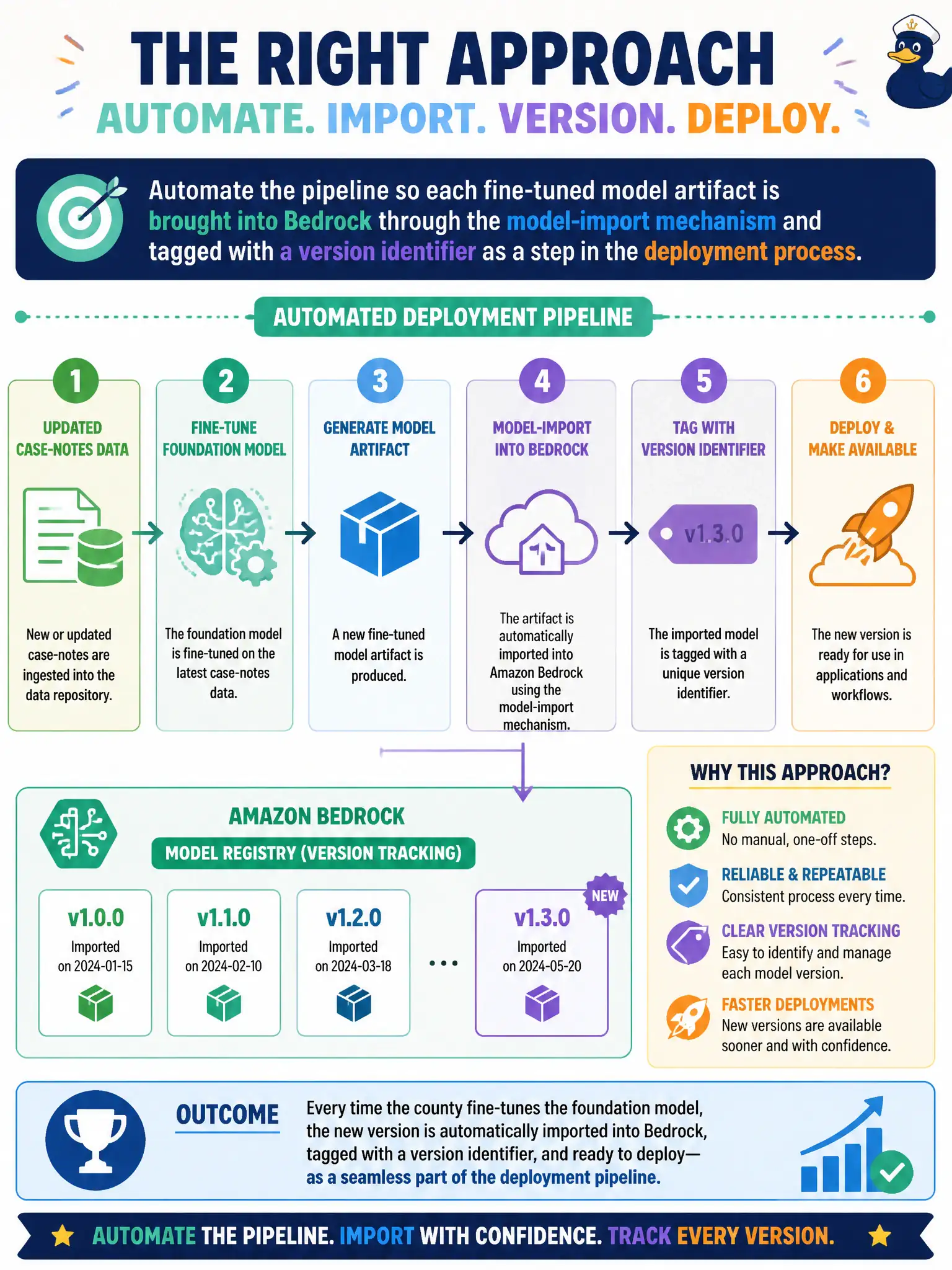
Manually walking a fine-tuned model through import every single time it's retrained is the kind of repetitive task that's just waiting for someone to forget a step. Automating that import as a pipeline stage, with each version tagged as it goes in, means a fresh fine-tune reliably ends up available and traceable in Bedrock without a person babysitting the process each cycle.
Full Explanation
Wiring the model-import step into the deployment pipeline itself — rather than treating it as a manual task — means each new fine-tuned artifact is automatically brought into Bedrock and tagged with an identifiable version as part of a repeatable process, which is what "automated FM deployment with versioning" actually means in practice. Manually re-running the import each cycle reintroduces the exact human-error risk automation is meant to remove, and it provides no consistent version tracking unless someone diligently records it by hand every time. Skipping the import step and calling the fine-tuning job's raw output artifact directly bypasses whatever the import mechanism does to make a model consumable through Bedrock's inference interface, and it forfeits the version tracking an import-and-tag pipeline step would otherwise create. Continuing to use a single imported version indefinitely defeats the purpose of periodic fine-tuning altogether — new case-notes data wouldn't ever reach production if the pipeline never re-imports and promotes newer versions. Scope caveat: version tags should tie back to the specific fine-tuning run and dataset version that produced the artifact, so a later rollback or audit can trace exactly what data shaped a given version's behavior. Operational check: trigger a new fine-tuning run through the pipeline and confirm the resulting version appears in Bedrock with a distinct, traceable version identifier without any manual import step.