
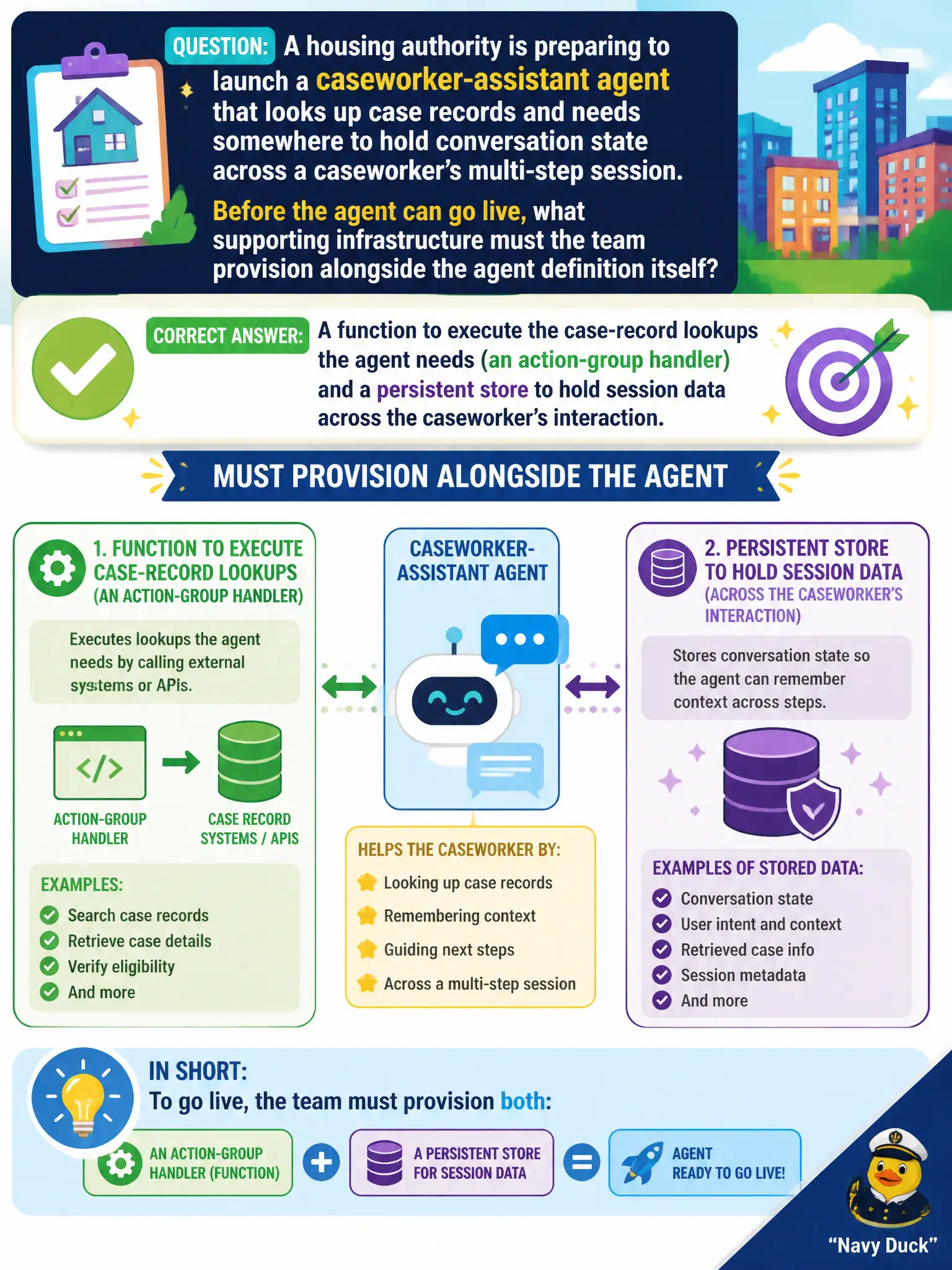
A housing authority is preparing to launch a caseworker-assistant agent that looks up case records and needs somewhere to hold conversation state across a caseworker's multi-step session. Before the agent can go live, what supporting infrastructure must the team provision alongside the agent definition itself?
Select an answer to reveal the explanation.
Short Explanation
An agent without action-group compute and a session store is like a receptionist with no phone line and no notepad — it can talk, but it can't actually look anything up or remember what you asked five minutes ago. Provisioning a lookup function and a session-state store alongside the agent definition is what turns a chat interface into something that can actually do the caseworker's job.
Full Explanation
An agentic workflow's action groups need real backend compute to execute — typically a function that the agent invokes to run the actual case-record lookup — and that compute must be provisioned and wired to the agent's action-group definition before it can do anything beyond generate text. Session data (what's been asked, what's been returned) needs a persistent store so the conversation coheres across the caseworker's multiple steps rather than resetting each turn. Assuming the foundation model alone handles lookups misunderstands what a foundation model actually does: it can plan which function to call and interpret the result, but it does not itself query a case-management system. Fronting the agent with a content delivery network solves a caching problem for static or slowly-changing content, not the need for live case-record execution and session continuity. A full retraining pipeline is unrelated to wiring an agent to backend functions — customizing a foundation model's weights and giving it tools to call are different concerns entirely. Scope caveat: the action-group function and the session store both need access controls scoped to the case data they touch, since casework often includes sensitive resident information. Operational check: run an end-to-end test where the agent performs a lookup and then, in a later turn, correctly references the result it returned earlier.