
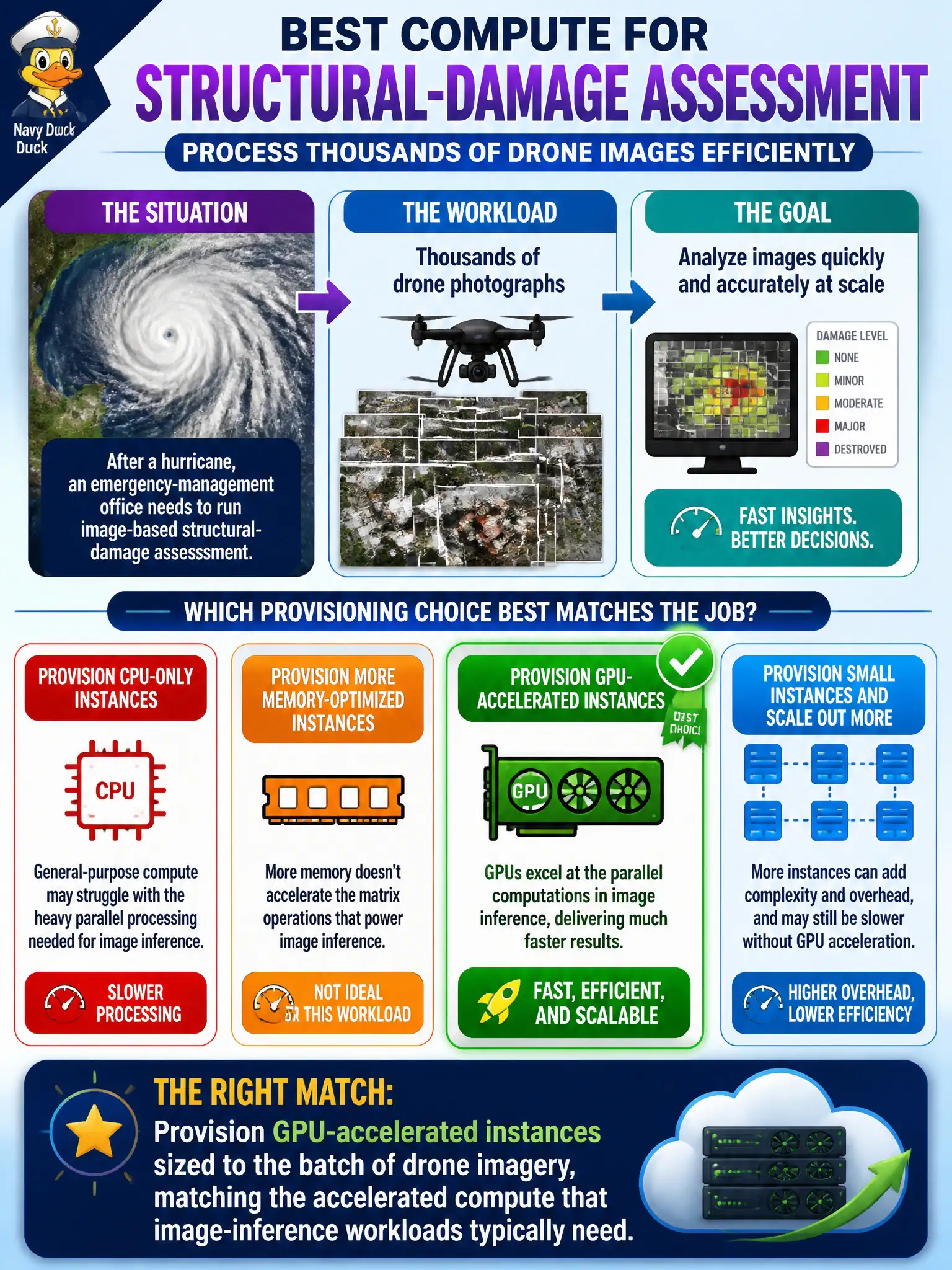
After a hurricane, an emergency-management office needs to run image-based structural-damage assessment on thousands of drone photographs and must provision compute that handles this workload efficiently. Which choice best matches the job?
Select an answer to reveal the explanation.
Short Explanation
Running image inference on CPU-only hardware is like asking someone to move a house with a hand truck — technically possible, painfully slow. GPU-accelerated instances are built for the parallel math that image models lean on, so sizing the fleet around GPU compute is what gets thousands of drone photos processed in a reasonable window after a disaster, when speed actually matters.
Full Explanation
Image-based inference models, especially convolutional or vision-transformer architectures, rely on heavy parallel matrix computation that GPU accelerators are purpose-built for, so provisioning GPU-backed instances sized to the expected batch volume is what keeps throughput high enough to process thousands of images promptly. General-purpose CPU-only instances can technically run the same model, but throughput drops sharply for compute-heavy vision workloads, which matters when damage assessments need to reach responders quickly. Storage-optimized instances address a different bottleneck — high local disk I/O — and while image files do need to be read, the dominant cost in this workload is the model's compute per image, not disk throughput, so that instance family solves the wrong constraint. Burstable instances are designed for workloads with long idle periods and short spikes; a sustained batch of thousands of images will exhaust burst credit balances and then throttle to baseline performance, which is the opposite of what an urgent post-disaster workload needs. Scope caveat: if the images arrive as a one-time batch rather than a steady stream, a batch transform job on GPU instances that shuts down after completion avoids paying for idle capacity. Operational check: benchmark inference throughput per instance on a representative sample before sizing the full fleet, so the job's expected completion time is known in advance.