
A county already runs its citizen-services data in an Amazon RDS for PostgreSQL database and is adding a Bedrock knowledge base for a resident-facing RAG assistant, with a document corpus in the low tens of thousands of pages. The team is weighing a dedicated managed search service against extending their existing relational database. Which choice best fits this situation?
Select an answer to reveal the explanation.
Short Explanation
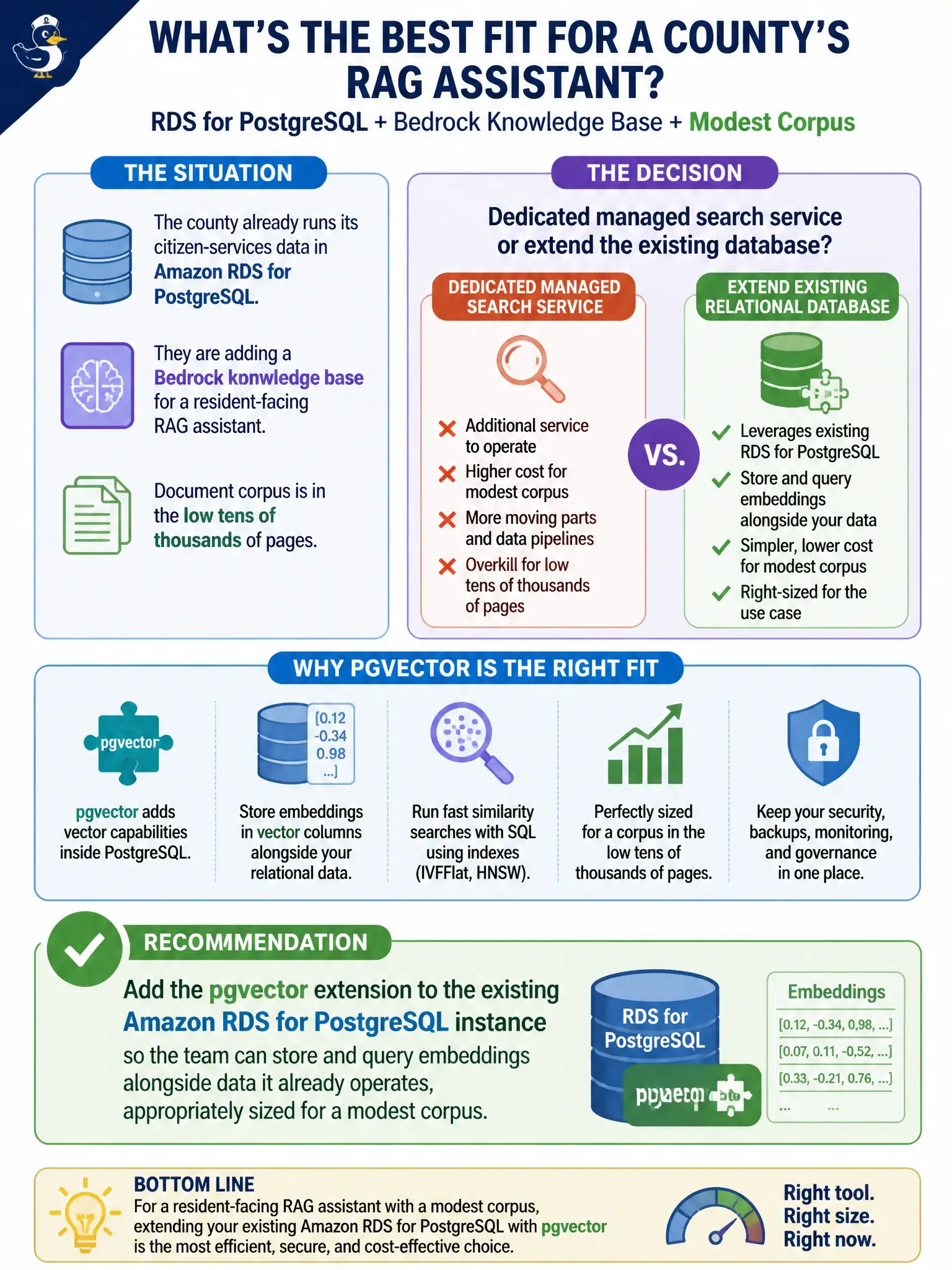
You don't buy a bigger truck just because you might someday move a bigger couch — you size the truck to the couch you actually have. With a modest document count and a team that already knows and runs PostgreSQL, turning on pgvector keeps embeddings next to the data you already manage instead of standing up and learning a whole new managed search service. That's less operational surface for the same job.
Full Explanation
pgvector adds vector indexing and similarity-search operators directly to PostgreSQL, so a Bedrock knowledge base can query embeddings with the same connection, backup process, and access controls the county already has in place for its relational data — a strong fit when corpus size is modest and the team's operational expertise is already relational. Standing up an oversized managed search domain trades a right-sized, low-effort option for a service with its own cluster management, scaling knobs, and cost profile that isn't justified by tens of thousands of documents. Doing similarity math in application code over plain text columns throws away the point of a vector extension: without indexed nearest-neighbor operators, every query becomes a full scan that gets slower as the corpus grows, and it forfeits the query optimizations a database engine provides. Swapping in a graph database solves a different problem — modeling relationships between entities — and doesn't address vector similarity search at all, while adding an unnecessary migration. Scope caveat: if the corpus later grows into the millions of documents or needs very high query throughput, revisit whether a dedicated vector search service scales better than a single RDS instance. Operational check: run a representative similarity query through the knowledge base and confirm retrieval latency stays acceptable under expected concurrent load.