
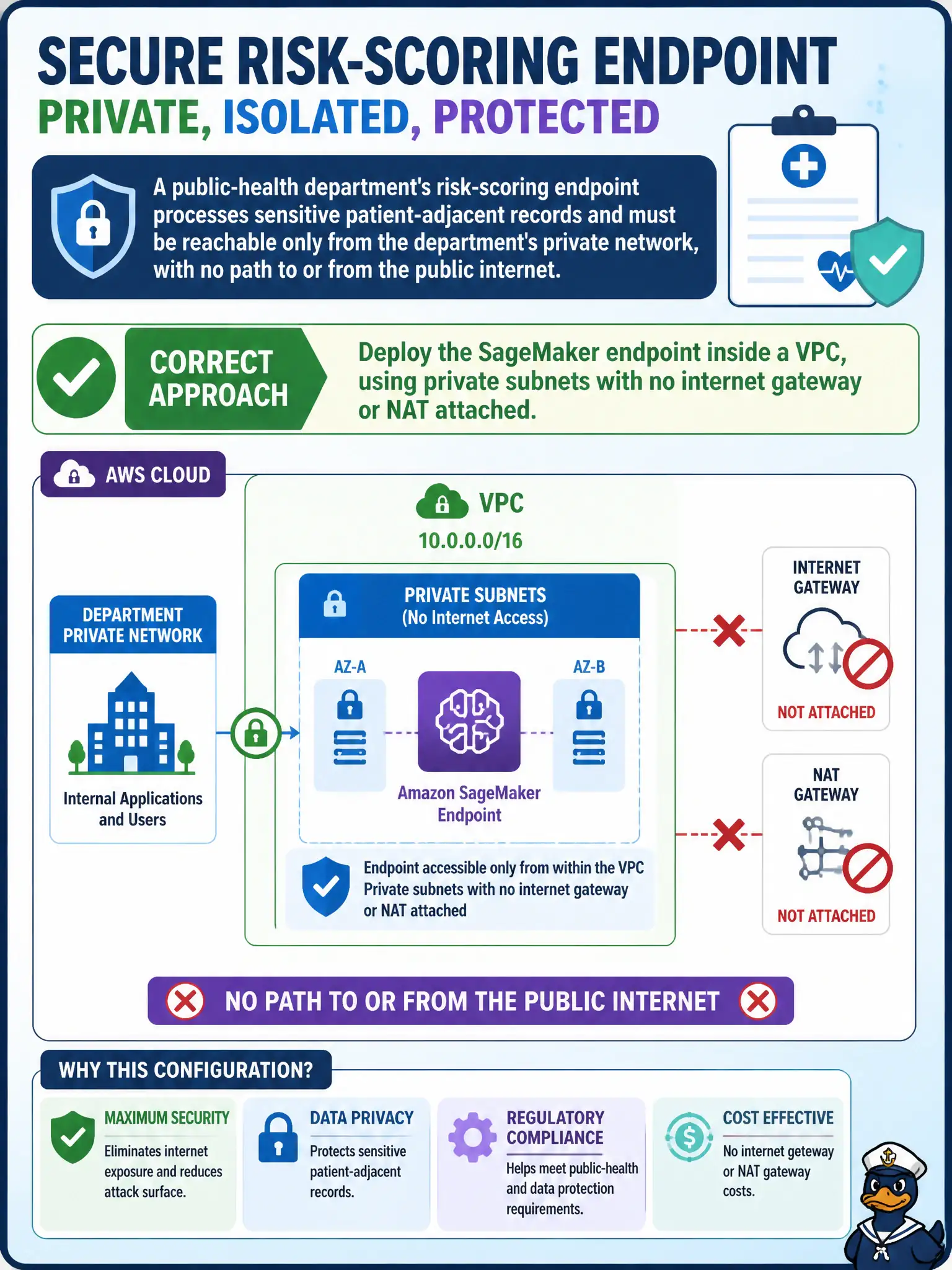
A public-health department's risk-scoring endpoint processes sensitive patient-adjacent records and must be reachable only from the department's private network, with no path to or from the public internet. How should the team configure the endpoint?
Select an answer to reveal the explanation.
Short Explanation
Locking down who's allowed to call an endpoint isn't the same as making sure the endpoint has no path to the internet at all — those are two different layers of protection. Placing it in private VPC subnets with no internet gateway or NAT closes off the network path entirely, not just the permission to use it. For patient-adjacent data, you want both, but the network isolation is the piece that can't be skipped.
Full Explanation
Deploying a SageMaker endpoint inside a VPC's private subnets, with no internet gateway or NAT device attached, removes any network path between the endpoint and the public internet at the infrastructure level, which is what reachable only from the private network actually requires for sensitive, patient-adjacent data. Relying on IAM policy alone while leaving default public network access in place secures who is authorized to call the endpoint, but it doesn't close the network path itself — a misconfigured policy or a leaked credential would still have an internet route to reach it, which is exactly the exposure the department wants eliminated. Adding a NAT gateway reopens an outbound path to the public internet, which directly contradicts the stated requirement of no path to or from the internet, even if the intent (fetching updates) sounds reasonable. Security groups restrict traffic by IP and port, but without placing the endpoint inside private VPC subnets in the first place, there's still an underlying network reachable from outside the department's private network that the security group is only partially filtering. Scope note: dependencies the endpoint needs (container images, model artifacts) must be reachable through VPC endpoints rather than the public internet once NAT is removed. Operational check: attempt to reach the endpoint from outside the department's private network and confirm the request fails at the network layer, not just the authorization layer.