
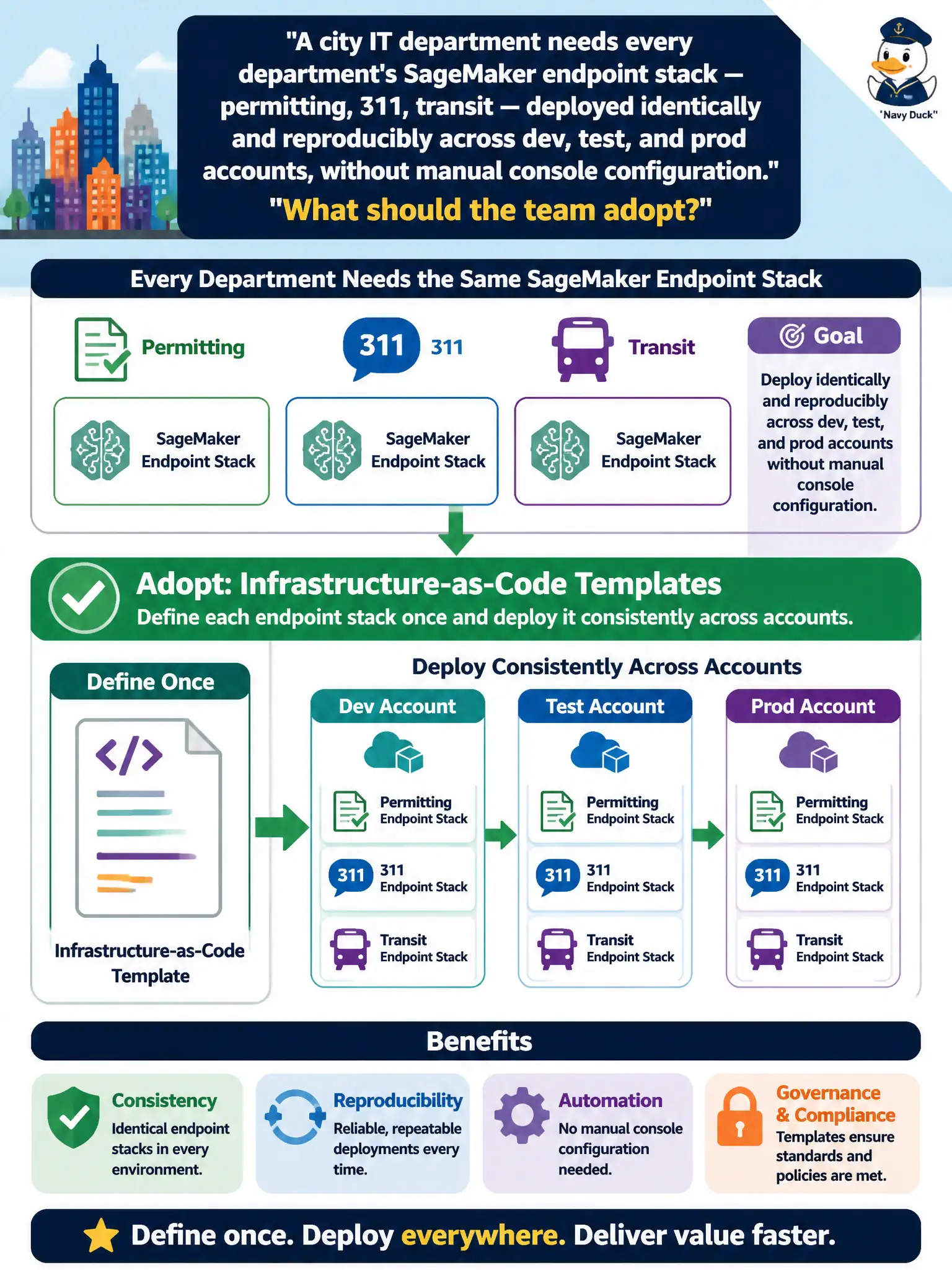
A city IT department needs every department's SageMaker endpoint stack — permitting, 311, transit — deployed identically and reproducibly across dev, test, and prod accounts, without manual console configuration. What should the team adopt?
Select an answer to reveal the explanation.
Short Explanation
Clicking through a console the same way three times, in three different accounts, is exactly where things quietly drift apart. Infrastructure-as-code templates define the stack once, as code, and deploy that same definition everywhere — dev, test, and prod all get the identical setup. That's what reproducible actually means.
Full Explanation
Infrastructure-as-code templates capture a resource configuration — instance types, scaling settings, networking — as versioned, declarative code that can be deployed identically across multiple accounts, which is exactly the repeatability the city IT department needs across dev, test, and prod for three department stacks. A manual checklist still relies on a human correctly executing every step by hand each time, and checklists drift from reality as they age or get skipped under time pressure, which is the exact inconsistency risk manual console work carries. Independent shell scripts per department without a shared template or schema might automate each one individually, but with no common definition, the three stacks can still diverge from each other over time as each script is edited separately. Manually copying a working configuration from one department's console to the next is still manual, console-driven work prone to missed settings and transcription errors, and it doesn't produce a reusable, auditable definition the way a template does. Scope note: templates still need parameterization for per-department differences (traffic volume, instance sizing) rather than being copy-pasted with values hardcoded. Operational check: diff the deployed configuration in each account against the template's expected state periodically to catch drift.