
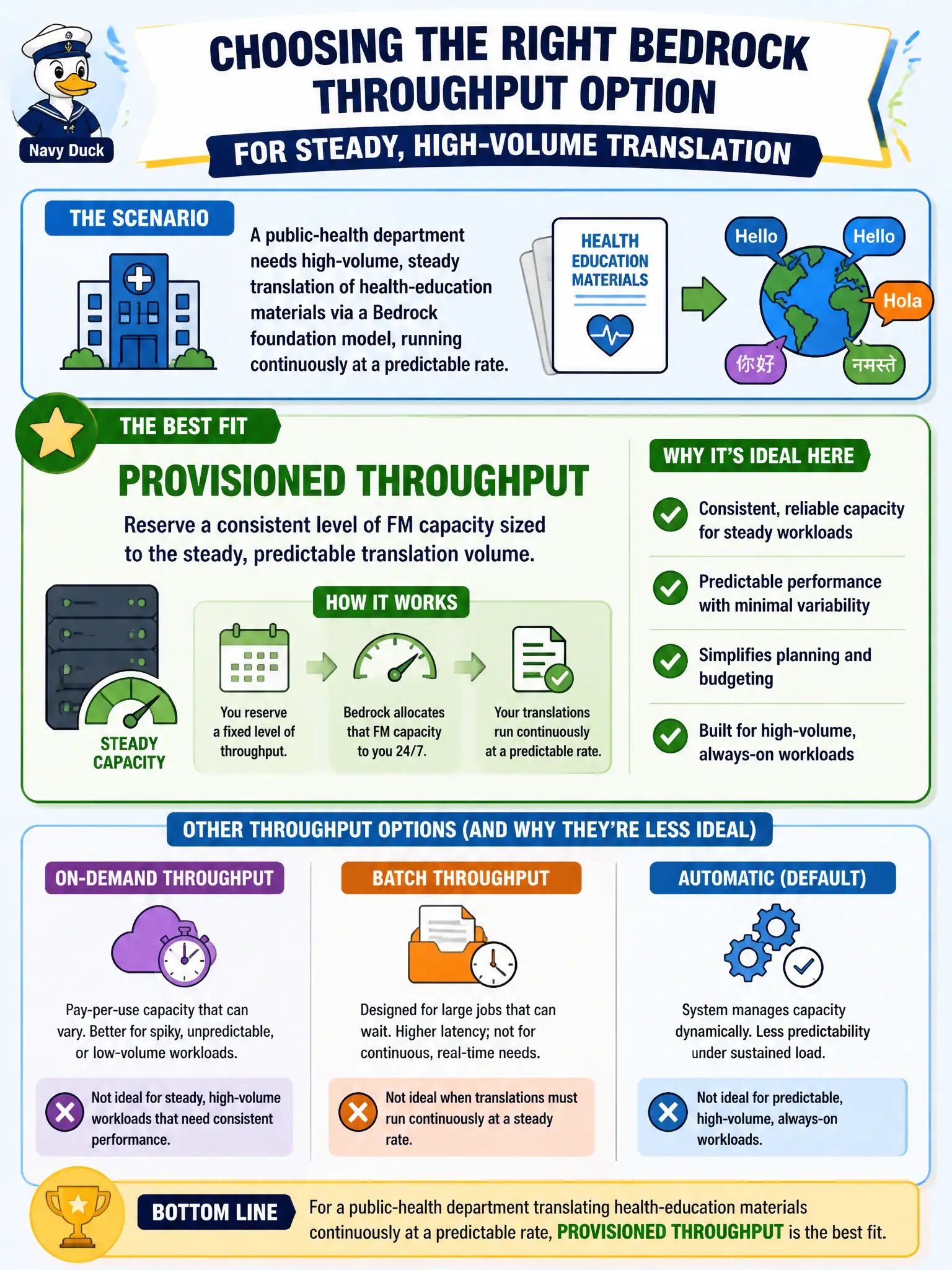
A public-health department needs high-volume, steady translation of health-education materials via a Bedrock foundation model, running continuously at a predictable rate. Which throughput option best fits this workload?
Select an answer to reveal the explanation.
Short Explanation
A steady, round-the-clock stream of translation requests isn't the bursty, unpredictable pattern on-demand pricing is built to absorb efficiently. Provisioned throughput reserves a consistent slice of FM capacity sized to exactly that steady volume, so you're not paying the premium of per-request pricing for work you already know is coming. Match the commitment to the predictability.
Full Explanation
Provisioned throughput reserves a fixed amount of foundation-model capacity for a committed period, which is cost-efficient precisely when demand is steady and predictable enough to size that reservation against — exactly the department's continuous, high-volume translation pattern. On-demand throughput charges per request with no capacity commitment, which is well suited to unpredictable or bursty usage but typically costs more per unit than a matched provisioned reservation once volume is sustained and foreseeable, as it is here. Serverless inference is a SageMaker hosting pattern for traditional model endpoints that scales compute with request volume; it doesn't describe how Bedrock FM throughput is purchased, so it doesn't fit the tradeoff the department is actually facing between on-demand and provisioned FM capacity. A one-time batch translation job addresses translating an existing static library, but it doesn't serve continuous, ongoing translation demand as new health-education materials are produced, which is what the department describes. Scope note: provisioned throughput commitments typically lock in capacity for a term, so forecasting volume reasonably well before committing matters. Operational check: compare actual sustained request volume against the provisioned capacity periodically to confirm the reservation still matches demand.