
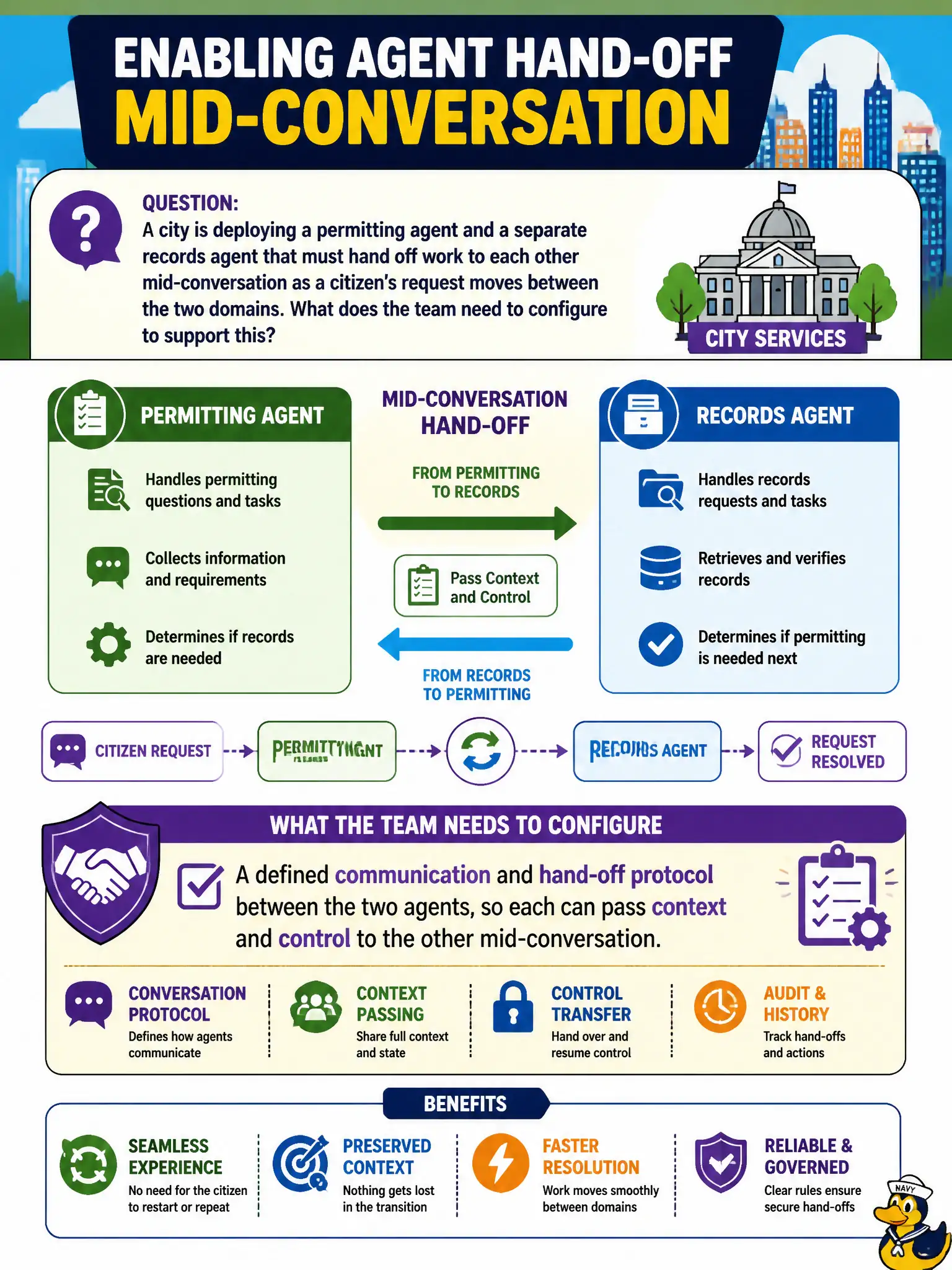
A city is deploying a permitting agent and a separate records agent that must hand off work to each other mid-conversation as a citizen's request moves between the two domains. What does the team need to configure to support this?
Select an answer to reveal the explanation.
Short Explanation
Two specialists that never talk to each other can't hand off a case smoothly — the citizen ends up repeating themselves. What actually solves that is giving the permitting agent and the records agent a defined way to pass context and control between each other mid-conversation. That's the coordination layer, not just two agents sitting side by side.
Full Explanation
A multi-agent architecture needs an explicit communication and hand-off protocol so one agent can pass conversational context, task state, and control to another mid-conversation, which is what lets a citizen's request move from permitting to records without starting over. Building one monolithic agent that internally handles both domains avoids the hand-off problem by avoiding multi-agent design altogether, which trades away the separation of concerns (and independent scaling, ownership, and iteration) that motivated splitting the work into two agents in the first place. Two independent agents with no connection between them forces the citizen to re-explain their situation to whichever agent they land on next, which is the exact broken experience the hand-off requirement was meant to prevent. Deploying the same model checkpoint twice addresses compute, not coordination — having two copies of similar weights running says nothing about whether either one can pass context or control to the other, since that's an orchestration concern, not a model-weights concern. Scope note: hand-off design should specify what state (conversation history, extracted entities, task status) transfers at each boundary, not just that a transfer happens. Operational check: trace a test conversation across both agents and confirm no context is dropped at the hand-off point.