
A city clerk's public-records-request assistant retrieves answers from a RAG system built over a mixed archive of ordinances, meeting minutes, and permits. Residents often ask for documents from a specific department and date range. Which document-preparation step most directly enables the assistant to filter retrieval results by department and date?
Select an answer to reveal the explanation.
Short Explanation
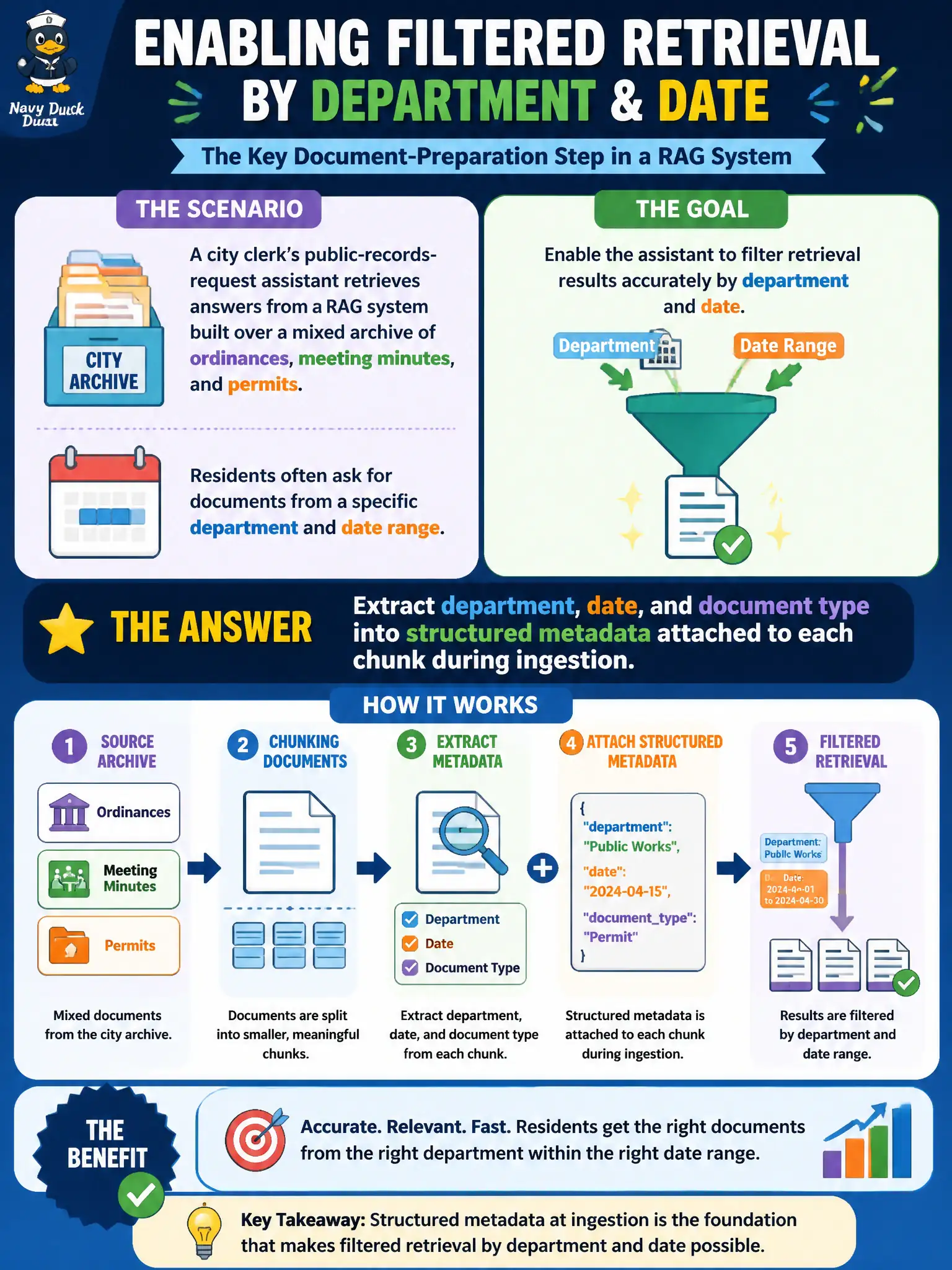
Think of a library card catalog with filters, not just a shelf of unsorted books someone has to skim page by page. Tagging each chunk with its department, date, and document type gives the assistant real filters to work with, instead of relying on semantic search to guess what a resident really wants.
Full Explanation
Mechanism: attaching structured metadata such as department, date, and document type to each chunk during ingestion lets the retrieval step combine that metadata as a filter alongside vector similarity search, narrowing candidates to the right department and date range before or during the semantic match, rather than hoping the embedding alone captures those attributes. Why the wrong options fail by concept: increasing chunk overlap improves how much surrounding context a passage carries and helps preserve continuity across chunk boundaries, but it does nothing to let the system filter by a structured attribute like department. Text augmentation generates paraphrased training variants to improve model robustness, it's unrelated to enabling structured filtering over an already-ingested retrieval corpus. Deduplicating near-identical documents improves corpus quality and reduces redundant retrieval hits, but even a perfectly deduplicated corpus still can't be filtered by department or date without metadata attached to it. Scope caveat: the extracted metadata is only as reliable as the parsing that produced it, a misread date or a missing department tag silently degrades filtered retrieval for that document. Operational check: sample a handful of ingested chunks after the pipeline runs and confirm each carries populated department, date, and document-type fields before enabling filtered retrieval in production.