
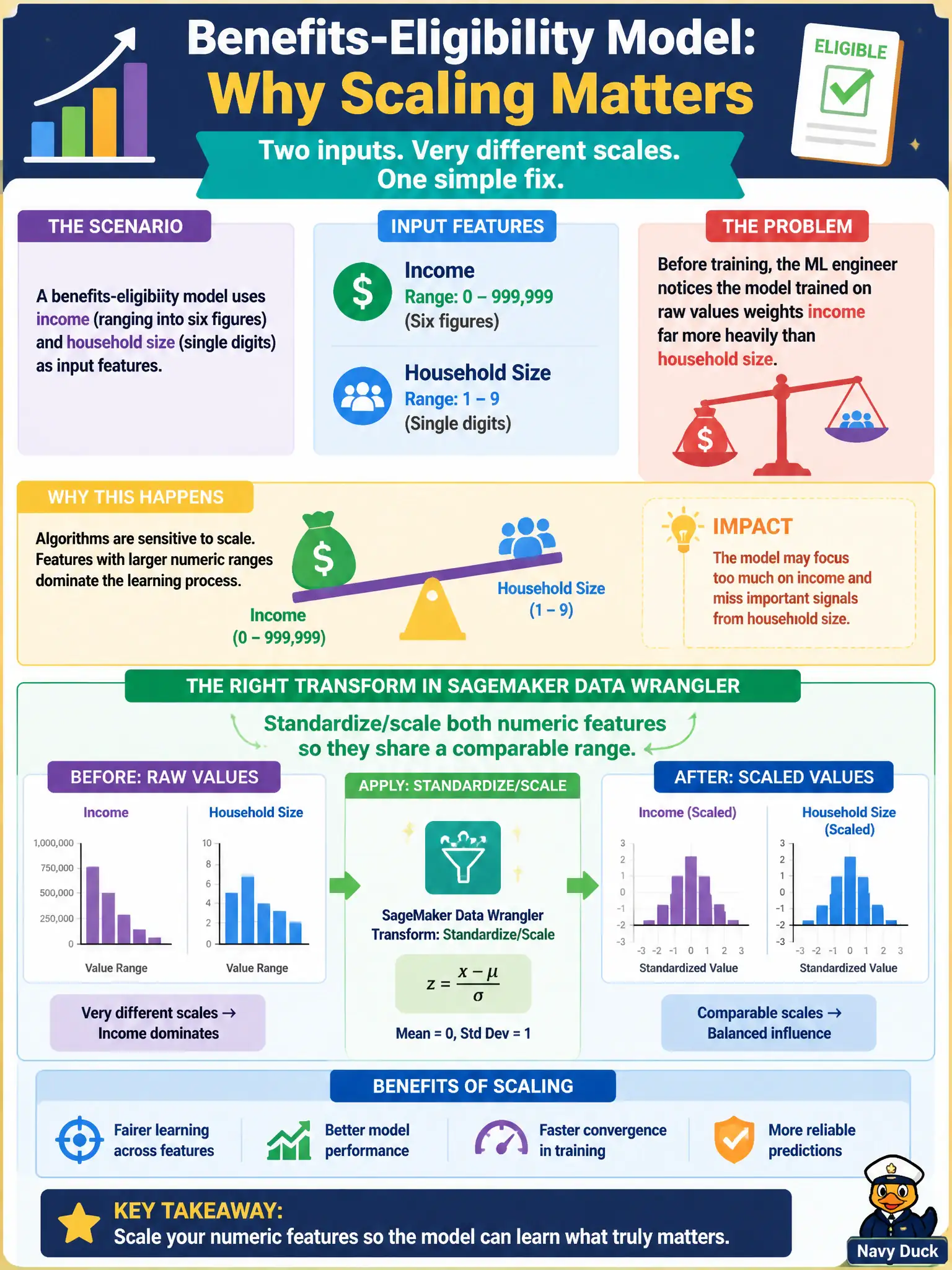
A benefits-eligibility model uses income (ranging into six figures) and household size (single digits) as input features. Before training, an ML engineer notices the model trained on raw values weights income far more heavily than household size. Which SageMaker Data Wrangler transform addresses this most directly?
Select an answer to reveal the explanation.
Short Explanation
Picture comparing a distance in feet against one in inches without converting either, the bigger number wins by default even when it shouldn't. Scaling puts income and household size on the same measuring stick so the model judges them by their actual signal, not their raw magnitude.
Full Explanation
Mechanism: standardization (z-score) or min-max scaling rescales numeric features so they occupy comparable ranges, which matters because many training algorithms are sensitive to feature magnitude, a raw six-figure income otherwise dominates gradient updates or distance calculations purely due to scale, not predictive value. Why the wrong options fail by concept: one-hot encoding is built for unordered categorical variables, household size is already a meaningful numeric quantity, encoding it that way discards its magnitude and ordering instead of fixing the scale mismatch. Deduplication addresses redundant rows, a data-quality concern entirely separate from why two present, valid features have mismatched ranges. Tokenization is a text pre-processing technique for splitting strings into units, income is a continuous number, not text, so tokenization doesn't apply and wouldn't fix the scale problem even conceptually. Scope caveat: scaling parameters like the mean and standard deviation, or the min and max, must be fit only on the training split and then reapplied unchanged at inference and on the test split, fitting them on the full dataset leaks information. Operational check: after the transform, inspect each feature's summary statistics in the Data Wrangler flow and confirm income and household size now show comparable variance rather than one dwarfing the other.