
A court clerk's office is preparing scanned case-filing PDFs for a RAG knowledge base and must choose between fixed-size chunking and semantic chunking to split documents before embedding. Case filings contain long, legally structured sections (facts, arguments, rulings) where splitting mid-argument would hurt retrieval quality. Which chunking approach best fits this document type?
Select an answer to reveal the explanation.
Short Explanation
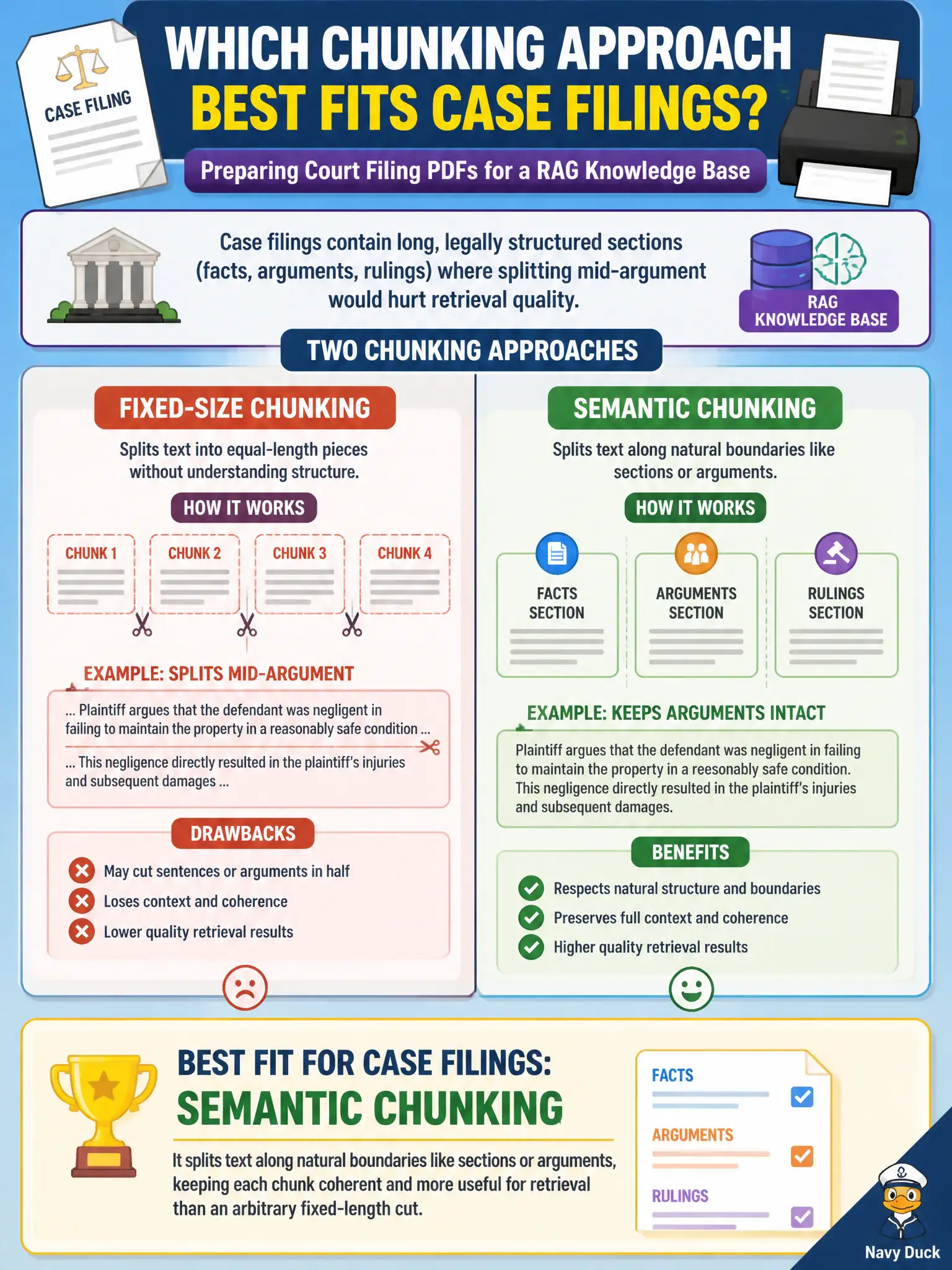
Think about cutting a legal brief in half mid-sentence versus cutting it between the facts and the argument — one leaves you with a fragment that makes no sense on its own, the other leaves two pieces you could actually hand someone and have them understand. Semantic chunking follows the document's own structure, so each retrieved chunk stays coherent instead of getting sliced arbitrarily. For case filings with clearly organized sections, that coherence is exactly what keeps retrieval useful.
Full Explanation
Semantic chunking splits a document along meaningful boundaries — section headers, paragraph breaks, argument structure — so each resulting chunk represents a coherent unit of meaning that an embedding model can represent well and a retrieval step can return as a self-contained, useful passage; that matters directly for case filings where splitting mid-argument would hand the RAG pipeline a fragment missing critical context. Fixed-size chunking optimizes for a different goal: predictable, uniform chunk lengths, which simplifies embedding computation and storage but ignores document structure entirely, so a fixed cut can land in the middle of a ruling or an argument exactly where this document type is most sensitive to that kind of split. Dismissing semantic chunking as unreliable for unpredictable legal structure gets the tradeoff backwards — structured legal documents, with headers, numbered sections, and standard formatting, are actually a good candidate for semantic or structure-aware chunking, since there are real boundaries to detect. Claiming chunk boundaries don't matter because embedding models compensate overstates what embeddings can fix; an embedding represents the text it's given, and a fragment missing its surrounding context produces a less meaningful vector regardless of how strong the underlying model is. Scope note: semantic chunking still needs a target size range to avoid producing chunks so long they dilute retrieval precision or so short they lose context. Operational check: manually review a sample of generated chunks from a real case filing to confirm they end at coherent boundaries before embedding the full corpus.