
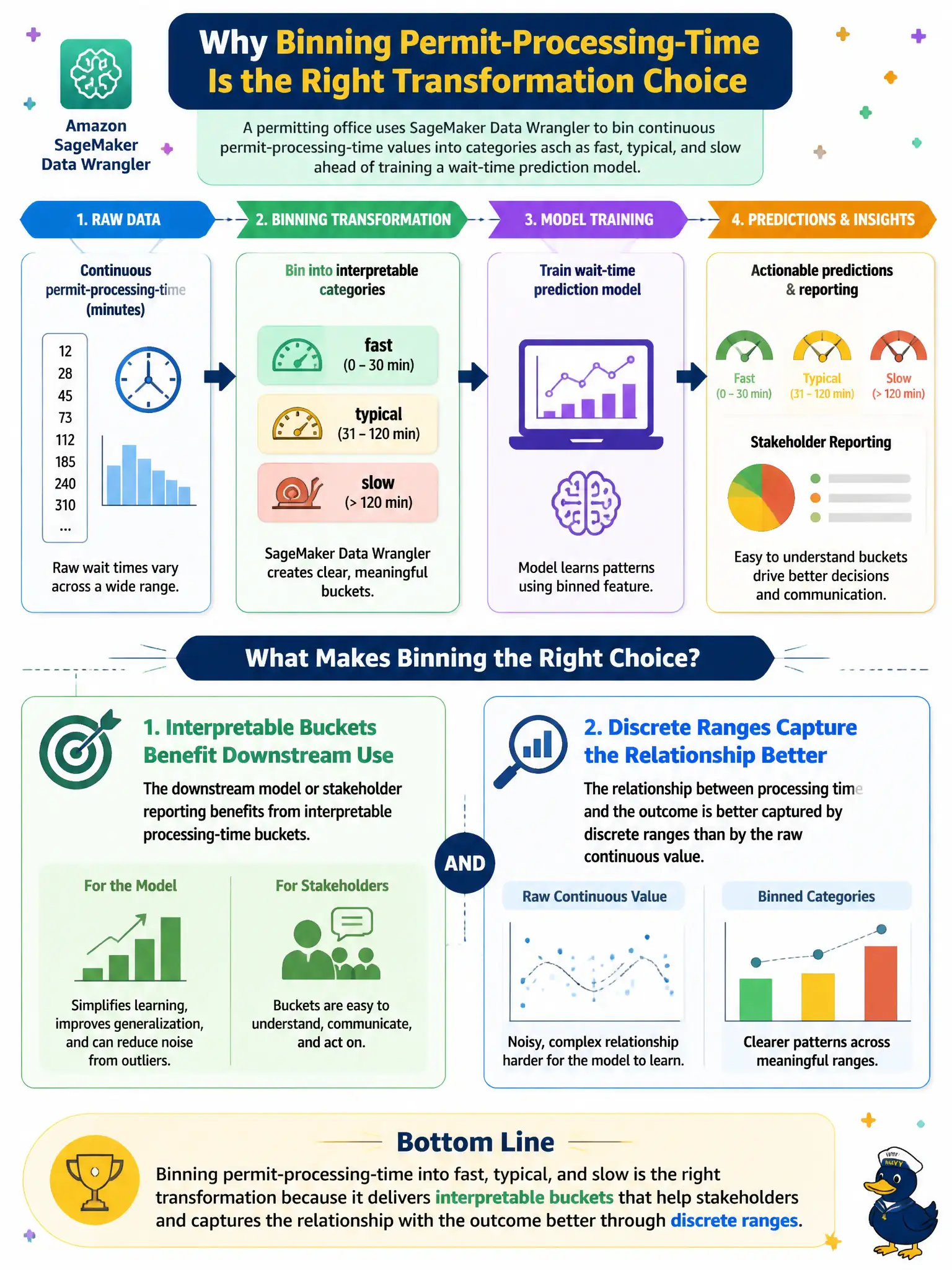
A permitting office uses SageMaker Data Wrangler to bin continuous permit-processing-time values into categories such as fast, typical, and slow ahead of training a wait-time prediction model. Which situation makes binning this feature the right transformation choice?
Select an answer to reveal the explanation.
Short Explanation
Think about how a weather report says "hot" instead of the exact temperature: sometimes a handful of meaningful buckets tells the story better than the raw number. Binning processing time into fast, typical, slow makes sense when that grouping captures the outcome relationship better or is easier to explain, not because it's mandatory.
Full Explanation
Binning is the right transformation when discretizing a continuous variable genuinely improves how a model captures its relationship with the target, or when interpretability for reporting matters more than precision — for instance, if wait-time outcomes cluster into meaningfully different bands rather than varying smoothly with processing time. Claiming binning is required before any numeric feature can be used misunderstands most ML algorithms; regression models, gradient-boosted trees, and neural networks all consume continuous numeric inputs directly and routinely perform better with the original precision than with an unnecessarily coarsened version. Claiming binning eliminates the need to handle outliers conflates two different problems — grouping extreme values into an edge bucket can reduce their visible influence, but it doesn't replace proper outlier detection and handling, and poorly chosen bin edges can still let outliers distort a bucket's characteristics. Claiming more features tends to improve accuracy ignores that binning can actually destroy predictive signal by discarding the fine-grained variation within a bin, and adding features indiscriminately raises overfitting risk rather than guaranteeing better performance. Scope note: bin edges should be chosen from the data's actual distribution (quantiles or domain-meaningful thresholds), not arbitrary round numbers. Operational check: compare model performance with the binned feature against the original continuous feature on a validation set before committing to the transformation.