
A housing authority needs to merge inconsistent casework records — some CSV, some JSON, arriving from several county source systems with slightly different schemas — into a single feature table for a benefits-eligibility model. Which approach best handles this heterogeneous, multi-source merge?
Select an answer to reveal the explanation.
Short Explanation
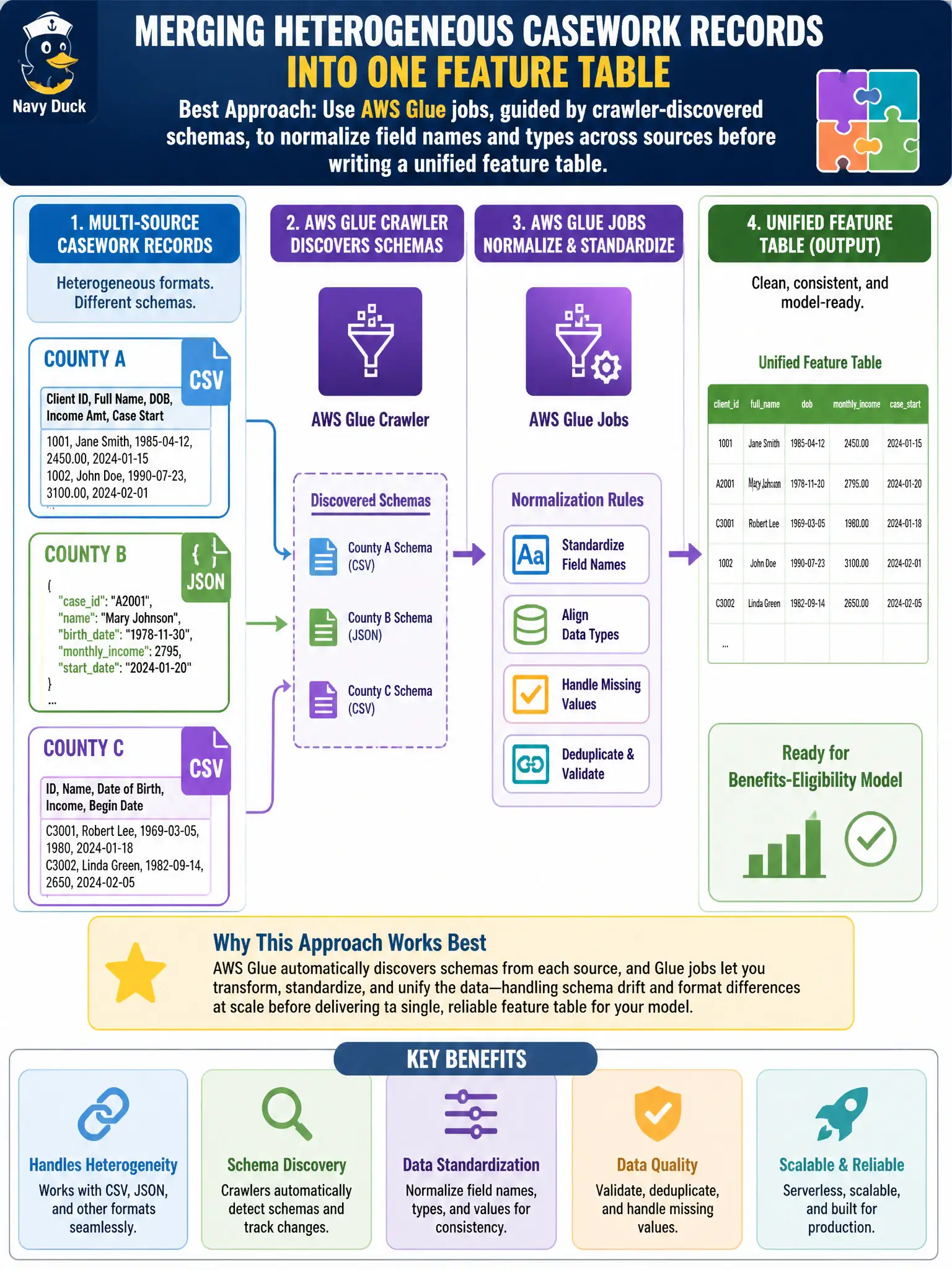
Think of Glue like a translator sitting between county offices that all fill out forms a little differently — it reads each format, maps the fields to a common vocabulary, and hands you one clean document instead of a stack of mismatched ones. That schema discovery and transformation step is what heterogeneous, multi-source casework data needs before it can become one feature table. Skipping that reconciliation, in raw SQL, a NoSQL table, or a spreadsheet, just pushes the mismatch downstream.
Full Explanation
AWS Glue crawlers can inspect CSV and JSON sources and infer their schemas into the Data Catalog, and Glue ETL jobs can then apply mapping and transformation logic — renaming fields, casting types, resolving structural differences — to produce one consistent feature table, which is the standard pattern for merging inconsistent multi-source records at scale. Unioning the raw sources directly in Athena SQL without reconciliation assumes the schemas already line up; when field names or types differ across counties, an unqualified union either fails or silently produces mismatched columns. Loading everything into DynamoDB and reconciling at read time pushes schema-mapping logic into every consuming application instead of solving it once upstream, and it also misapplies a key-value store to a problem that's fundamentally about batch schema transformation. Manually reconciling exports in a spreadsheet does not scale past a handful of files, is not repeatable as new county extracts arrive, and introduces transcription error into eligibility data with real consequences for residents. Scope note: crawler-inferred schemas should still be reviewed by a human before the transformation job trusts them blindly, since automated inference can misjudge ambiguous types. Operational check: run the Glue job against a sample from each county source and diff the resulting row counts and field types against the originals.