
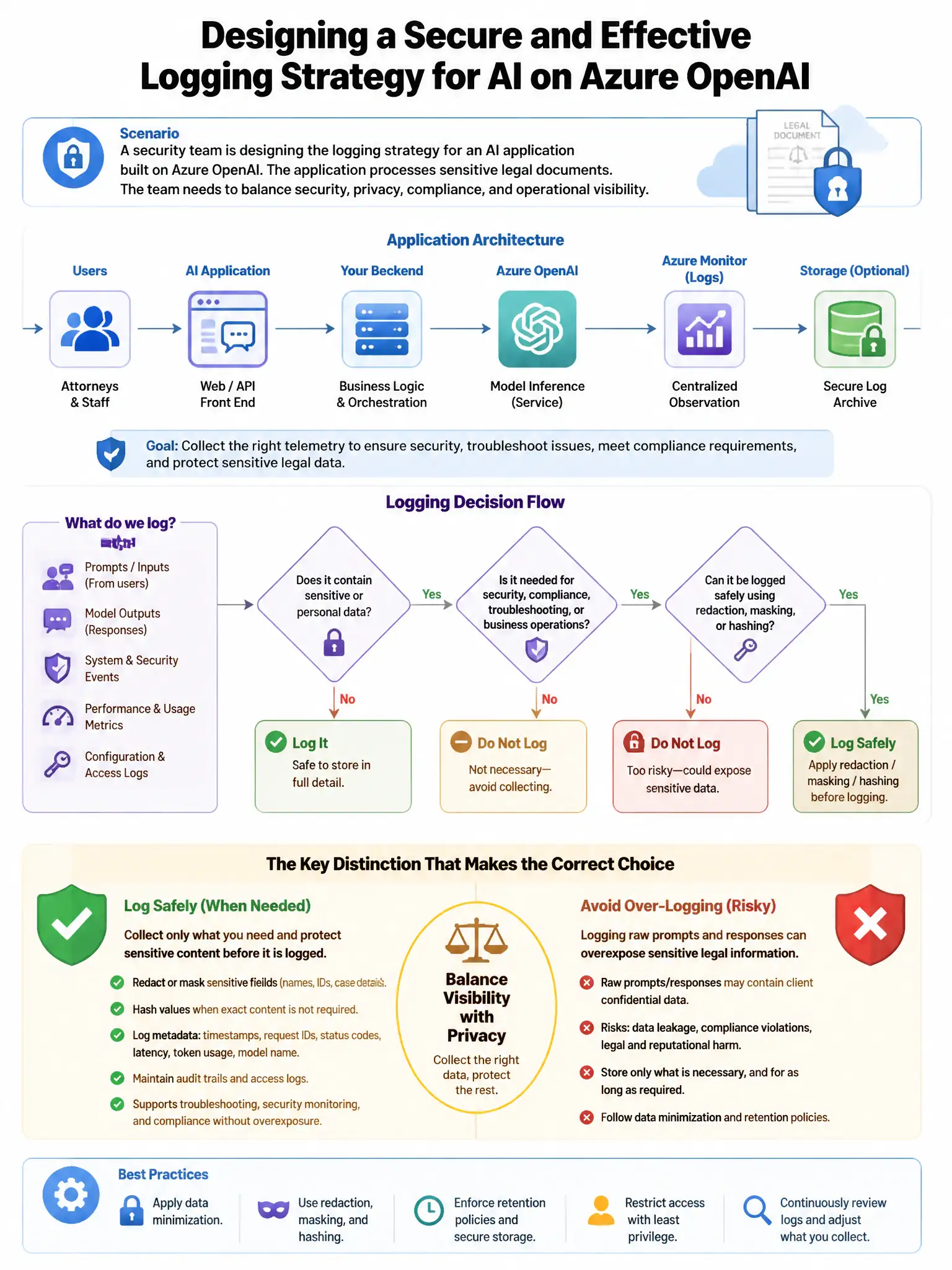
A security team is designing the logging strategy for an AI application built on Azure OpenAI. The application processes sensitive legal documents. The team needs to balance security visibility (logging prompt content for forensics) against privacy (not logging PII in legal documents). What approach achieves this balance?
Select an answer to reveal the explanation.
Short Explanation
Here's the deal — you disable native content logging and put a logging proxy in front of Azure OpenAI that redacts PII before storing logs. That gives your security team forensic visibility while keeping sensitive legal-document PII out of the logs.
Full Explanation
The correct approach is to disable Azure OpenAI's native content logging, which stores raw prompts and completions in Microsoft systems, and implement a custom logging proxy layer that applies PII redaction before persisting logs. This achieves the balance: security teams get visibility into AI interactions for forensics and security monitoring, while sensitive PII in legal documents is masked before storage, addressing both privacy and compliance requirements. The option that enables full Azure OpenAI diagnostic logging with prompt and completion content and applies Microsoft Purview auto-labeling to the logs is incorrect because enabling full content logging stores raw prompts containing PII in Azure Monitor logs, creating a compliance risk and an additional sensitive data store; applying labels after the fact does not prevent PII exposure during log ingestion. The option that enables diagnostic logging without content logging, using metadata only, and implements a separate audit log with PII-scrubbed summaries generated by a secondary AI model is incorrect because metadata-only logging provides limited security forensic value without content context, and a secondary AI model for summarization adds complexity while the secondary model itself would process PII. The option that logs only error responses from Azure OpenAI and relies on Microsoft Defender for AI alerts for security visibility is incorrect because logging only errors provides very limited forensic capability, and Defender for AI alerts are triggered by specific threat patterns, not comprehensive audit coverage of all AI interactions.