
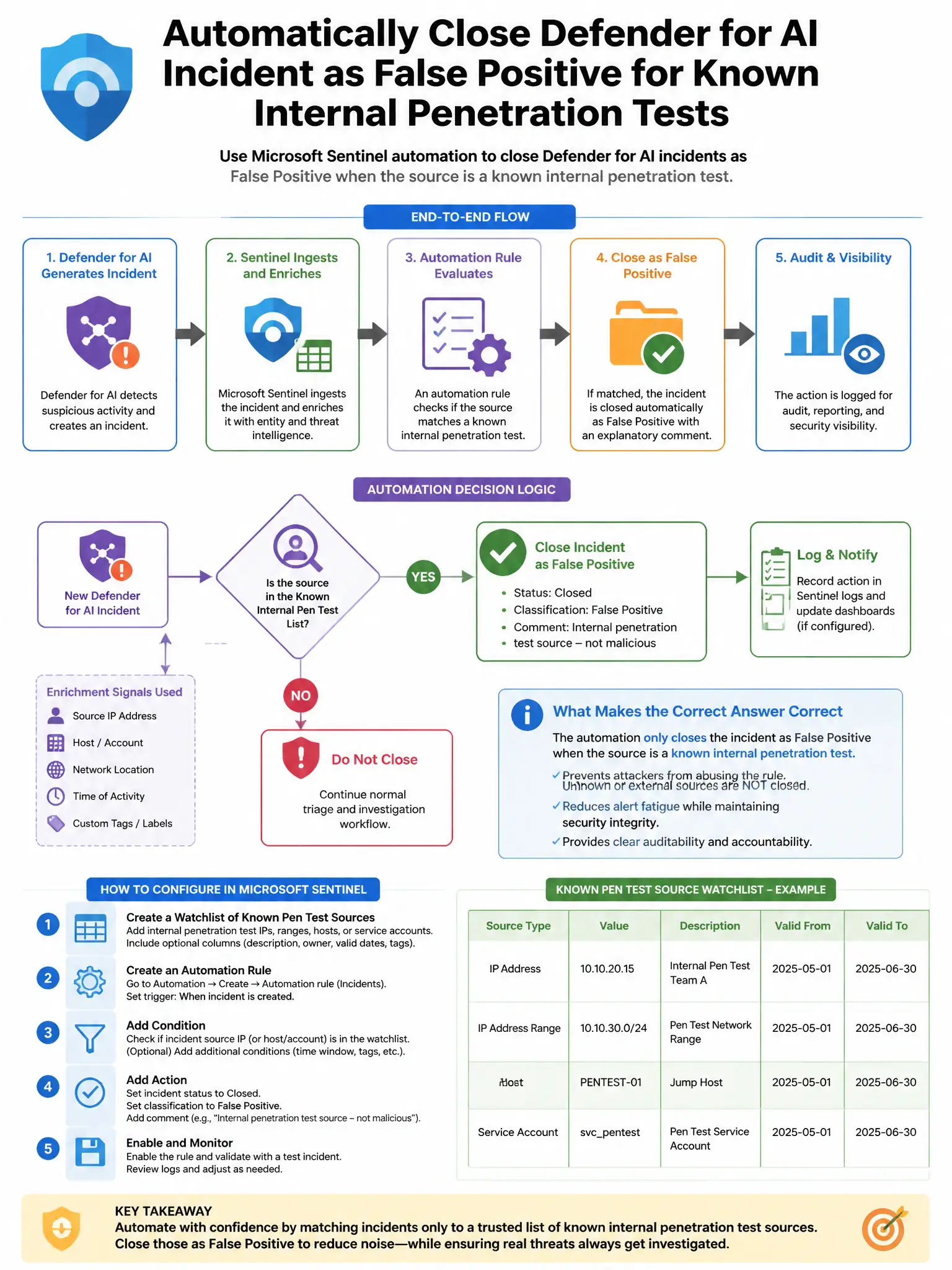
A security engineer needs to configure Microsoft Sentinel to automatically close a Defender for AI incident as a false positive when the source is a known internal penetration testing team's IP addresses. The pen test team's IPs are stored in a Sentinel watchlist. Which Microsoft Sentinel feature handles incident disposition automation?
Select an answer to reveal the explanation.
Short Explanation
You'll use a Sentinel Automation Rule because it can check incident properties like source IP against a watchlist and then close the incident as a false positive automatically. That gives you automated false positive management without spinning up a playbook.
Full Explanation
The correct choice is the Sentinel Automation Rule with a condition checking the incident's IP against the watchlist and an action to close the incident as false positive. Microsoft Sentinel Automation Rules support conditions based on incident properties, such as entity IP addresses, and can reference watchlists in conditions. When a new incident is created and its source IP matches an entry in the pen testing team watchlist, the automation rule action can automatically close the incident with a 'False Positive - Incorrect alert logic' classification, providing automated false positive management without playbook overhead. The analytics rule suppression option is incorrect because analytics rule suppression prevents new alert or incident creation for matching conditions during a suppression window; it does not close already-created incidents or provide watchlist-based conditional logic as sophisticated as automation rules. The playbook option is incorrect because a playbook is a valid approach but automation rules are simpler, have lower latency, and do not require Logic App execution costs; automation rules are the preferred first option for condition-based incident closure. The Fusion rule exclusion list option is incorrect because Fusion rule exclusion lists are for reducing false positive Fusion incidents, not for suppressing individual Defender for AI alerts based on entity watchlist matching.