
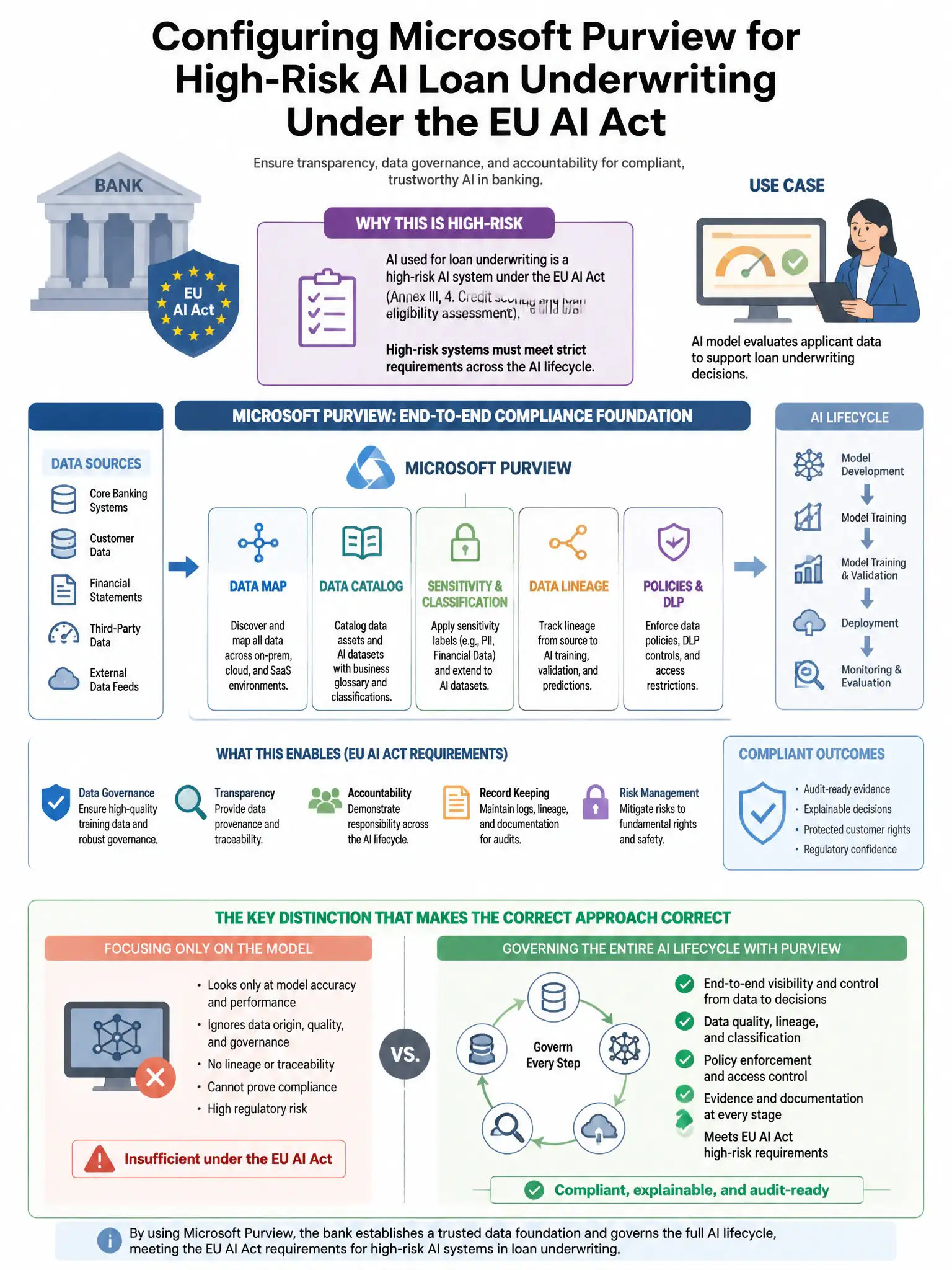
A compliance engineer is configuring Microsoft Purview for a banking organization that uses AI for loan underwriting decisions. The EU AI Act requires that high-risk AI systems maintain logs sufficient for post-hoc auditability of individual decisions. Which combination of Azure services provides the required audit trail for each AI-driven loan decision?
Select an answer to reveal the explanation.
Short Explanation
Here's the deal — you need the combo that captures the full decision context for each loan: Azure OpenAI diagnostic logs for prompts and responses, plus Azure Cosmos DB for per-decision audit records. That gives you the input features, model version, output, and rationale you need for post-hoc audit.
Full Explanation
The correct combination is Azure OpenAI diagnostic logs capturing prompts/responses combined with Azure Cosmos DB storing per-decision audit records including input features, model version, output, and decision rationale. EU AI Act auditability for individual loan decisions requires capturing the complete decision context: the input data (loan applicant features), the model version used, the model's output (score/recommendation), and the decision rationale. Azure OpenAI diagnostic logs capture the prompt and response (including input features and model reasoning), while Azure Cosmos DB provides a structured, queryable audit store for per-decision records with all required fields. This combination enables post-hoc reconstruction of any individual decision. The Azure Machine Learning model monitoring option with data drift detection logs and Azure Monitor metrics for model performance is incorrect because model monitoring with drift detection and performance metrics provides aggregate model health insights, not individual decision-level audit records required for EU AI Act compliance. The Microsoft Purview Audit (Premium) option capturing Azure OpenAI API events and Microsoft Sentinel for long-term retention is incorrect because Purview Audit (Premium) captures event metadata and API call records but may not contain the complete input feature set and decision rationale needed for individual decision auditability. The Azure Data Factory pipeline logs option capturing training data lineage and Azure Machine Learning experiment tracking is incorrect because Data Factory pipeline logs track ETL data movement and AML experiment tracking monitors training runs; neither provides individual inference decision audit records.