
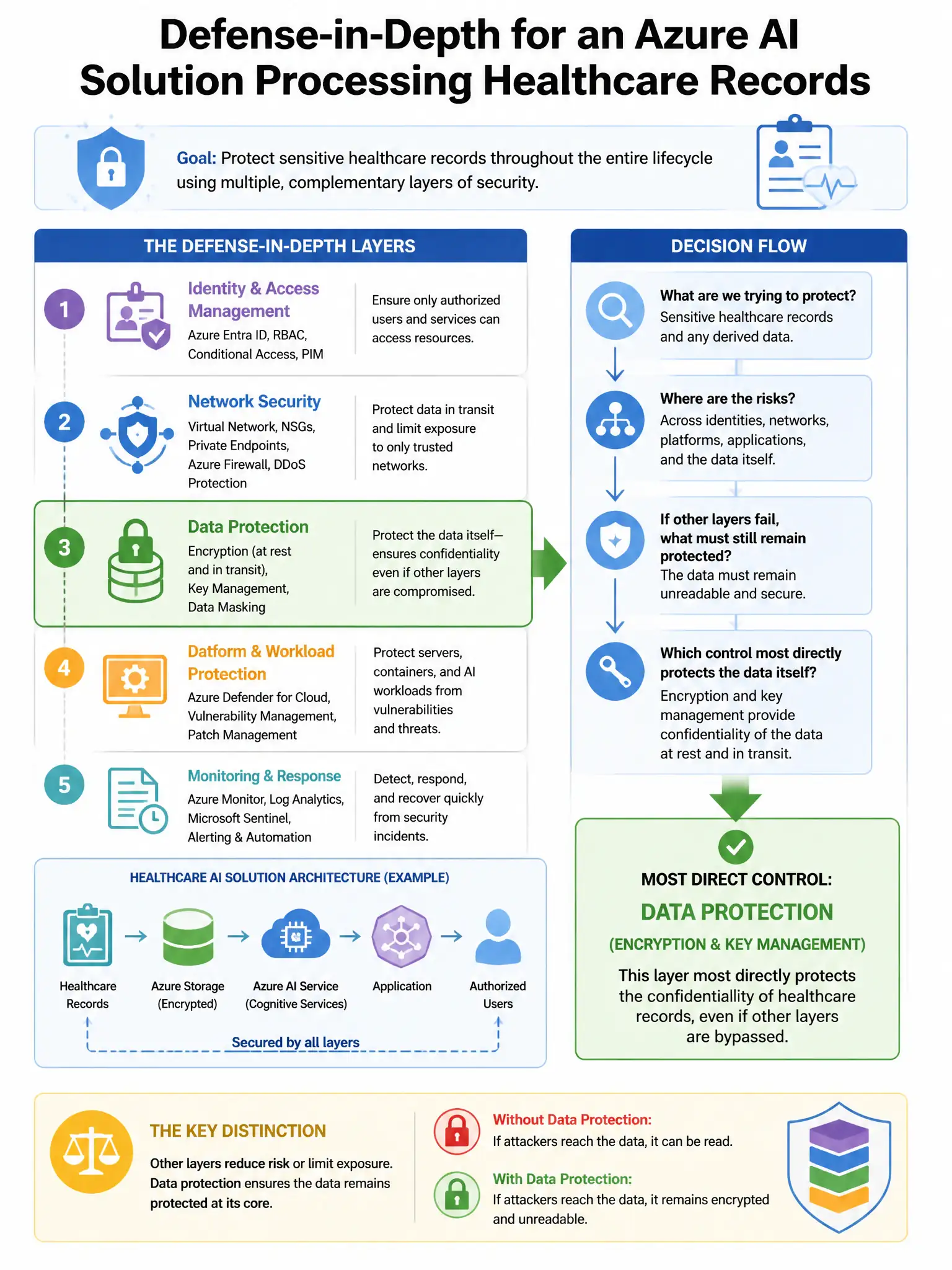
A security architect is designing a defense-in-depth strategy for an Azure AI solution that processes healthcare records. The architect needs to identify which control most directly addresses the risk that a malicious insider with Azure subscription Owner role could extract training data.
Select an answer to reveal the explanation.
Short Explanation
Here's the deal — you want cryptographic separation, so use customer-managed key encryption on Azure Machine Learning datasets with the key held in a separate security team-controlled Key Vault. That way, an Azure subscription Owner still can't read plaintext training data without the security team granting key access.
Full Explanation
The customer-managed key encryption option is correct because encrypting training data with customer-managed keys where the Key Vault access policy is controlled by a separate security team creates cryptographic separation between the Azure subscription Owner and the training data. An Owner cannot access plaintext training data without the separate security team's authorization for key access. The just-in-time access option using Entra ID PIM for subscription Owner role with approval workflows is incorrect because PIM reduces the time an Owner has elevated access but does not prevent access to training data during the activation window. The network isolation option using Azure Policy to deny creation of Azure Machine Learning training compute without network isolation is incorrect because network isolation prevents external exfiltration paths but does not protect against an insider with Owner access who could modify network configurations. The Microsoft Sentinel analytics rules option that alerts on Azure Machine Learning dataset download operations is incorrect because Sentinel alerts provide detection after the fact but do not prevent a determined insider from exfiltrating data before the alert is acted upon.