
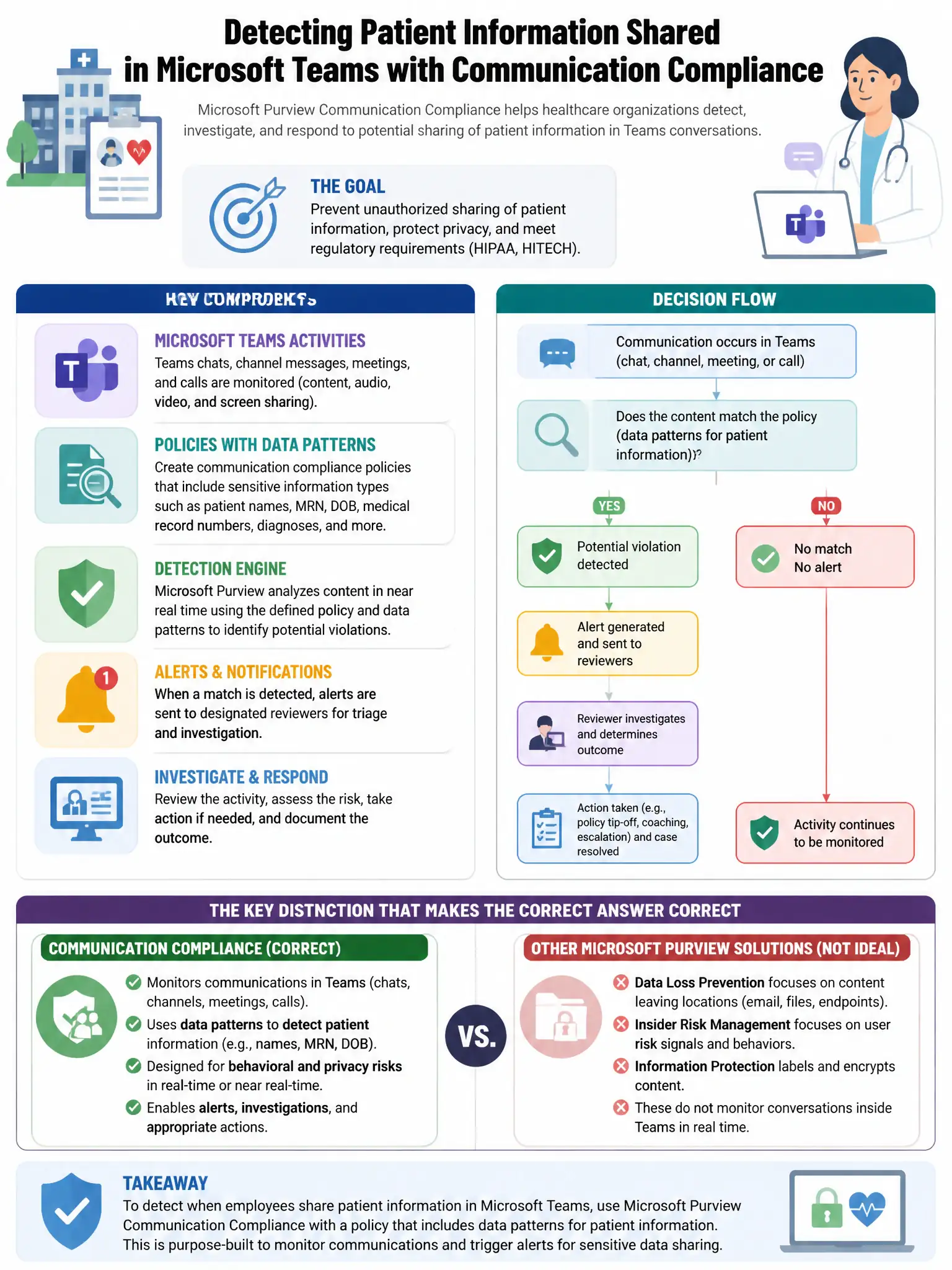
A healthcare organization is using Microsoft Purview Communication Compliance to detect when employees share patient information through Microsoft Teams. The policy should also cover Microsoft 365 Copilot interactions for the same employees. Which communication compliance policy configuration scope includes both Teams messages and Copilot interactions?
Select an answer to reveal the explanation.
Short Explanation
Here's the deal — you want one communication compliance policy that selects both Microsoft Teams and Microsoft 365 Copilot as supervised communication channels. That lets the same policy and classifiers watch Teams messages, channel posts, chats, and Copilot interactions together.
Full Explanation
Creating a single communication compliance policy with Microsoft Teams and Microsoft 365 Copilot both selected as communication channels in the policy scope is correct because Microsoft Purview Communication Compliance policies support multiple communication channels within a single policy. An administrator can select both Microsoft Teams (messages, channel posts, chats) and Microsoft 365 Copilot interactions as supervised communication locations in one policy. Classifiers (such as health information or HIPAA-related trained classifiers) are applied across all selected channels, enabling unified compliance monitoring. Creating separate communication compliance policies—one for Teams and one for Copilot—is wrong because while two separate policies would work, the question asks about the configuration—a single policy covering both is more efficient and easier to manage. Creating a DLP policy covering both Teams and Copilot to replace communication compliance is wrong because DLP policies focus on preventing data loss through classification and blocking actions; communication compliance focuses on detecting policy violations in communications for review and remediation. Using Microsoft Purview Audit to manually review both Teams and Copilot interactions is wrong because Purview Audit provides searchable log records for investigation but lacks the automated content classification, workflow routing, and reviewer functionality of communication compliance.