
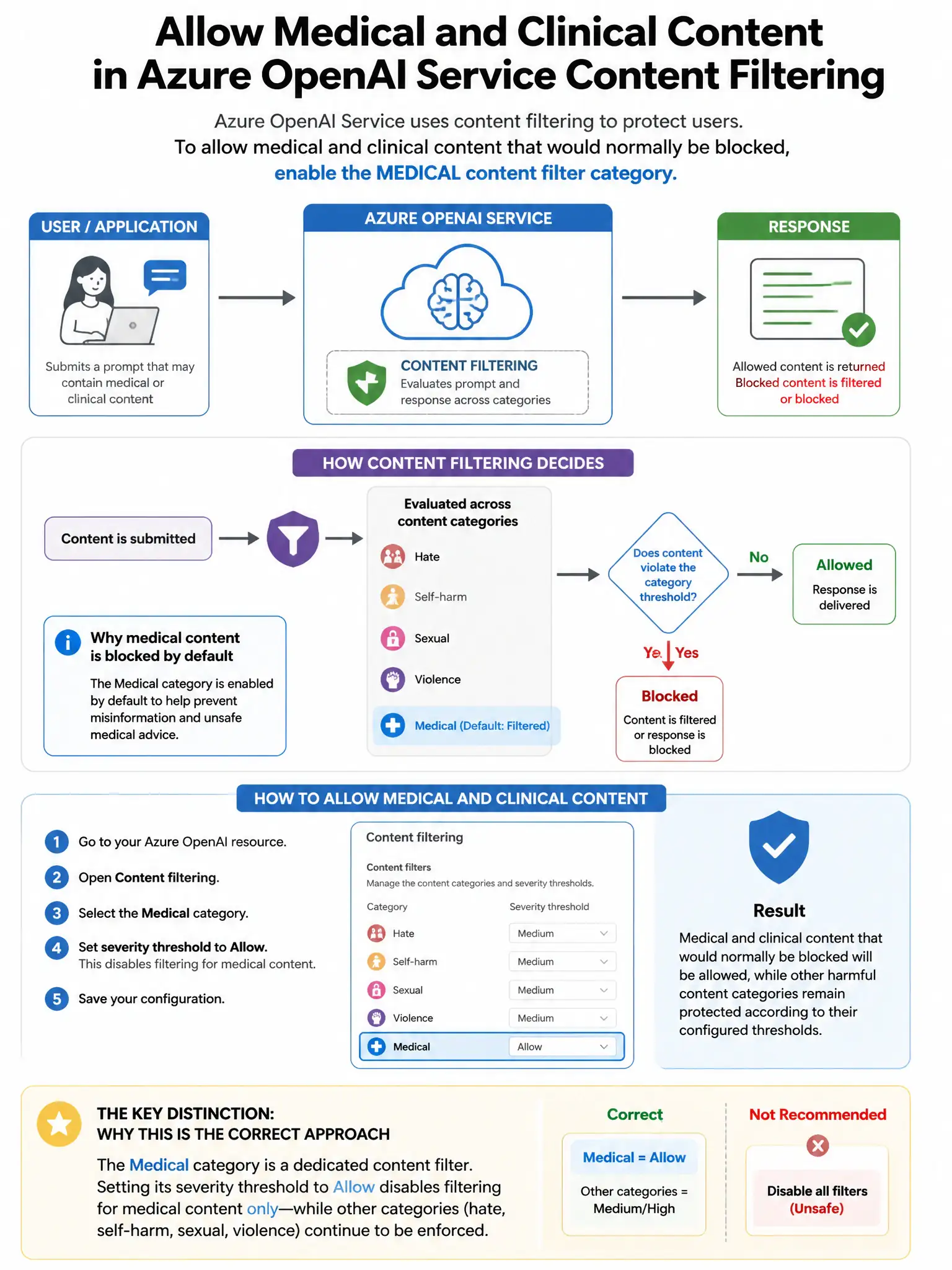
An organization uses Azure OpenAI Service with content filtering and needs to configure the content filter to allow medical and clinical content that would normally be blocked at the default severity settings (because it contains descriptions of injuries and medication effects for a legitimate clinical decision support tool). Which approach allows this content type while maintaining safety controls?
Select an answer to reveal the explanation.
Short Explanation
Here's the deal — you should request a content filter modification through Azure's responsible AI process, because legitimate clinical decision support can get severity thresholds adjusted without turning safety off. That keeps the medical content flowing while staying within supported controls.
Full Explanation
The correct approach is to request a content filter modification (filter override) through Azure's responsible AI process to adjust severity thresholds for specific categories for the legitimate medical use case. Azure OpenAI Service's content filters are designed with responsible AI principles and cannot be entirely disabled for standard deployments. However, Microsoft offers a process for customers with legitimate use cases (such as clinical decision support tools in healthcare) to apply for content filter modifications that adjust severity thresholds for specific categories through the Azure responsible AI review and approval process. This allows the medical application to receive clinically relevant content without disabling safety controls entirely. The option to disable all content filtering categories on the Azure OpenAI deployment is wrong because completely disabling all content filtering is not available for standard Azure OpenAI deployments—it would violate responsible AI principles and is not supported by default. The option to deploy an on-premises LLM that has no content filtering is wrong because it removes content filtering entirely and shifts all safety responsibility to the organization; it does not represent a control-appropriate solution. The option to use prompt engineering to instruct the model to ignore content filters is wrong because prompt engineering attempts to bypass content filters constitute misuse of the service and are not a legitimate or reliable control; content filters are designed to resist prompt-level bypass attempts.