
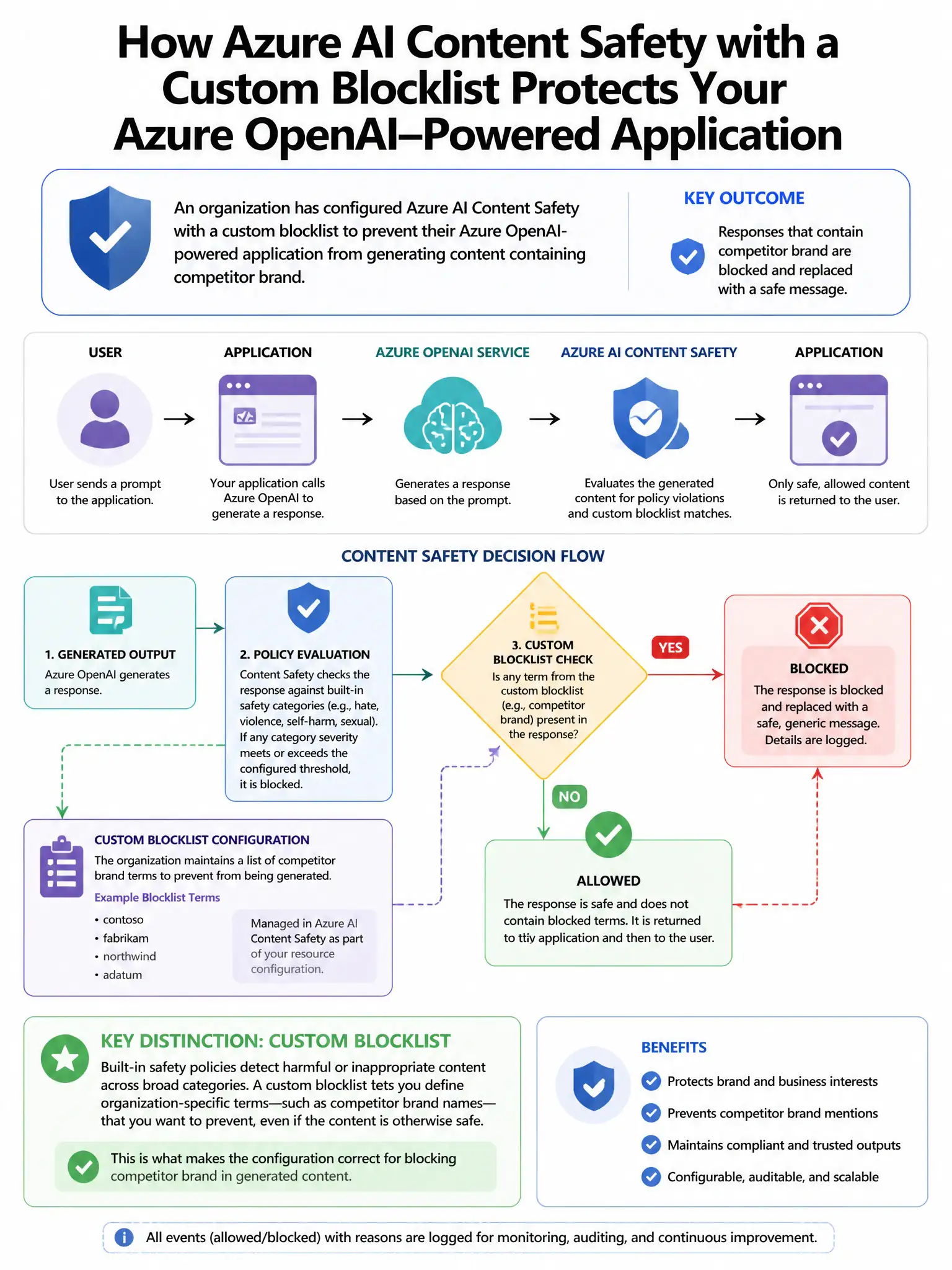
An organization has configured Azure AI Content Safety with a custom blocklist to prevent their Azure OpenAI-powered application from generating content containing competitor brand names. A user submits a prompt containing a competitor name. The content safety API should block the response before it reaches the user. Which Azure AI Content Safety configuration step creates this custom blocking behavior?
Select an answer to reveal the explanation.
Short Explanation
Here's the deal — you create a custom blocklist in Azure AI Content Safety, add the competitor brand names as blocklist items, and associate that blocklist with the content filter policy applied to your Azure OpenAI deployment. That makes the content safety API block prompts or completions containing those terms before the user sees them.
Full Explanation
The correct configuration is to create a custom blocklist in Azure AI Content Safety, add the competitor brand names as blocklist items, and associate the blocklist with the content filter policy applied to the Azure OpenAI deployment. Azure AI Content Safety supports custom blocklists, which are user-defined lists of terms or phrases that should be blocked. After creating the blocklist and adding the competitor brand names as items, you associate the blocklist with the content filter policy applied to your Azure OpenAI model deployment. When any blocklisted term appears in a prompt or completion, the content safety API returns a block action, preventing the response from reaching the user. Enabling the 'Hate' content category filter at severity level 2 is wrong because the 'Hate' category filter detects hate speech, not competitor brand names; it is a semantic harm category, not a keyword blocklist. Configuring a DLP policy in Microsoft Purview targeting Azure OpenAI outputs is wrong because Microsoft Purview DLP operates on classified content through Microsoft services and does not provide real-time blocking at the Azure AI Content Safety API level. Training a custom classifier using Azure Machine Learning and integrating it with Azure OpenAI is wrong because it requires significant ML expertise and infrastructure, while Azure AI Content Safety's blocklist feature directly addresses this text-matching use case without ML training.