
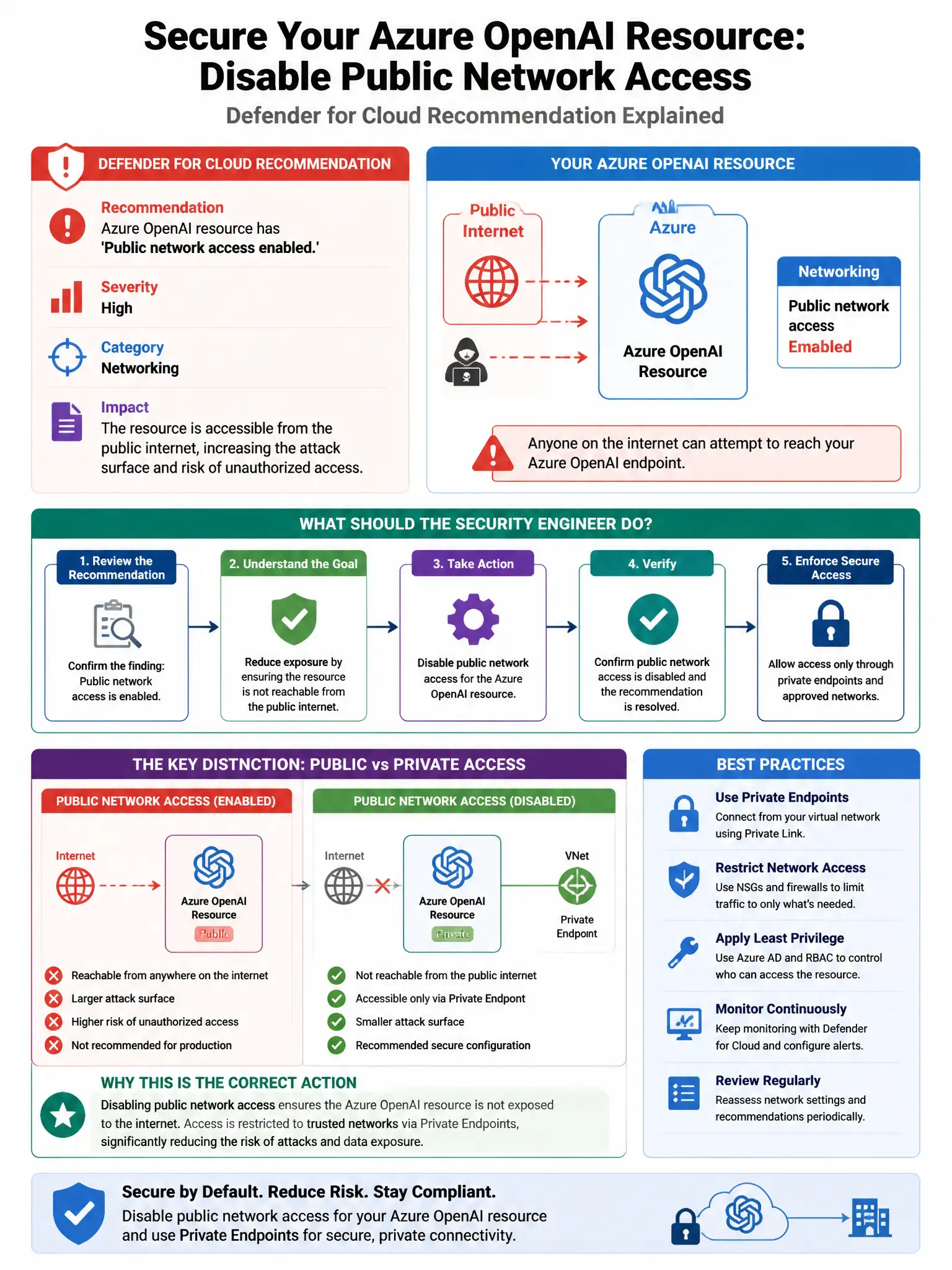
A Defender for Cloud recommendation states that an Azure OpenAI resource has 'Public network access enabled.' The recommendation severity is 'High.' The security engineer wants to understand what specific risk this creates before remediating. Which Defender for Cloud feature provides the contextual risk reasoning for this recommendation?
Select an answer to reveal the explanation.
Short Explanation
Here's the deal — the 'Risk factors' and 'Attack paths' section in the recommendation detail pane gives you the contextual reasoning. It shows exposure to the internet, sensitive data access, and how an attacker could exploit public network access to the Azure OpenAI resource.
Full Explanation
The 'Risk factors' and 'Attack paths' section in the recommendation detail pane is correct because Defender for Cloud's contextual security posture management enriches recommendations with risk factors—such as exposure to the internet, sensitive data access, and lateral movement potential—and shows associated attack paths that explain how the misconfiguration could be exploited. The 'Attack paths' section visually illustrates how an attacker could leverage public internet exposure to the Azure OpenAI resource to exfiltrate data or abuse AI capabilities. The Quick Fix button in the recommendation detail is wrong because it provides automated remediation, not risk reasoning or context. The Regulatory Compliance dashboard mapped to NIST controls is wrong because it maps controls to standards, but it does not provide contextual risk reasoning for individual resource misconfigurations. The Microsoft Defender for AI Services alert list is wrong because it shows active threat detections, not the risk context for posture recommendations.