
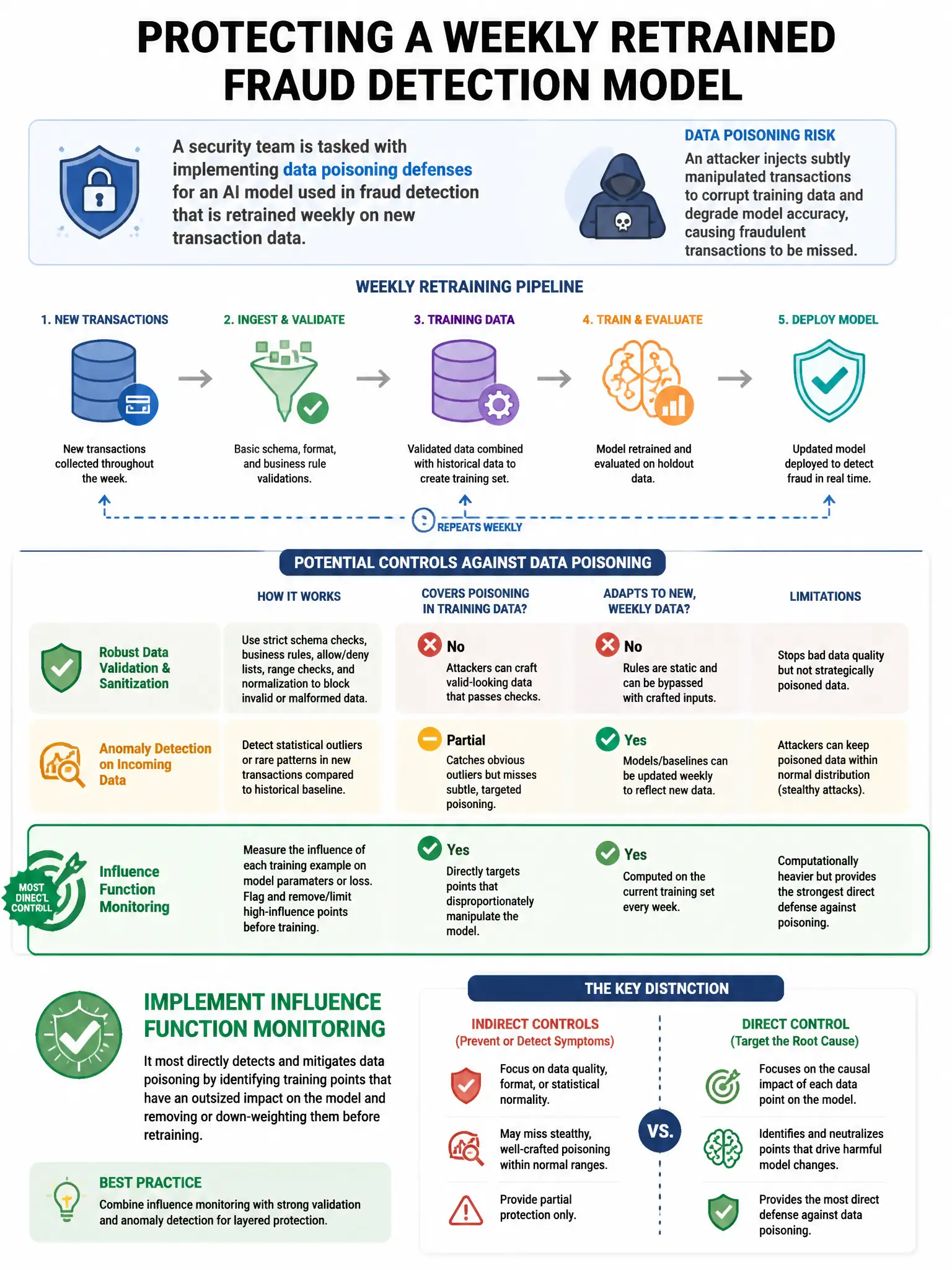
A security team is tasked with implementing data poisoning defenses for an AI model used in fraud detection that is retrained weekly on new transaction data. Which control most directly prevents poisoned data from corrupting the model during retraining?
Select an answer to reveal the explanation.
Short Explanation
Data poisoning attacks slip bad samples into retraining data, so you need to inspect and validate new transaction records before they enter the pipeline. Statistical anomaly detection plus human review of flagged samples catches poisoned records before the model learns from them.
Full Explanation
Implementing statistical anomaly detection on new training data and conducting human review of flagged samples before including them in training datasets is correct because data poisoning attacks work by injecting malicious samples into training data that cause the model to learn incorrect behaviors, such as approving fraudulent transactions. The most direct defense is to inspect and validate new training data before it enters the retraining pipeline. Statistical anomaly detection can flag unusual data distribution shifts, such as a sudden spike in a particular transaction pattern, and human review of flagged samples catches adversarially crafted records before they corrupt the model. Enabling Azure DDoS Protection on the retraining pipeline is wrong because DDoS protection defends against network-layer volumetric attacks; it does not prevent semantic data poisoning through legitimate-looking data samples. Encrypting training data at rest using customer-managed keys is wrong because encryption protects the confidentiality of training data at rest but does not prevent a legitimate data source from being compromised and serving poisoned records. Applying differential privacy to the model output is wrong because differential privacy adds noise to model outputs to protect training data privacy; it does not prevent data poisoning attacks on the training inputs.