
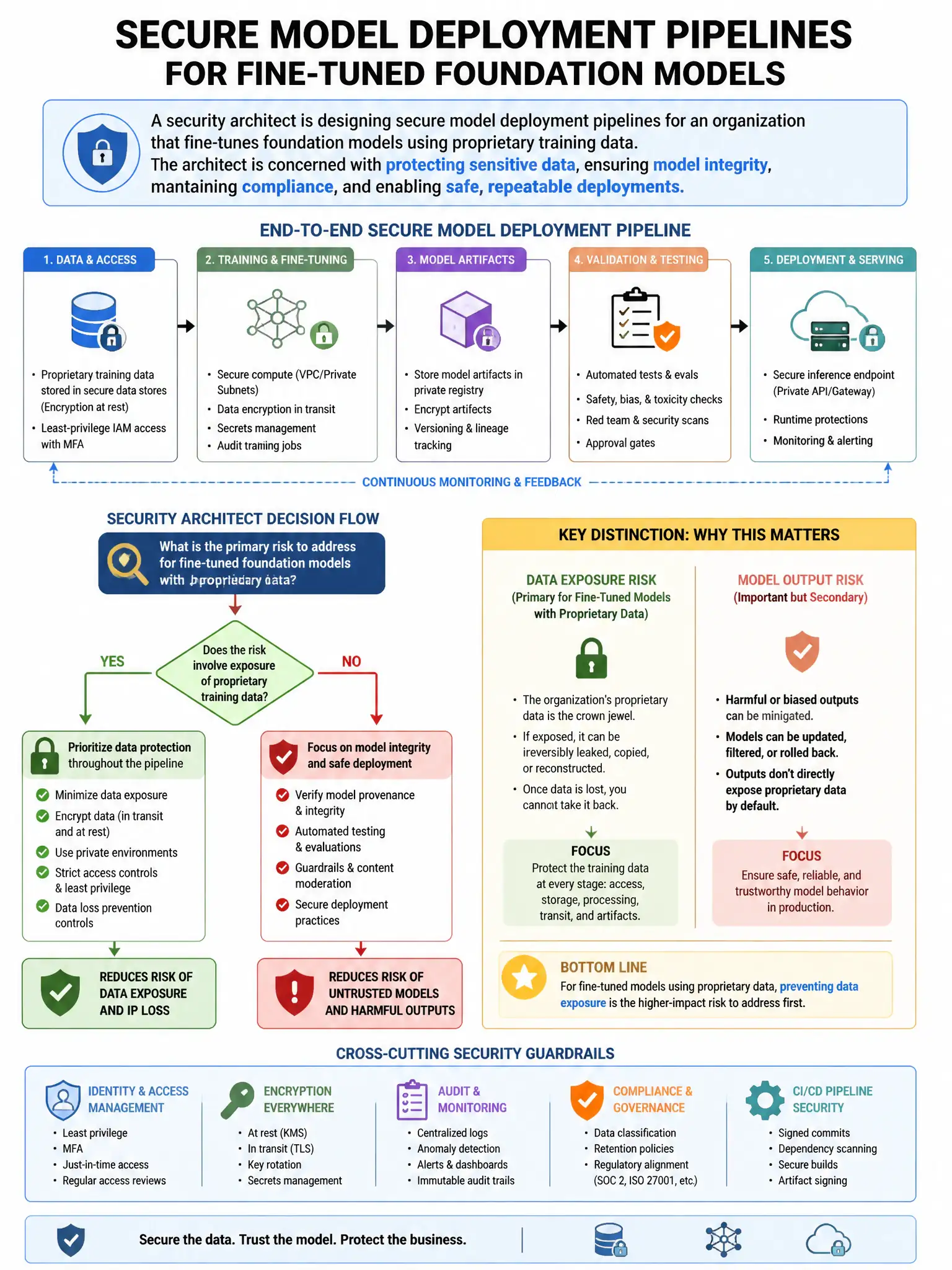
A security architect is designing secure model deployment pipelines for an organization that fine-tunes foundation models using proprietary training data. The architect is concerned about supply chain attacks where a malicious actor injects backdoors into pre-trained model weights downloaded from public repositories. Which control mitigates this risk?
Select an answer to reveal the explanation.
Short Explanation
Here's the deal — verify cryptographic hashes of model weight files against publisher-provided checksums before loading them into training pipelines. That tells you the weights haven't been tampered with or swapped for malicious versions, which is what stops backdoor injection in the supply chain.
Full Explanation
Verifying cryptographic hashes of model weight files against publisher-provided checksums before loading them into training pipelines is correct because it ensures the model files have not been tampered with in transit or replaced with malicious versions. This is analogous to software supply chain integrity verification and directly mitigates backdoor injection through tampered model files. Enabling HTTPS for all model downloads is wrong because HTTPS protects data in transit from eavesdropping and tampering, but it does not verify that the model weights served by the source are themselves clean—a compromised model repository can serve backdoored models over HTTPS. Storing all downloaded models in Azure Blob Storage with private access is wrong because private Blob Storage prevents unauthorized access to stored models, but it does not verify the integrity of models before they are stored. Scanning model weight files with Microsoft Defender Antivirus is wrong because traditional antivirus tools detect known malware signatures in executable files; they cannot detect semantic backdoors embedded in neural network weight tensors.