
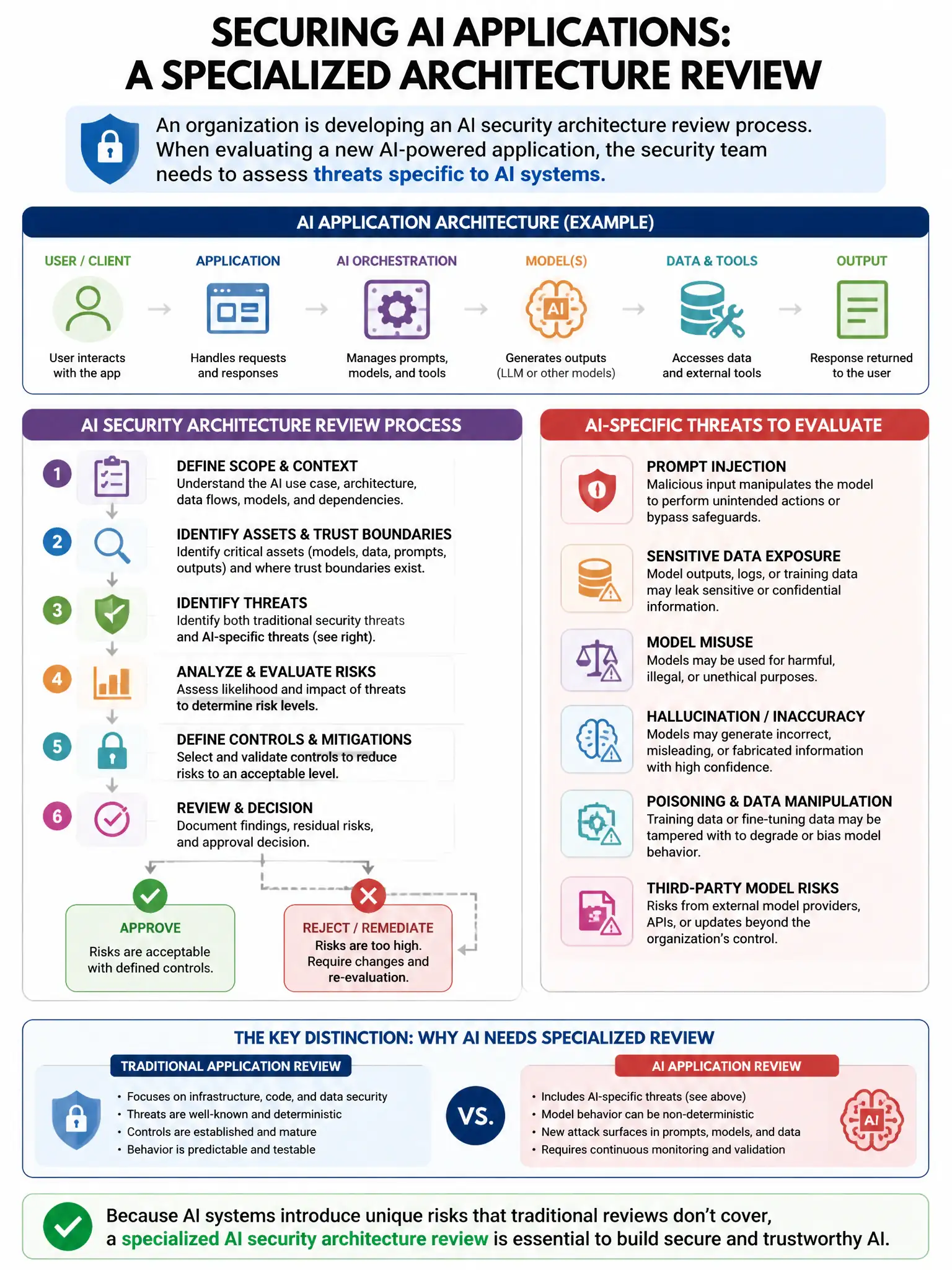
An organization is developing an AI security architecture review process. When evaluating a new AI-powered application, the security team needs to assess threats specific to AI systems, such as data poisoning, model inversion, and adversarial examples. Which threat modeling methodology is most applicable to AI systems?
Select an answer to reveal the explanation.
Short Explanation
Here's the deal — MITRE ATLAS is the right choice because it's built for AI/ML security threats. It catalogs real-world attacks like data poisoning, model inversion, membership inference, and evasion, mapped to adversary tactics and techniques. Think of it as MITRE ATT&CK for AI systems.
Full Explanation
MITRE ATLAS (Adversarial Threat Landscape for Artificial-Intelligence Systems) is correct because it is a knowledge base specifically designed for AI/ML security threats. It catalogs real-world adversarial techniques used against AI systems—including data poisoning, model inversion, membership inference, and evasion attacks—mapped to adversary tactics and techniques, analogous to MITRE ATT&CK but AI-specific. The STRIDE threat modeling applied to AI components option is wrong because STRIDE (Spoofing, Tampering, Repudiation, Information disclosure, Denial of service, Elevation of privilege) is a general software threat model; it can be adapted for AI but lacks the specificity of AI attack techniques. The PASTA option is wrong because PASTA is a risk-centric threat modeling process (not specific to AI) focused on business risk and attack simulations. The DREAD risk assessment model option is wrong because DREAD is a risk rating model (Damage, Reproducibility, Exploitability, Affected users, Discoverability) for scoring vulnerabilities, not a threat taxonomy for AI systems.