
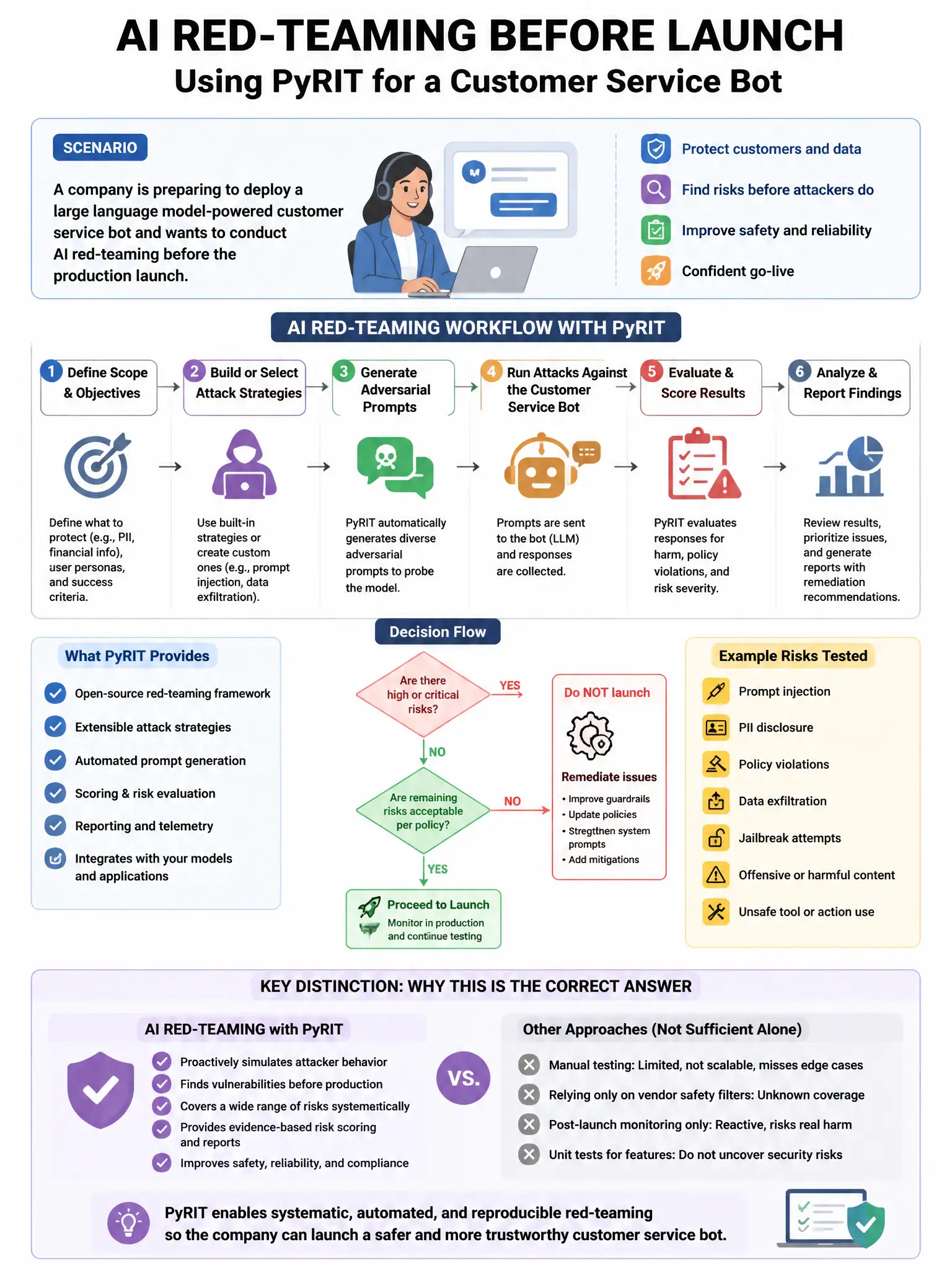
A company is preparing to deploy a large language model-powered customer service bot and wants to conduct AI red-teaming before production launch. The security team is using PyRIT (Python Risk Identification Toolkit for generative AI) developed by Microsoft. What is the primary purpose of using PyRIT in this context?
Select an answer to reveal the explanation.
Short Explanation
Here's the deal — the Python Risk Identification Toolkit for generative AI is built for AI red-teaming, so you use it to automate adversarial probing of the bot for safety and security failures. It helps you find jailbreaks, harmful content generation, and prompt injection before launch.
Full Explanation
The correct answer is the option describing automated adversarial probing of the AI system for safety and security failures such as jailbreaks, harmful content generation, and prompt injection. The Python Risk Identification Toolkit for generative AI is Microsoft's open-source framework specifically designed for AI red-teaming. It automates the process of sending adversarial prompts to generative AI systems to identify safety and security failures, including jailbreaks, which bypass safety guardrails, harmful content generation, and prompt injection vulnerabilities. It helps security teams scale red-teaming efforts. The option focused on benchmarking response speed and throughput under load is wrong because the toolkit focuses on security and safety testing, not performance load testing; load testing would use tools like Azure Load Testing or JMeter. The option about classifying and labeling training data is wrong because data labeling is a machine learning data preparation task, not a security red-teaming activity. The option about monitoring production traffic for anomalies is wrong because production monitoring uses tools like Azure Monitor, Application Insights, or Sentinel; the toolkit is a pre-deployment security testing tool.