
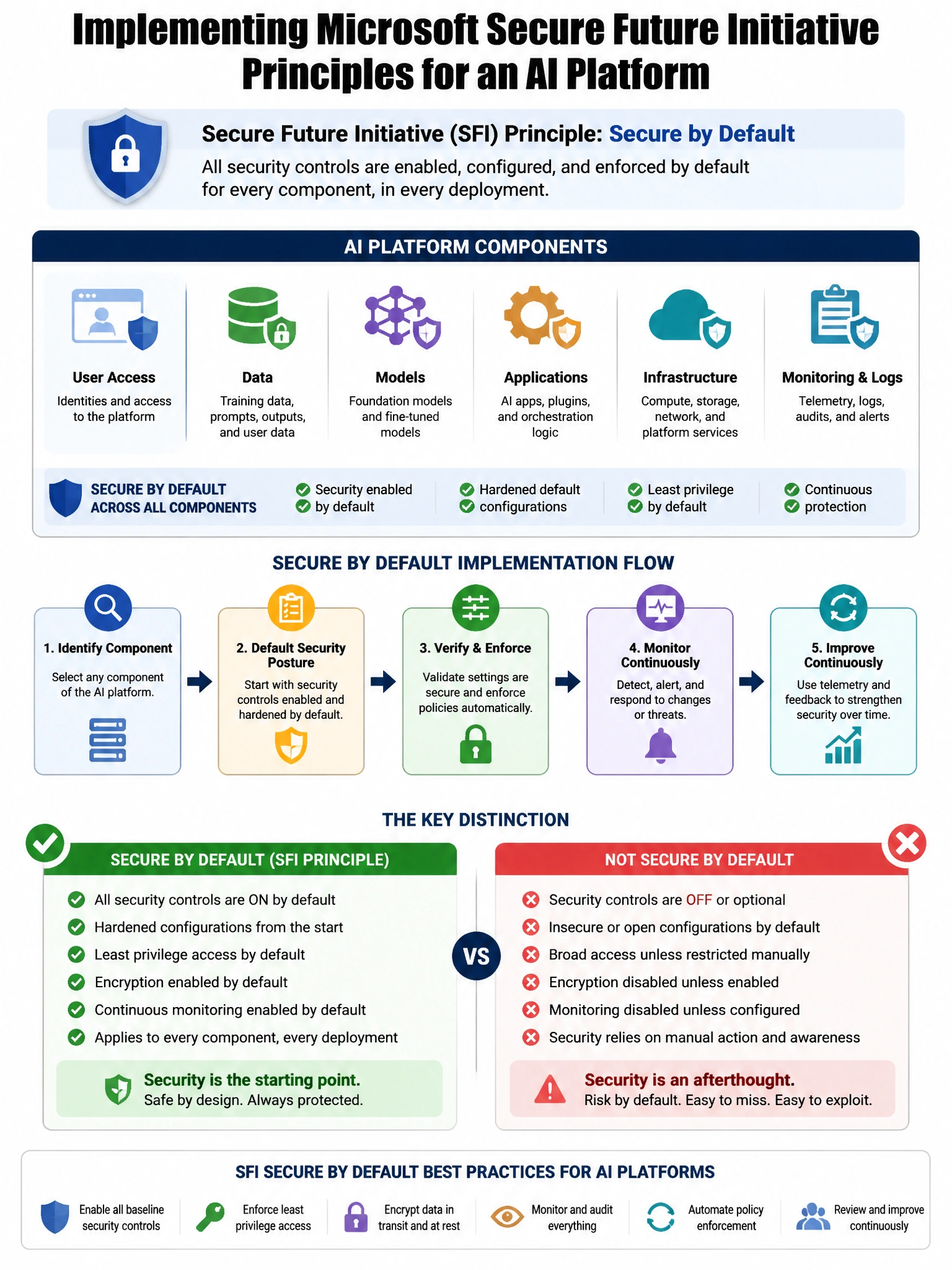
A security engineer is implementing Microsoft's Secure Future Initiative (SFI) principles for an AI platform. The SFI principle of 'Secure by Default' requires that all security controls are enabled automatically without customer action. For Azure OpenAI, which control is an example of a 'Secure by Default' implementation?
Select an answer to reveal the explanation.
Short Explanation and Infographic
Here's the deal — b is correct because Azure OpenAI content filtering is enabled by default on all model deployments with baseline severity filters for harm categories (violence, hate speech, sexual content, self-harm) active. Customers do not need to take any action to enable this protection; it is the default state.
Full explanation below image
Full Explanation
B is correct because Azure OpenAI content filtering is enabled by default on all model deployments with baseline severity filters for harm categories (violence, hate speech, sexual content, self-harm) active. Customers do not need to take any action to enable this protection; it is the default state. A is incorrect because private endpoints for Azure OpenAI are not enabled by default; customers must manually configure them and disable public network access. C is incorrect because customer-managed key encryption is an optional configuration that customers must explicitly set up; Microsoft-managed keys are the default. D is incorrect because Microsoft Defender for AI requires customers to explicitly enable the plan in Defender for Cloud; it is not automatically enabled or free by default.