
An organization wants to implement a centralized AI API Gateway pattern to govern all AI API traffic flowing from applications to Azure OpenAI Service. The gateway must enforce rate limiting per application, centralize logging of all AI interactions, and apply content safety screening before requests reach the model. Which Azure service is best suited to implement this AI API Gateway?
Select an answer to reveal the explanation.
Short Explanation and Infographic
Here's the deal — b is correct because Azure API Management (APIM) is a full-featured API gateway that supports: (1) Rate limiting using quota and throttling policies per API consumer/application, (2) Centralized logging of all API requests and responses to Azure Monitor and Event Hub for downstream SIEM ingestion, and (3) Custom inbound policies that call Azure AI Content Safety before forwarding requests to Azure OpenAI, returning a rejection if content safety issues are detected. APIM is the architectural pattern recommended by Microsoft for building an AI API gateway.
Full explanation below image
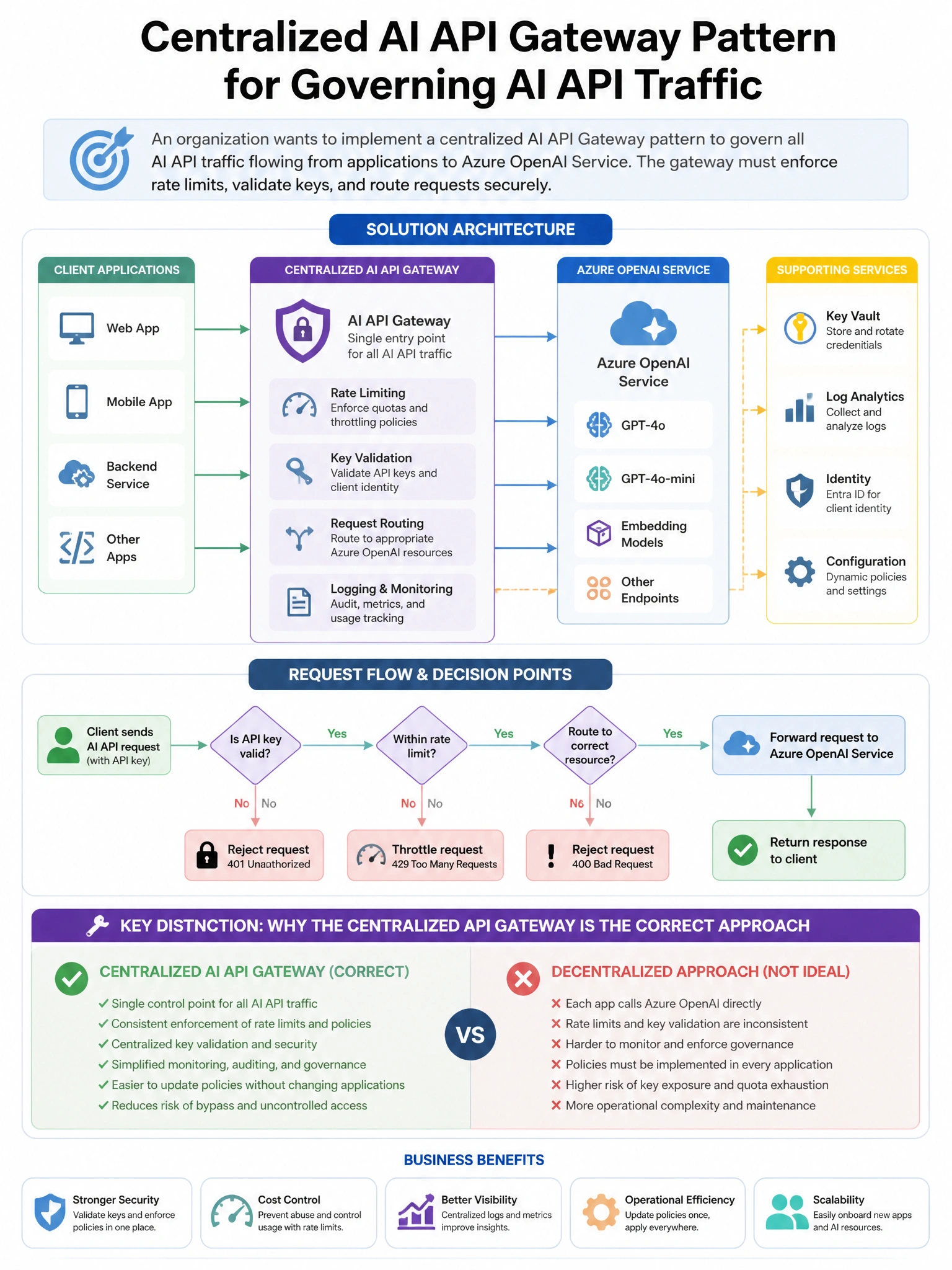
Full Explanation
B is correct because Azure API Management (APIM) is a full-featured API gateway that supports: (1) Rate limiting using quota and throttling policies per API consumer/application, (2) Centralized logging of all API requests and responses to Azure Monitor and Event Hub for downstream SIEM ingestion, and (3) Custom inbound policies that call Azure AI Content Safety before forwarding requests to Azure OpenAI, returning a rejection if content safety issues are detected. APIM is the architectural pattern recommended by Microsoft for building an AI API gateway. A is wrong because Application Gateway with WAF is a Layer 7 load balancer with web application firewall capabilities; it can route traffic and protect against web attacks, but it lacks the policy engine for rate limiting per consumer, AI content safety integration, and detailed request/response logging at the payload level. C is wrong because Azure Front Door provides CDN, global load balancing, and WAF; it is optimized for web application delivery, not for AI API governance with per-application rate limiting and content screening. D is wrong because Azure Service Bus is a message broker for reliable asynchronous communication; it introduces asynchronous processing patterns, not the synchronous request inspection and enforcement needed for an AI API gateway.