
An organization wants to use Microsoft Purview Exact Data Match (EDM) to prevent Azure OpenAI from generating responses that contain specific patient identifiers from their patient database (patient IDs, SSNs, and date-of-birth combinations). How does EDM differ from a standard sensitive information type for this use case?
Select an answer to reveal the explanation.
Short Explanation and Infographic
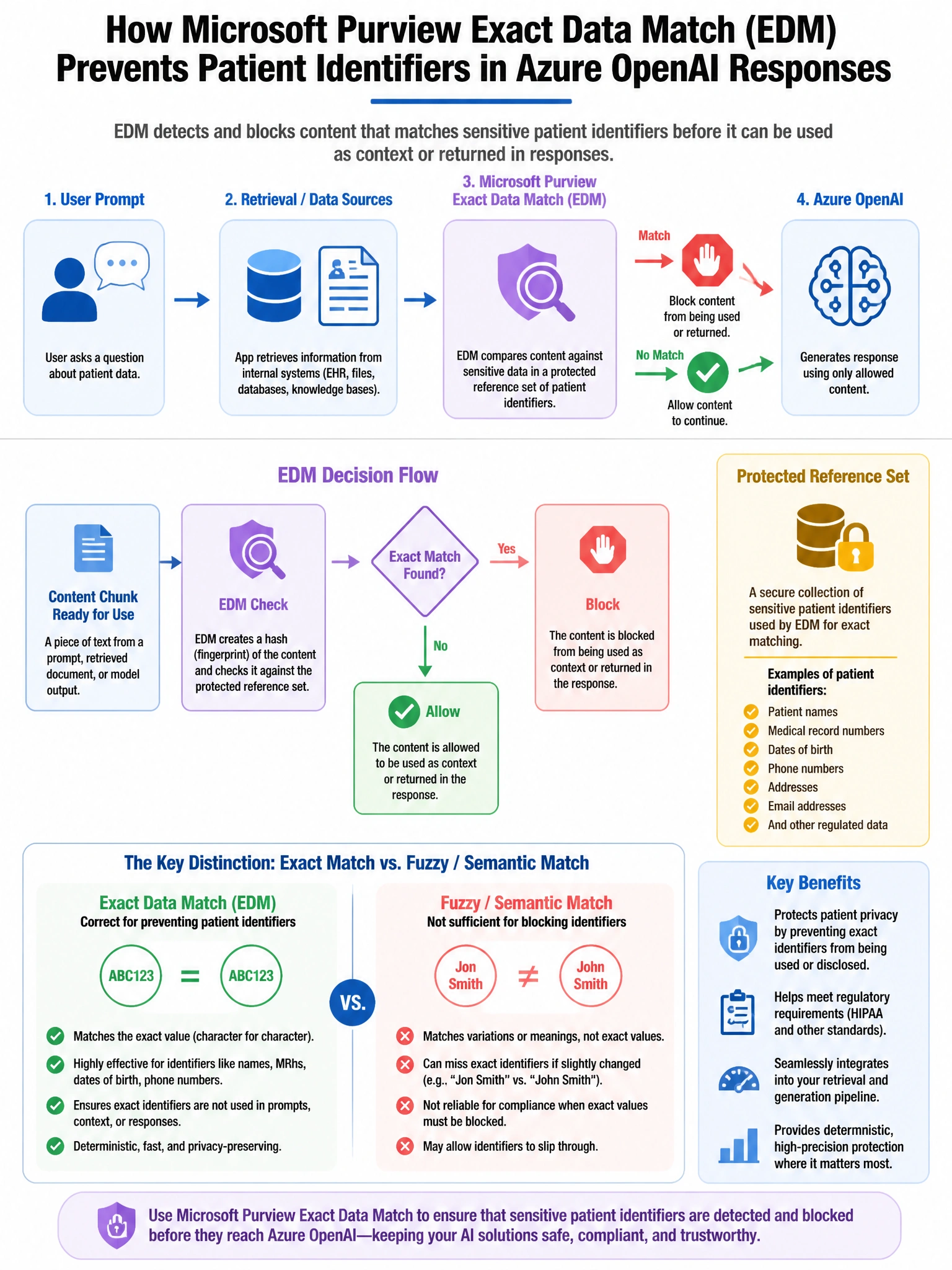
Here's the deal — b is correct because Exact Data Match (EDM) is a Purview feature that enables fingerprinting and detection of exact records from a specific dataset (such as a patient database). The patient records are hashed and uploaded to Purview; when content inspection finds a combination of values that matches an exact record from the database (e.g., a specific patient's ID + SSN + DOB), it triggers a match.
Full explanation below image
Full Explanation
B is correct because Exact Data Match (EDM) is a Purview feature that enables fingerprinting and detection of exact records from a specific dataset (such as a patient database). The patient records are hashed and uploaded to Purview; when content inspection finds a combination of values that matches an exact record from the database (e.g., a specific patient's ID + SSN + DOB), it triggers a match. Standard sensitive information types use regex patterns to detect any value matching a structural format (e.g., any 9-digit SSN-formatted number), regardless of whether it belongs to your actual patients. EDM dramatically reduces false positives for data specific to your organization. A is wrong because this reverses the descriptions—EDM uses database fingerprinting, not regex; standard SITs use patterns including regex. C is wrong because EDM involves additional processing against hashed records and may be computationally more complex than simple pattern matching. D is wrong because EDM can be applied to cloud services including M365 workloads and via DLP policies on cloud AI services.