
A security team needs to implement network segmentation for Azure AI services to ensure that Azure AI Search, Azure OpenAI, and Azure Machine Learning can communicate with each other privately, while remaining isolated from the internet. Which combination of controls achieves this?
Select an answer to reveal the explanation.
Short Explanation and Infographic
Here's the deal — a is correct because deploying private endpoints for each AI service (Azure AI Search, Azure OpenAI, Azure Machine Learning) within the same VNet ensures all inter-service traffic uses private IP addresses over the Microsoft backbone. Private DNS Zones ensure that each service's FQDN resolves to the private IP address rather than the public IP.
Full explanation below image
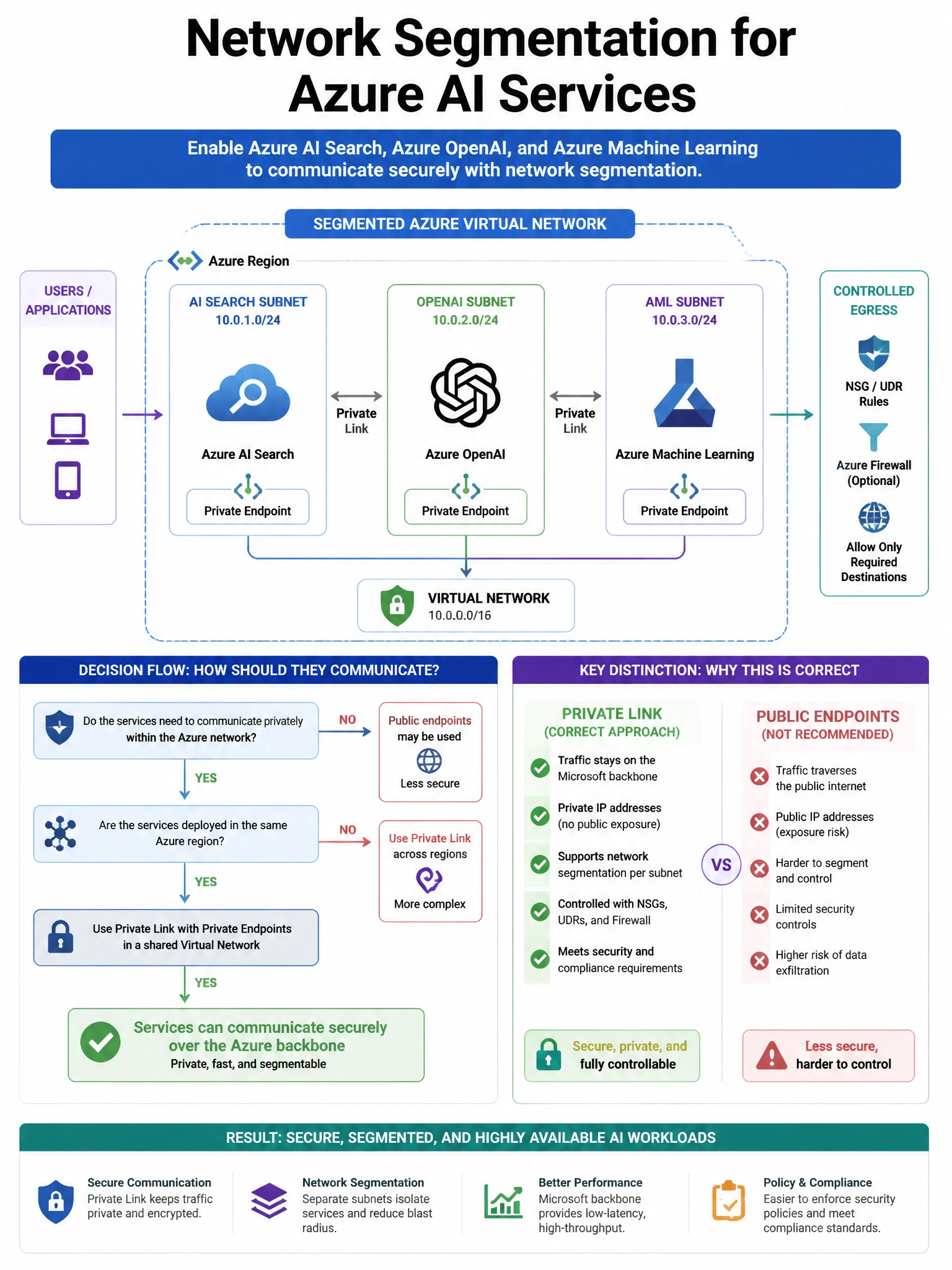
Full Explanation
A is correct because deploying private endpoints for each AI service (Azure AI Search, Azure OpenAI, Azure Machine Learning) within the same VNet ensures all inter-service traffic uses private IP addresses over the Microsoft backbone. Private DNS Zones ensure that each service's FQDN resolves to the private IP address rather than the public IP. Disabling public network access removes the public endpoint, ensuring no internet exposure. B is wrong because VNet service endpoints restrict traffic to the service over the Microsoft backbone from the VNet but do not create private IP mappings, and the services may still accept public traffic. C is wrong because Application Gateway with WAF is a reverse proxy for inbound internet traffic, not a mechanism for private inter-service communication. D is wrong because Private Link Service is for exposing your own services to other VNets (provider side), not for consuming Azure PaaS services privately.