
A company needs to configure Microsoft Purview Information Barriers to prevent Microsoft 365 Copilot from surfacing information between two business units that must remain informationally separated due to regulatory requirements. Which Purview feature implements this separation for Copilot?
Select an answer to reveal the explanation.
Short Explanation and Infographic
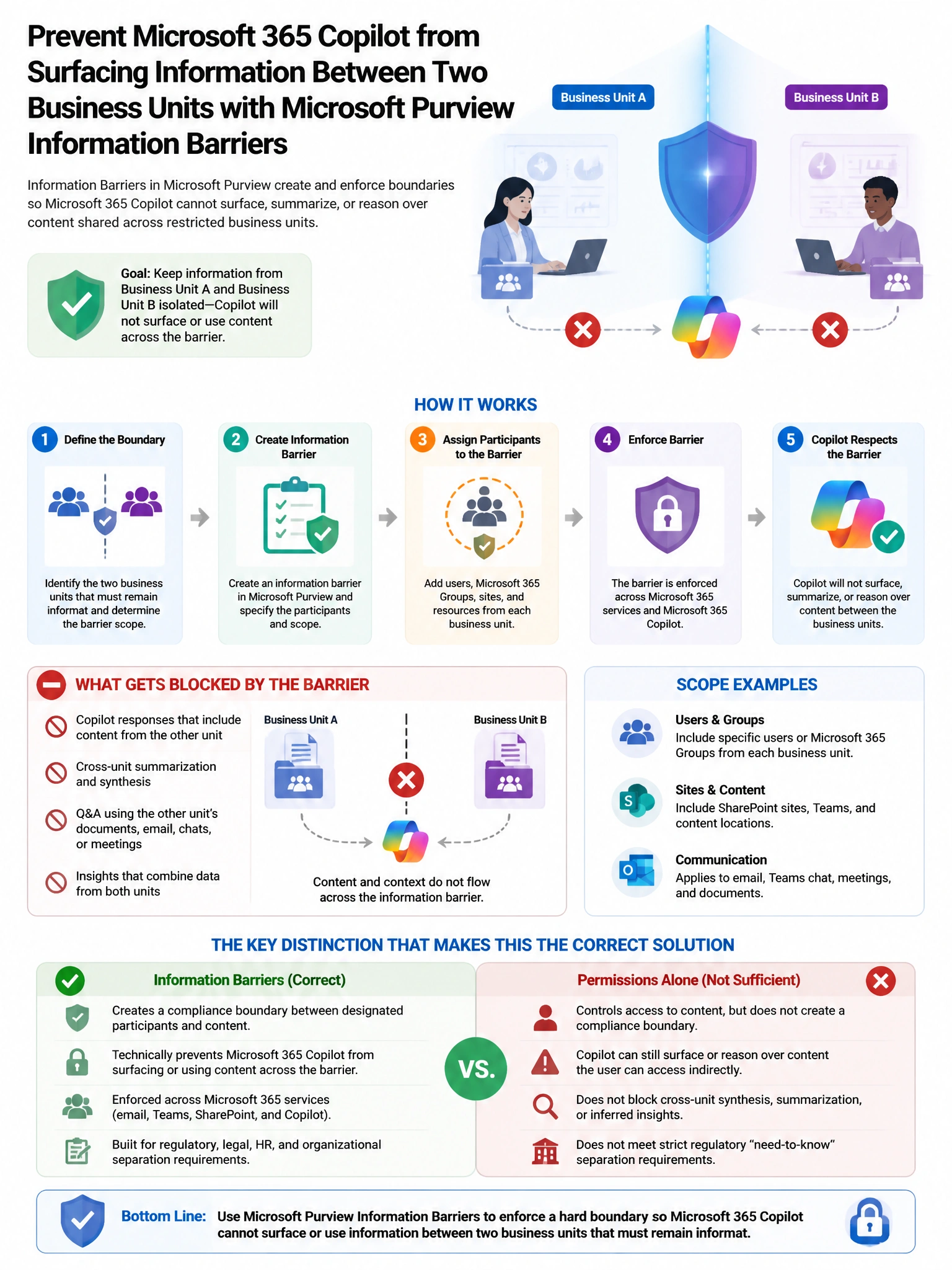
Here's the deal — b is correct because Microsoft Purview Information Barriers (IB) policies define which groups of users can communicate with or discover content from other groups. Information Barriers now extend to Microsoft 365 Copilot—when IB is enforced, Copilot respects the barriers and does not surface content from informationally separated segments to users in restricted segments.
Full explanation below image
Full Explanation
B is correct because Microsoft Purview Information Barriers (IB) policies define which groups of users can communicate with or discover content from other groups. Information Barriers now extend to Microsoft 365 Copilot—when IB is enforced, Copilot respects the barriers and does not surface content from informationally separated segments to users in restricted segments. A is wrong because Communication Compliance with adaptive scopes detects policy violations in communications, it does not block content discovery in Copilot. C is wrong because DLP policies protect against data leakage based on content classification, not organizational segment separation. D is wrong because Insider Risk Management focuses on detecting risky behaviors, not enforcing information separation barriers.