
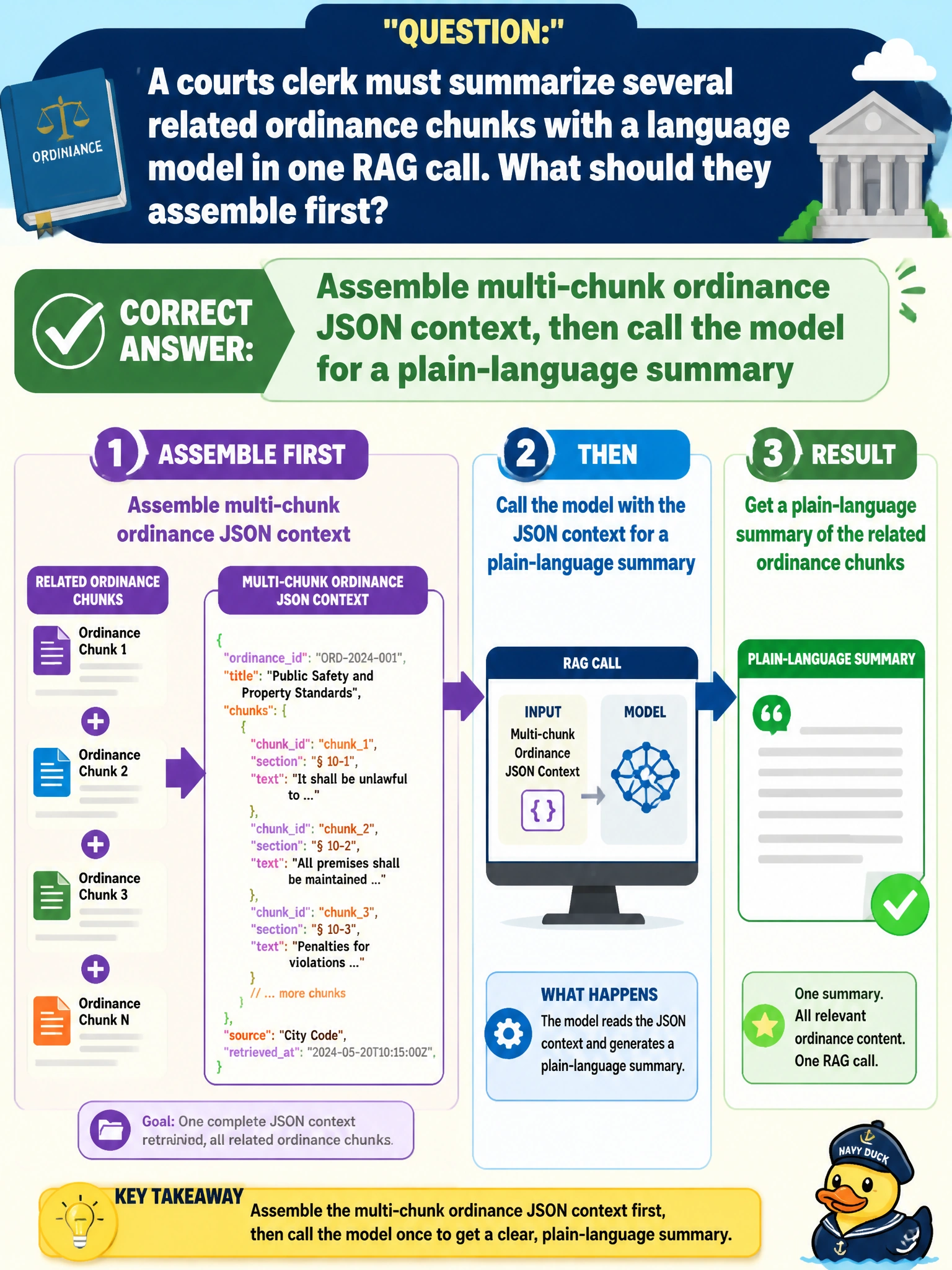
A courts clerk must summarize several related ordinance chunks with a language model in one RAG call. What should they assemble first?
Select an answer to reveal the explanation.
Short Explanation
You’ll want to gather the related ordinance chunks into one JSON context before asking the model for a plain-language summary. That gives the model a grounded briefing binder to work from in a single RAG call.
Full Explanation
A courts clerk should assemble the related ordinance chunks as JSON context first, then call the language model once for a plain-language summary. Providing the related ordinance set gives the model material for a coherent summary, rather than leaving it with an isolated fragment or no source text. Asking the model to rely on general legal knowledge alone fails because it produces an ungrounded response, not a RAG summary of the municipal law text. Sending an empty JSON object while omitting the ordinance chunks supplies structure without substance, leaving nothing authoritative to summarize. Deleting the ordinance table before any model call destroys the source corpus needed for grounded retrieval and for auditing what was summarized. Exam caveat: keep the assembled context within the model’s limits and preserve chunk IDs for citations; an oversized context can truncate critical sections. As a practical check, retrieve the related chunks, package them as JSON with stable IDs, make one model call, verify that citations map back to those chunks, and rerun the summary if any constituent ordinance has been amended.