
Housing merges keyword and vector ranked lists for lease-policy assistants. Which fusion technique should they apply?
Select an answer to reveal the explanation.
Short Explanation
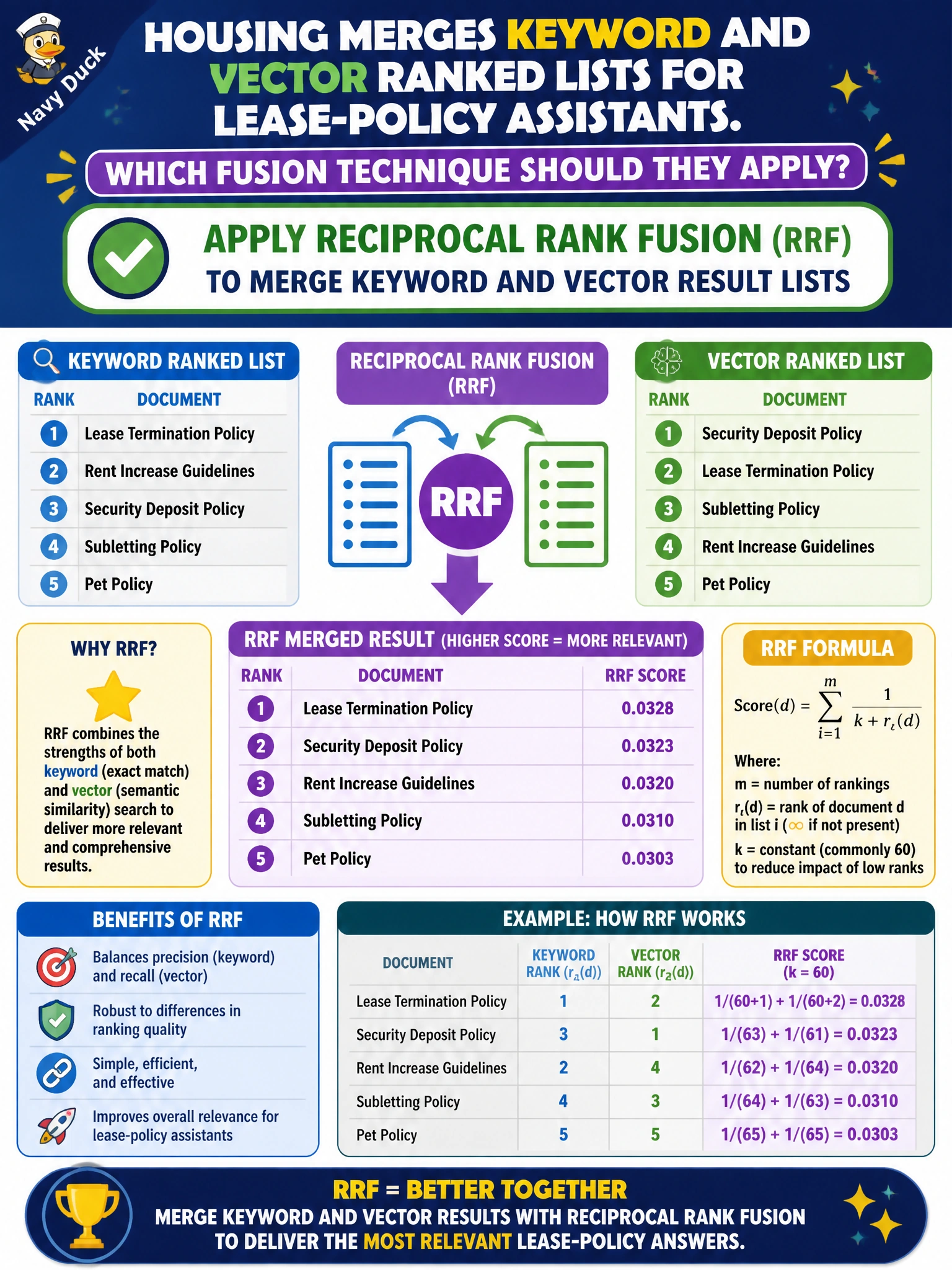
You can bring keyword and vector evidence together with reciprocal rank fusion (RRF), which combines their ranked lists into one ordering. That gives your lease-policy assistant a fairer set of top results than relying on just one ranking.
Full Explanation
Reciprocal rank fusion (RRF) merges keyword and vector ranked lists by combining reciprocal ranks rather than requiring calibrated raw scores. This makes it practical for hybrid search in housing lease-policy assistants: it blends lexical and semantic evidence into one stable top-k without forcing the two scorers onto a shared numeric scale. Selecting keyword results whenever available and leaving out the vector ranking fails because it discards semantic evidence and prevents the two rankings from contributing together. Averaging unrelated parcel acreage values fails because acreage is a property attribute, not a way to fuse search rankings, and cannot create a coherent ordering of lease clauses. Dropping both result lists and returning a random lease clause fails because chance replaces ranked retrieval and removes the basis for auditing why a policy snippet was shown. Exam caveat: RRF improves list fusion but does not replace good underlying full-text and vector indexes; poor candidate lists can still fuse into poor answers. Practical check: generate keyword and vector candidate lists for lease-policy queries, apply RRF with a documented k constant, compare the fused top-k against housing SME labels, and verify citation order remains stable across paraphrases of the same resident question.