
City 311 wants retrieval that combines keyword full-text hits with vector similarity over knowledge articles. What should they implement?
Select an answer to reveal the explanation.
Short Explanation
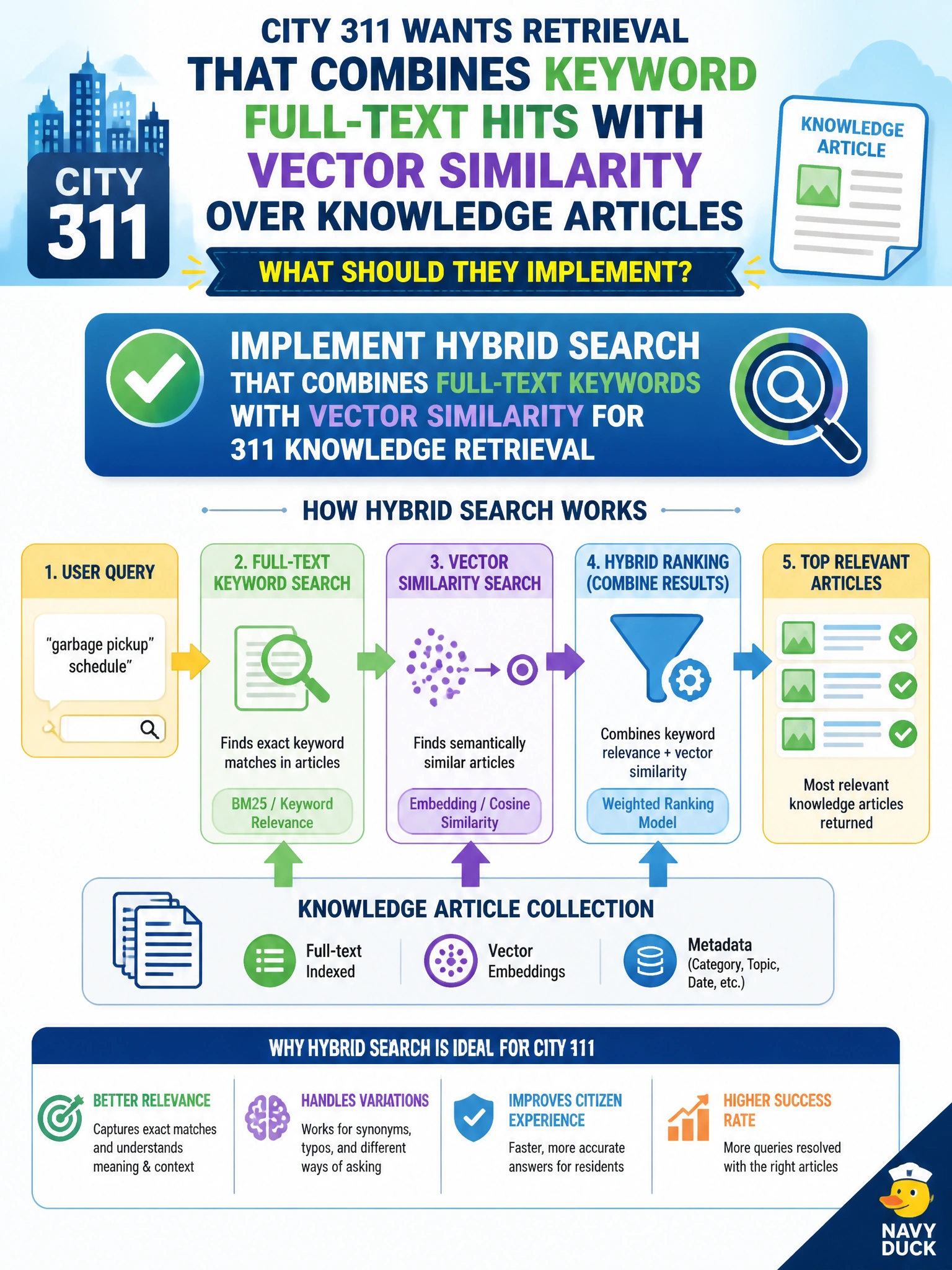
You get the best of both approaches with hybrid search: keywords catch exact phrases, while vectors find questions phrased differently. That helps 311 residents find useful knowledge articles whether they know the precise term or describe the issue in their own words.
Full Explanation
Hybrid search combines full-text keyword matching with vector similarity, allowing city 311 retrieval to honor exact terms residents type while also finding paraphrased or semantically related knowledge articles. This is useful when the same knowledge base must handle precise codes or program names and less exact wording. Vector-only retrieval relies on semantic similarity while ignoring residents’ exact keyword matches; it can undervalue ordinance numbers, form names, or service codes that should boost a relevant result. Full-text-only retrieval ignores semantic similarity, so a paraphrased question may not match the words in an article’s title or body. Turning search off and requiring residents to browse every article by hand abandons retrieval and creates an unusable self-service experience. Exam caveat: hybrid quality depends on how keyword and vector ranked lists are fused and weighted; simply running both without a fusion strategy can still produce unstable top results. As a practical check, implement hybrid retrieval over 311 knowledge articles, use reciprocal rank fusion or an equivalent merging method, measure exact-match and paraphrase cases separately, and tune boosts so regulated keywords surface when present.