
Courts expose infrequently changing statute lookup entities through Data API builder REST. How should they improve read performance for those lookups?
Select an answer to reveal the explanation.
Short Explanation
Statute codes barely move—cache those DAB lookups so every clerk app isn’t re-asking the database for the same chapter and verse.
Full Explanation
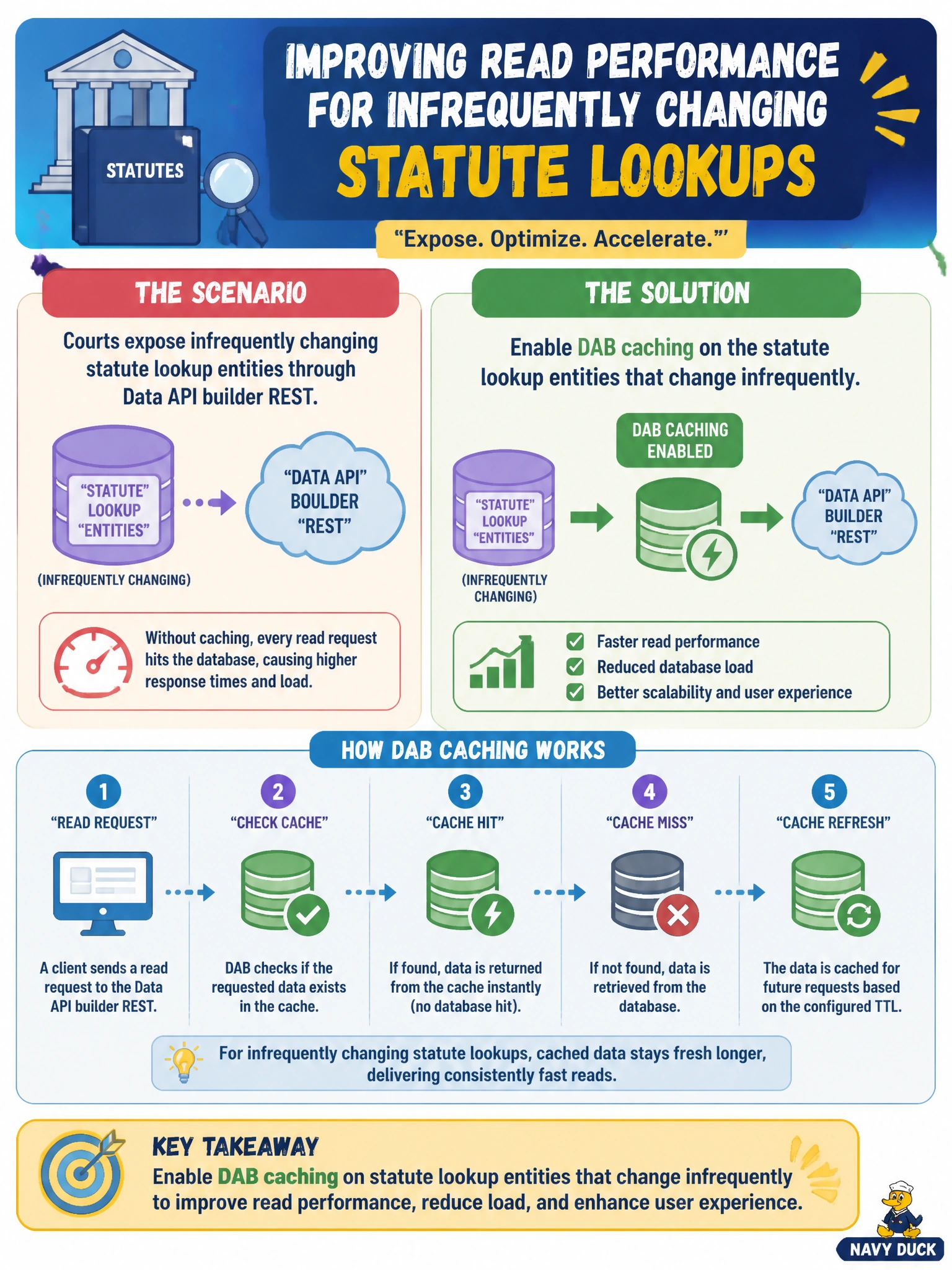
Courts expose infrequently changing statute lookup entities through Data API builder REST and need better read performance. They should enable DAB caching on those statute lookup entities that change infrequently, so repetitive clerk and application reads are served without hammering base tables for the same chapter-and-verse payloads. Caching is appropriate precisely because statute lookups are read-heavy and relatively static—matching the municipal use case in the stem.
Forcing every lookup request to scan base tables with caching disabled forever fails performance by design and ignores DAB’s cache capability for stable entities. Deleting lookup entities so clients hard-code statute text fails maintainability: statute updates would require application releases instead of data/API updates. Caching only write operations and never caching read lookups fails by applying cache to the wrong workload; lookups are reads.
Exam caveat: enable DAB entity caching when data is infrequently changing and read-mostly. Do not confuse this with caching writes or removing entities. If data were highly volatile, caching would need shorter TTLs or different patterns—but this stem specifies infrequent change.
Operational check: enable caching on the statute lookup entity, measure response times and SQL load for repeated identical REST reads, then update a statute row and confirm cache invalidation/TTL behavior matches courts freshness requirements before promoting the setting to production.