
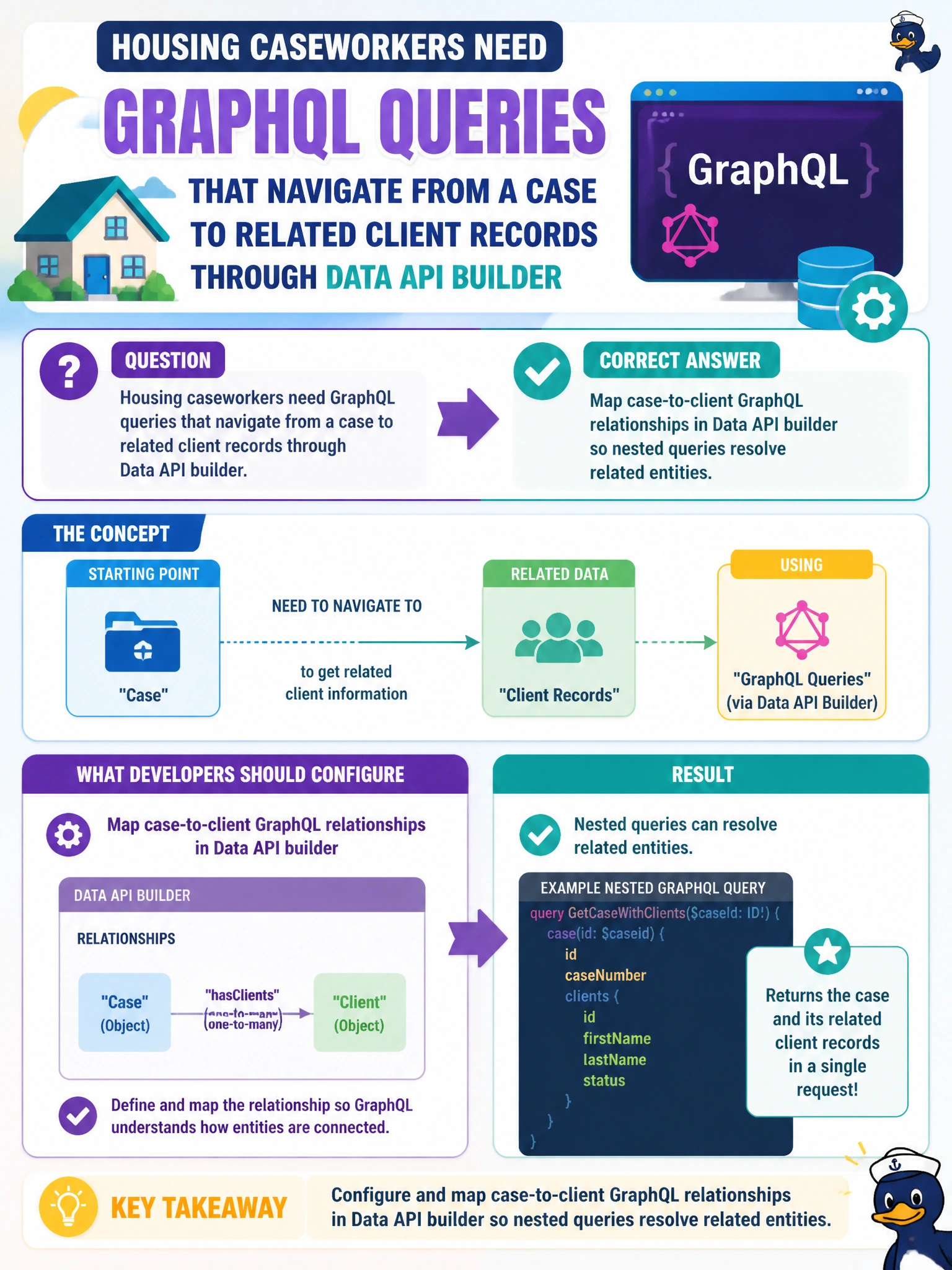
Housing caseworkers need GraphQL queries that navigate from a case to related client records through Data API builder. What should developers configure?
Select an answer to reveal the explanation.
Short Explanation
GraphQL relationships are the hallway doors between case and client rooms—configure them in DAB so housing apps can walk the graph without inventing joins.
Full Explanation
Housing caseworkers need GraphQL queries that navigate from a case to related client records through Data API builder. Developers should map case-to-client GraphQL relationships in DAB so nested queries resolve related entities in one structured request model. Relationship metadata is what turns disconnected tables into a navigable graph for municipal case management—caseworkers can retrieve a case and its clients without inventing join semantics in the app.
Exposing only disconnected tables with no relationship metadata fails the navigation requirement: clients cannot traverse case→client through GraphQL as designed. Requiring clients to join tables using ad-hoc SQL injected into GraphQL strings fails both security and API purity—SQL injection-style composition is not how DAB GraphQL relationships work. Hiding all entities from GraphQL and serving screenshots of case forms fails delivery of queryable data entirely.
Exam caveat: DAB GraphQL relationship mapping is the intended pattern for nested municipal entities. Distractors that push SQL into GraphQL strings or abandon the API for images are incorrect when the stem asks how to navigate related records.
Operational check: define the case–client relationship in the DAB configuration, run a nested GraphQL query from a case id to related clients, and assert the payload shape matches housing app expectations. Verify authorization still applies on related entities so caseworkers only see clients they are permitted to view.