
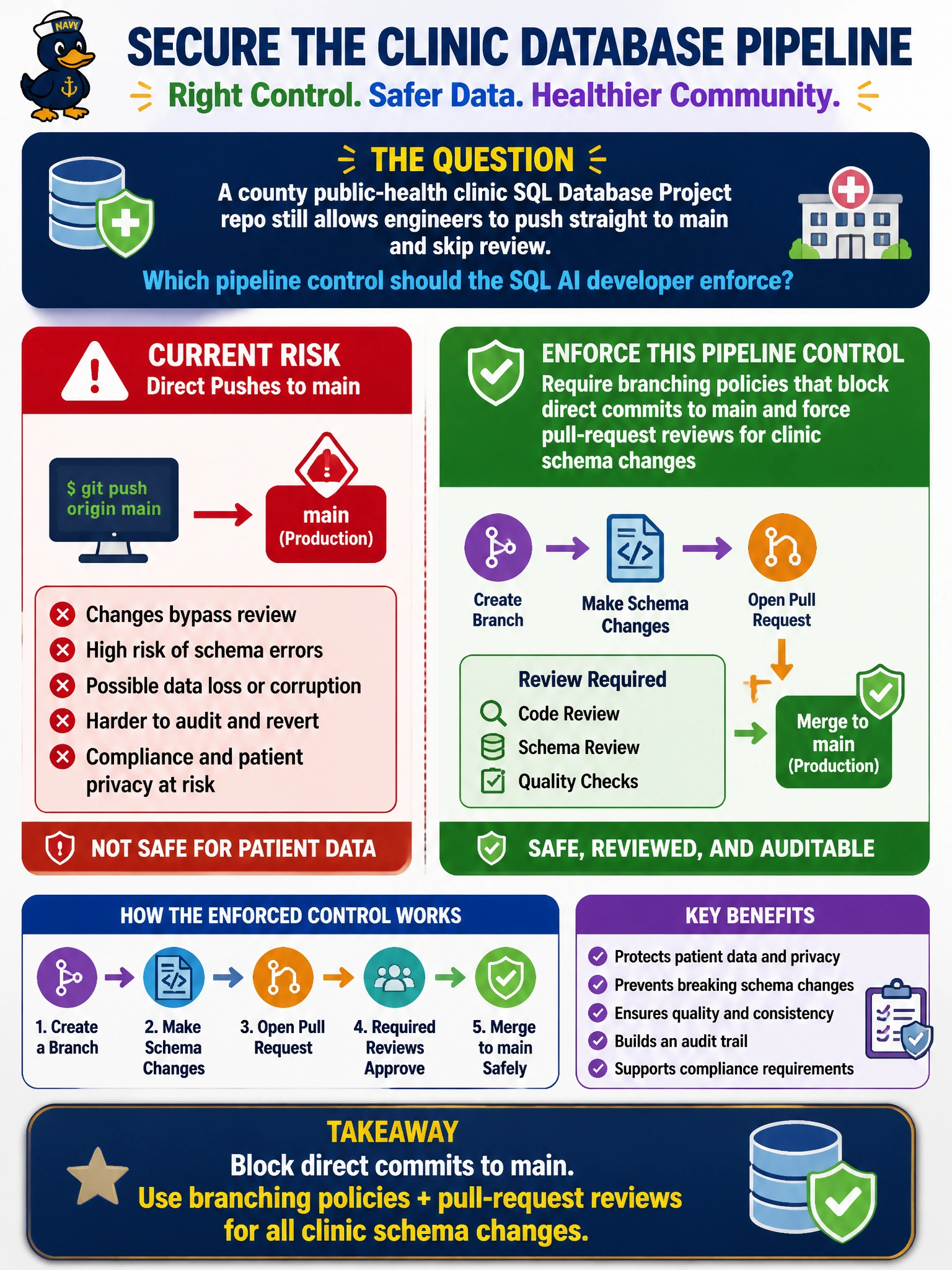
A county public-health clinic SQL Database Project repo still allows engineers to push straight to main and skip review. Which pipeline control should the SQL AI developer enforce?
Select an answer to reveal the explanation.
Short Explanation
Think of main like the clinic’s sterile supply closet—you don’t just walk in and rearrange shelves without a signed checklist. Branching policies force PRs so schema changes get eyes before they land.
Full Explanation
Branching policies on the county public-health clinic SQL Database Project repository are the pipeline control that stops engineers from pushing straight to main without review. When the policy requires pull requests and peer review before merges into protected branches, clinic schema changes—card tables, visit logging objects, or stored procedures that touch PHI-adjacent operational data—must pass through an auditable gate. That gate is what converts database-as-code from a convenience into a controlled municipal release practice aligned with least privilege and change management expectations for DP-800 secure-and-deploy scenarios.
Deleting the remote repository so schema changes never need review again fails by destroying the collaboration and history surface entirely; without a remote, there is no shared model, no PR trail, and no CI validation for clinic releases. Granting every clinic analyst force-push rights to main fails by concept because force-push and unprotected main invert branching policy: they maximize unreviewed overwrite risk rather than constrain it. Storing production connection strings in the main branch README fails as a secrets-hygiene defect—credentials in tracked docs become durable exposure unrelated to review control and create a separate compromise path.
Exam caveat: DP-800 items about SQL Database Projects and CI/CD emphasize protected branches, pull-request validation, and review—not removing repositories or widening write rights to speed delivery. Convenience options that skip review or embed secrets are distractors even when the stem mentions clinic urgency.
Operational check: after enabling branch policies on main, attempt a direct push from a non-exempt identity and confirm rejection; open a PR that changes clinic schema DDL, verify required reviewers and any build validation must succeed before merge, and confirm the merge commit—not an unreviewed push—is what advances the project model used by subsequent dacpac deploys.